The Complete Guide to AI-Powered Mobile App Development in 2026

TL;DR
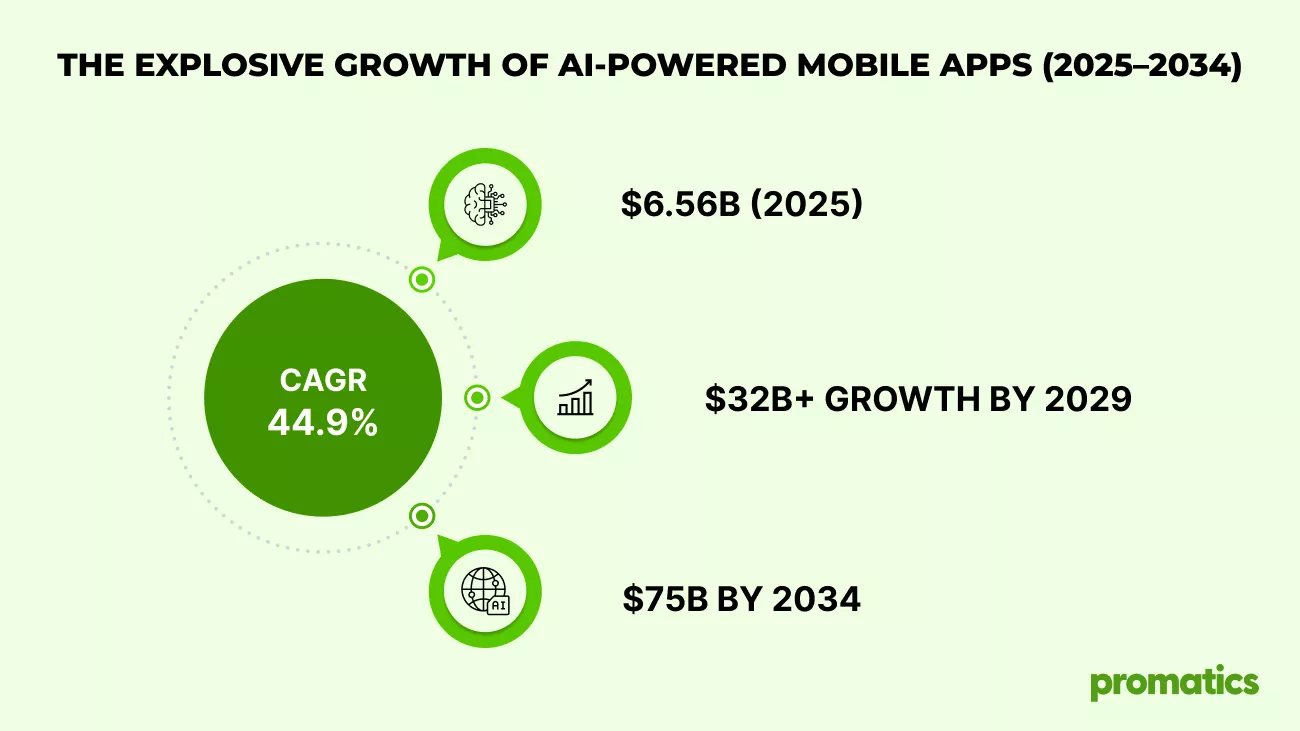
- The global AI app market reached $6.56 billion in 2025 and is projected to reach $75 billion by
- 2. AI-first mobile apps are improving personalization, automation, and user engagement.
- AI-powered features like chatbots, recommendations, and voice assistants are becoming standard.
- Developers are using AI to accelerate coding, testing, and deployment workflows.
- Businesses still face challenges around AI reliability, security, scalability, and performance.
The most successful mobile apps in 2026 will not just serve users. They will understand them. Artificial intelligence is transforming mobile apps from simple digital products into intelligent experiences capable of predicting user behavior, personalizing interactions, automating workflows, and delivering real-time assistance. From AI chatbots and voice assistants to predictive recommendations, intelligent search, and generative AI features, businesses are rapidly adopting AI-powered mobile applications to create smarter and more engaging customer experiences.
And the momentum is growing fast.
According to Technavio, the global AI app market is expected to grow by more than $32 billion between 2025 and 2029 at a CAGR of 44.9%, highlighting the rising demand for AI-driven mobile experiences.
As user expectations continue to evolve, businesses across eCommerce, healthcare, fintech, education, logistics, and entertainment are investing heavily in AI-powered mobile app development to improve engagement, streamline operations, and stay competitive in a digital-first world.
In this complete guide, we will explore everything you need to know about AI-powered mobile app development in 2026, including technologies, trends, development processes, costs, benefits, challenges, and real-world use cases shaping the future of mobile experiences.
Industries adopting AI:
| Healthcare |
| Fintech |
| eCommerce |
| Education |
What is AI in Mobile App Development?
AI in mobile app development refers to the integration of artificial intelligence technologies into mobile applications to make them smarter, more personalized, and capable of performing tasks that typically require human intelligence.
Instead of simply following predefined commands, AI-powered mobile apps can analyze user behavior, learn from interactions, recognize patterns, automate decisions, and continuously improve user experiences over time.
Modern mobile applications use technologies like machine learning (ML), natural language processing (NLP), computer vision, predictive analytics, and generative AI to deliver intelligent functionalities such as:
- AI chatbots and virtual assistants
- Personalized content and product recommendations
- Voice recognition and voice search
- Smart image and facial recognition
- Predictive search and analytics
- Real-time language translation
- Fraud detection and security monitoring
- Automated customer support and workflows
For example, apps like Netflix use AI to recommend content based on viewing behavior, while eCommerce apps leverage AI to personalize shopping experiences and improve product discovery. Similarly, healthcare and fintech apps use AI for predictive analysis, risk detection, and real-time decision-making.
In 2026, AI will no longer be considered an optional feature in mobile apps. It is becoming a core part of modern app development strategies as businesses focus on building faster, more intuitive, and highly engaging digital experiences.
By integrating AI, businesses can improve customer engagement, automate repetitive tasks, enhance operational efficiency, and create mobile applications that adapt to user needs in real time.
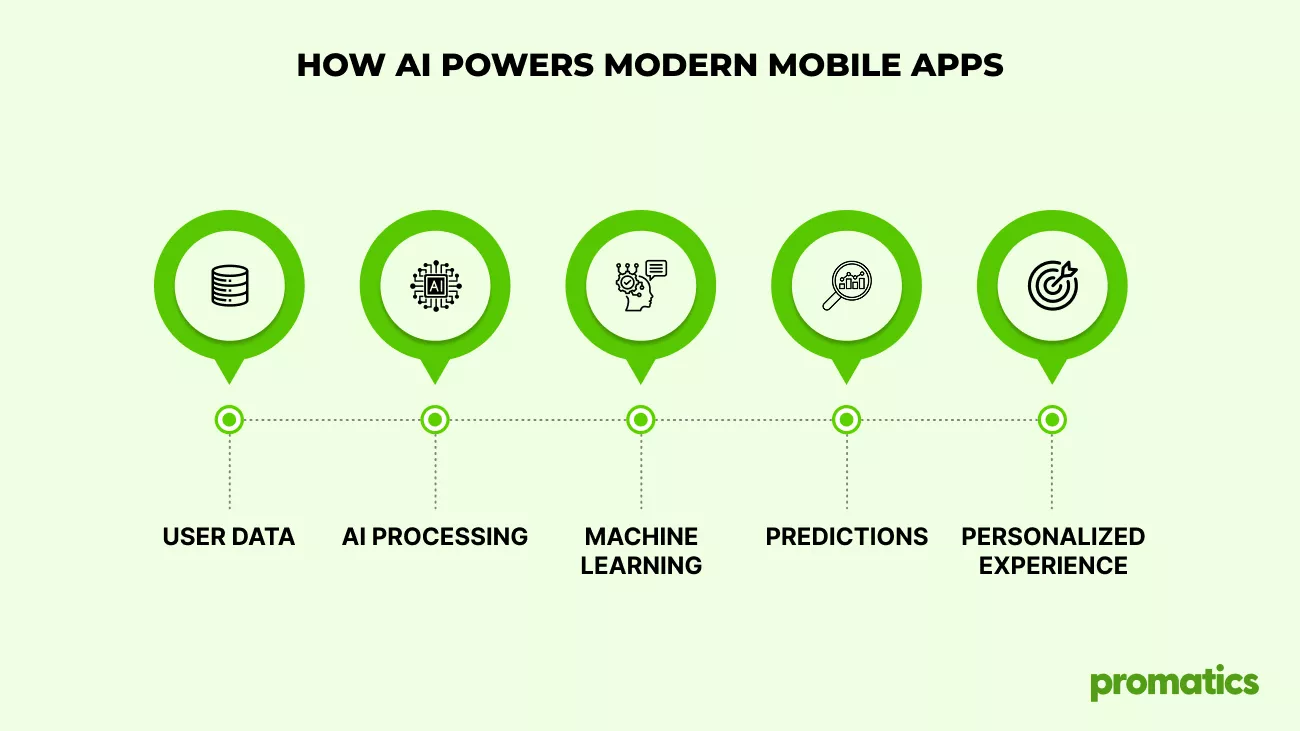
Technologies:
| User Data | Machine Learning |
| Ai Processing | NLP |
| Machine Learning | Predictive Analytics |
| Predictions | Computer Vision |
| Personalized Experience | Generative AI |
Key Applications of AI in Mobile App Development
Artificial intelligence is transforming mobile applications across industries by enabling smarter, faster, and more personalized user experiences. From automation and predictive analytics to intelligent customer interactions, AI is helping businesses build apps that deliver greater efficiency, engagement, and scalability.
Here are some of the most impactful applications of AI in mobile app development in 2026:
1. AI Chatbots & Virtual Assistants
AI-powered chatbots and virtual assistants help businesses provide instant, 24/7 customer support within mobile apps. Using natural language processing (NLP), these systems can understand user queries, resolve issues, answer questions, and improve customer experiences in real time.
Popular examples include AI support assistants in banking, eCommerce, healthcare, and food delivery apps.
2. Personalized Recommendations
AI helps mobile apps analyze user behavior, preferences, browsing history, and interactions to deliver highly personalized recommendations.
Streaming platforms suggest content based on viewing habits, while eCommerce apps recommend products tailored to individual customer preferences. This improves user engagement, retention, and conversion rates.
3. Voice Recognition & Voice Assistants
Voice-enabled interactions are becoming increasingly popular in modern mobile applications. AI-powered voice recognition allows users to search, navigate, send commands, and interact with apps using natural speech.
Voice assistants improve accessibility and create more convenient, hands-free user experiences.
4. Predictive Analytics
AI-powered predictive analytics enables mobile apps to forecast user behavior, identify trends, and make data-driven recommendations.
Businesses use predictive insights to optimize marketing campaigns, improve customer retention, detect risks, and deliver proactive user experiences.
5. Image Recognition & Computer Vision
AI-powered computer vision enables apps to analyze images, detect objects, recognize faces, and process visual information in real time.
This technology is widely used in healthcare apps, facial authentication systems, retail applications, AR experiences, and security platforms.
6. Smart Search & Intelligent Automation
AI enhances mobile app search capabilities by understanding user intent, context, and behavior patterns instead of relying only on keywords.
Businesses also use AI to automate repetitive tasks, workflows, notifications, and operational processes, improving productivity and reducing manual effort.
7. Fraud Detection & Security
AI plays a critical role in improving mobile app security by identifying suspicious activities, detecting fraud patterns, and preventing unauthorized access in real time.
Fintech, banking, and eCommerce apps increasingly rely on AI-driven security systems to protect sensitive user data and transactions.
8. Real-Time Language Translation
AI-powered translation tools enable mobile apps to provide multilingual communication and real-time language translation for global users.
This improves accessibility, customer support, and international user experiences across different markets.
9. Generative AI Features
Generative AI is rapidly becoming a major part of mobile applications. Businesses are integrating AI-generated content, smart writing assistants, image generation tools, AI copilots, and conversational interfaces directly into apps to improve creativity, productivity, and user engagement.
10. AI-Powered Healthcare & Fitness Apps
Healthcare and fitness apps use AI for symptom analysis, activity tracking, personalized health recommendations, predictive diagnostics, and virtual consultations.
These intelligent features help users monitor health conditions, improve wellness, and receive more personalized care experiences.
As AI technologies continue to evolve, mobile applications are becoming more intelligent, adaptive, and capable of delivering highly personalized experiences across every industry.
Challenges of AI in Mobile App Development
Despite AI adoption in app development reaching 84% among developers, nearly 46% still express concerns regarding the reliability of AI-generated code. To successfully build scalable, secure, and high-performing AI-powered mobile applications, businesses must proactively address critical technical, operational, security, and performance-related challenges.
Here are some of the biggest challenges of AI in mobile app development in 2026:
1. Data Privacy & Security Concerns
AI-powered apps rely heavily on user data to deliver personalized experiences and intelligent recommendations. However, collecting, processing, and storing large volumes of sensitive data increases privacy and security risks.
Businesses must ensure compliance with data protection regulations while implementing strong encryption, authentication, and cybersecurity practices to protect user information.
2. High Development Costs
Developing AI-powered mobile apps often requires advanced technologies, skilled AI engineers, cloud infrastructure, large datasets, and ongoing model training. This can significantly increase development and maintenance costs compared to traditional mobile applications.
For startups and small businesses, balancing innovation with budget constraints can become a major challenge.
3. Complex AI Integration
Integrating AI into mobile apps can be complex, as businesses often face challenges connecting AI models with existing systems, APIs, databases, and app infrastructures.
Poor integration can impact app performance, user experience, and scalability.
4. Data Quality & Availability
AI performance depends heavily on the quality of the data it is trained on. Poor, incomplete, or biased data can result in inaccurate predictions, weak recommendations, and unreliable outcomes.
Using high-quality and well-structured datasets is essential for building effective AI-powered applications.
5. Performance & Device Limitations
AI features such as real-time analytics, computer vision, and voice recognition can consume significant processing power, storage, and battery life on mobile devices.
Developers must optimize AI models carefully to maintain fast performance, low latency, and smooth user experiences across different devices.
6. AI Model Accuracy & Bias
AI models can sometimes produce inaccurate results or biased outcomes depending on the training data used. This can negatively affect customer trust, decision-making, and user experiences.
Businesses need continuous monitoring, testing, and model optimization to improve AI accuracy and reduce bias.
7. Scalability Challenges
As user bases grow, AI-powered apps must handle larger datasets, higher traffic volumes, and real-time processing requirements without affecting performance.
Building scalable AI infrastructure requires strong cloud architecture, optimized backend systems, and efficient data processing capabilities.
8. Ongoing Maintenance & Updates
AI models require continuous monitoring, retraining, and updates to maintain accuracy and performance over time. Unlike traditional apps, AI-powered applications need ongoing optimization to keep up with changing user behavior and market trends, making long-term maintenance more complex for businesses.
9. Lack of Skilled AI Talent
Building advanced AI-powered mobile apps requires expertise in machine learning, data science, cloud computing, and AI infrastructure. However, finding experienced AI developers and specialists remains a major challenge for many businesses globally.
10. Ethical & Regulatory Challenges
As AI adoption grows, concerns around transparency, ethical AI usage, algorithmic bias, and responsible data handling are becoming increasingly important.
Businesses must ensure their AI systems remain fair, explainable, compliant, and aligned with evolving regulations and ethical standards.
Despite these challenges, AI continues to reshape the future of mobile app development. Businesses that strategically address these limitations can build intelligent, scalable, and highly engaging applications that deliver long-term competitive advantages.
| Challenges | Solutions |
| Data Privacy | Encryption & Compliance |
| AI Bias | Model Training |
| Scalability | Cloud Infrastructure |
| High Costs | MVP Development |
| Performance Issues | Edge AI Optimization |
Advantages of Using AI in Mobile App Development
Artificial intelligence is redefining how modern mobile applications are built, experienced, and optimized. By integrating AI technologies into mobile apps, businesses can deliver smarter user experiences, automate operations, improve decision-making, and create highly personalized digital interactions.
As competition in the mobile app market continues to grow, AI is becoming a major competitive advantage for businesses looking to improve engagement, efficiency, and long-term scalability.
Here are some of the biggest advantages of using AI in mobile app development:
1. Personalized User Experiences
AI helps mobile apps analyze user behavior, preferences, browsing history, and interactions to deliver highly personalized experiences.
From product recommendations and customized content feeds to personalized notifications and search results, AI enables businesses to create more engaging and user-centric applications that improve retention and customer satisfaction.
2. Improved Customer Engagement
AI-powered features like chatbots, virtual assistants, voice interactions, and intelligent recommendations help businesses provide faster, smarter, and more interactive customer experiences.
This keeps users engaged for longer periods and improves overall app usability.
3. Real-Time Automation
AI automates repetitive tasks and processes within mobile applications, reducing manual effort and improving operational efficiency.
Businesses can automate customer support, workflows, notifications, data processing, scheduling, and other routine activities to save time and improve productivity.
4. Smarter Decision-Making
AI-powered analytics and predictive insights help businesses make data-driven decisions more effectively.
By analyzing large volumes of data in real time, AI can identify patterns, predict customer behavior, optimize operations, and support better strategic planning.
5. Enhanced App Security
AI significantly improves mobile app security by detecting suspicious activities, identifying fraud patterns, and preventing unauthorized access in real time.
Industries like fintech, healthcare, and eCommerce increasingly rely on AI-driven security systems to protect sensitive user data and transactions.
6. Better Search & Recommendations
AI enhances app search functionality by understanding user intent and delivering more relevant results.
Recommendation engines powered by AI also improve product discovery, content engagement, and conversion rates by showing users exactly what they are most likely to need or prefer.
7. Faster & More Efficient Customer Support
AI chatbots and virtual assistants provide instant responses to customer queries 24/7 without human intervention.
This improves response times, reduces support costs, and ensures better customer experiences across mobile applications.
8. Predictive Analytics & Insights
AI enables businesses to forecast trends, predict user actions, and identify potential opportunities or risks before they occur.
These predictive capabilities help businesses optimize marketing strategies, improve customer retention, and deliver proactive user experiences.
9. Competitive Business Advantage
Businesses that adopt AI-powered mobile applications can deliver smarter, faster, and more innovative experiences compared to competitors.
AI-driven apps help brands stand out in crowded markets while improving customer loyalty and operational efficiency.
10. Scalability & Future Readiness
AI-powered mobile apps are more adaptable and capable of evolving alongside changing user expectations and technological advancements.
As technologies like generative AI, AI agents, and intelligent automation continue to grow, businesses investing in AI today are better positioned for future digital transformation opportunities.
In 2026, AI is no longer just an innovation in mobile app development. It is becoming a core driver of customer experience, business growth, and digital competitiveness across industries.
How To Implement AI in App Development
Implementing AI in mobile app development is not just about adding smart features. It requires a clear strategy, the right technologies, quality data, and a scalable development approach to create intelligent applications that deliver real business value.
Here is a step-by-step process businesses can follow to successfully implement AI in mobile app development:
1. Define Business Goals & AI Use Cases
The first step is identifying why your app needs AI and what problems it will solve.
Businesses should clearly define objectives such as improving customer engagement, automating support, personalizing user experiences, enhancing security, or optimizing operational efficiency.
Once the goals are clear, businesses can identify the most relevant AI use cases for their app, such as:
- AI chatbots
- Personalized recommendations
- Predictive analytics
- Voice recognition
- Fraud detection
- Smart search
- AI-powered automation
A focused AI strategy helps avoid unnecessary complexity and ensures measurable outcomes.
2. Choose the Right AI Technology
Different AI features require different technologies and frameworks. Businesses need to select the right AI technologies based on app requirements, scalability goals, and user expectations.
Common AI technologies used in mobile app development include:
- Machine Learning (ML)
- Natural Language Processing (NLP)
- Generative AI
- Computer Vision
- Speech Recognition
- Predictive Analytics
Popular AI tools and frameworks include TensorFlow, OpenAI APIs, Google ML Kit, IBM Watson, PyTorch, and Azure AI services.
3. Collect & Prepare Quality Data
AI systems rely heavily on data for training and decision-making. Businesses need accurate, relevant, and well-structured datasets to ensure AI models perform effectively.
Poor-quality or biased data can lead to inaccurate predictions and poor user experiences. Data preparation often includes:
- Data collection
- Data cleaning
- Labeling and categorization
- Data security and compliance checks
High-quality data is essential for building reliable AI-powered applications.
4. Design a Scalable App Architecture
AI-powered apps often require advanced backend infrastructure capable of handling large datasets, real-time processing, and intelligent automation.
Businesses should design scalable app architectures that support:
- Cloud integration
- AI model deployment
- API connectivity
- Real-time analytics
- Secure data management
A scalable infrastructure ensures better app performance and future growth flexibility.
5. Develop & Integrate AI Features
Once the infrastructure is ready, developers can begin integrating AI models and intelligent functionalities into the mobile app.
This may include:
- AI chatbots and virtual assistants
- Recommendation engines
- Voice-enabled interactions
- Smart search functionality
- AI-generated content
- Predictive analytics dashboards
Developers can either build custom AI models or integrate pre-trained AI APIs depending on project requirements and budget.
6. Focus on User Experience (UX)
AI should improve the user experience, not complicate it.
Businesses must ensure AI features feel intuitive, fast, and helpful within the app. Poorly implemented AI can frustrate users and reduce adoption rates.
A user-focused AI strategy should prioritize:
- Personalization
- Simplicity
- Fast response times
- Seamless interactions
- Transparency in AI decisions
7. Test AI Performance Thoroughly
AI-powered apps require continuous testing to ensure accuracy, reliability, and performance across different devices and user scenarios.
Testing should focus on:
- AI model accuracy
- Response quality
- App performance
- Bias detection
- Security vulnerabilities
- Scalability under high traffic
Regular testing helps improve AI efficiency and user trust.
8. Monitor, Optimize & Continuously Improve
AI systems evolve over time and require ongoing monitoring and optimization.
Businesses should continuously analyze app performance, user feedback, AI accuracy, and behavioral insights to improve AI capabilities and adapt to changing user expectations.
Continuous learning and optimization help AI-powered apps remain relevant, intelligent, and competitive in the long term.
As AI technologies continue to evolve, businesses that strategically implement AI in mobile app development can build smarter, more scalable, and highly engaging applications that drive long-term digital growth.
AI App Development Tools and Frameworks
Building a successful AI-powered mobile app requires the right combination of development tools, frameworks, APIs, and cloud platforms. These technologies help businesses integrate machine learning, automation, natural language processing, computer vision, and generative AI capabilities into modern mobile applications.
In 2026, developers will have access to a wide range of AI tools that simplify development, improve scalability, and accelerate time-to-market for intelligent mobile applications.
Here are some of the most widely used AI app development tools and frameworks:
1. TensorFlow
TensorFlow is one of the most popular open-source machine learning frameworks developed by Google. It is widely used for building and training AI models for mobile and web applications.
Key Features:
- Machine learning and deep learning support
- Scalable AI model training
- Mobile optimization with TensorFlow Lite
- Real-time AI processing capabilities
Best For:
Predictive analytics, recommendation engines, computer vision, and AI-powered automation.
2. PyTorch
PyTorch is a flexible and developer-friendly AI framework widely used for deep learning and neural network development.
Key Features:
- Faster prototyping and model training
- Dynamic computation graphs
- Strong community support
- Easy AI experimentation and research
Best For:
Advanced AI applications, NLP models, computer vision, and generative AI solutions.
3. OpenAI APIs
OpenAI APIs allow developers to integrate powerful generative AI capabilities into mobile applications, including conversational AI, content generation, summarization, coding assistance, and intelligent automation.
Key Features:
- AI chatbots and virtual assistants
- Natural language understanding
- Text and content generation
- AI copilots and workflow automation
Best For:
Generative AI apps, AI assistants, customer support automation, and productivity tools.
4. Google ML Kit
Google ML Kit is a mobile AI SDK that enables developers to integrate ready-to-use AI features directly into Android and iOS applications.
Key Features:
- Face detection
- Text recognition
- Barcode scanning
- Language translation
- On-device machine learning
Best For:
Real-time mobile AI features and lightweight AI integrations.
5. IBM Watson
IBM Watson provides enterprise-grade AI tools and cloud-based AI services for building intelligent applications.
Key Features:
- NLP and conversational AI
- Speech-to-text capabilities
- Predictive analytics
- AI-powered business automation
Best For:
Enterprise AI applications, customer support systems, and business intelligence platforms.
6. Microsoft Azure AI
Azure AI offers cloud-based AI services and machine learning tools that help businesses build scalable AI-powered applications.
Key Features:
- AI model deployment
- Cognitive services
- Speech and vision APIs
- Cloud scalability and security
Best For:
Enterprise AI apps, predictive analytics, and large-scale AI infrastructure.
7. Dialogflow
Dialogflow by Google is a conversational AI platform used for creating intelligent chatbots and virtual assistants.
Key Features:
- Natural language processing
- Voice and text-based conversations
- Multi-platform integrations
- AI-driven customer support automation
Best For:
AI chatbots, customer service apps, and conversational mobile experiences.
8. Core ML
Core ML is Apple’s machine learning framework designed specifically for iOS applications.
Key Features:
- On-device AI processing
- Optimized performance for Apple devices
- Image, speech, and text analysis
- Strong privacy and security support
Best For:
AI-powered iOS applications and Apple ecosystem integrations.
9. Firebase AI & Cloud Services
Firebase provides backend services and AI integrations that simplify mobile app development and real-time data management.
Key Features:
- Real-time databases
- Cloud functions
- AI integrations
- App analytics and performance monitoring
Best For:
Scalable mobile app development with AI-powered backend support.
10. Hugging Face
Hugging Face has become one of the leading platforms for NLP models, transformers, and generative AI development.
Key Features:
- Pre-trained AI models
- NLP and transformer support
- Open-source AI ecosystem
- Easy AI model deployment
Best For:
Conversational AI, NLP applications, generative AI, and language-based mobile apps.
Choosing the right AI tools and frameworks depends on your business goals, app complexity, scalability needs, budget, and target audience. A well-planned AI technology stack helps businesses build intelligent, high-performing, and future-ready mobile applications that deliver real competitive advantages.
| Tool | Best For |
| TensorFlow | Machine Learning |
| PyTorch | Deep Learning |
| OpenAI APIs | Generative AI |
| Google ML Kit | Mobile AI |
| Azure AI | Enterprise AI |
| Dialogflow | AI Chatbots |
Monetization Strategies of AI in Mobile App Development
AI-powered mobile apps are not only transforming user experiences but also creating new revenue opportunities for businesses. By combining intelligent features with the right monetization strategy, businesses can maximize profitability while delivering greater value to users.
In 2026, AI is enabling businesses to build smarter monetization models that are more personalized, data-driven, and scalable than traditional app revenue strategies.
Here are some of the most effective monetization strategies for AI-powered mobile applications:
1. Subscription-Based Models
Subscription models remain one of the most popular monetization strategies for AI-powered apps.
Businesses can offer premium AI features such as:
- Personalized recommendations
- Advanced analytics
- AI assistants
- Smart automation tools
- AI-generated content
- Premium productivity features
Users pay monthly or yearly subscriptions to access advanced AI functionalities and enhanced user experiences.
Best For:
AI productivity apps, fitness apps, educational platforms, SaaS apps, and content generation tools.
2. Freemium Model
The freemium model allows users to access basic app features for free while charging for premium AI-powered capabilities.
This approach helps businesses attract larger user bases while encouraging upgrades to paid plans for advanced features.
Examples of premium AI features may include:
- Unlimited AI usage
- Advanced personalization
- Faster AI responses
- Ad-free experiences
- AI copilots and automation tools
Best For:
AI chatbots, creative tools, editing apps, and consumer mobile applications.
3. In-App Purchases
AI-powered apps can generate revenue through one-time in-app purchases for additional features, virtual products, AI credits, or premium content.
Examples include:
- AI image generation credits
- Custom AI avatars
- Premium templates
- Advanced editing tools
- AI voice packs
Best For:
Gaming apps, creative apps, photo/video editing apps, and entertainment platforms.
4. AI-Powered Advertising
Artificial intelligence helps businesses deliver highly targeted and personalized advertisements based on user behavior, interests, and engagement patterns.
AI-driven advertising improves:
- Ad relevance
- Click-through rates
- User engagement
- Conversion rates
This creates better monetization opportunities while improving user experiences compared to traditional ads.
Best For:
Social media apps, entertainment platforms, content apps, and free mobile applications.
5. Usage-Based Pricing
Some AI-powered apps use pay-as-you-go or usage-based pricing models where users are charged based on AI usage volume.
Pricing may depend on:
- Number of AI-generated outputs
- API requests
- AI processing time
- Storage usage
- Feature consumption
Best For:
Generative AI apps, AI APIs, enterprise tools, and developer platforms.
6. Enterprise Licensing & SaaS Models
Businesses developing enterprise AI mobile solutions can monetize through SaaS subscriptions, enterprise licensing, or custom AI implementation services.
Companies often pay for:
- AI workflow automation
- Business intelligence tools
- AI-powered analytics
- Enterprise AI assistants
- Custom AI integrations
Best For:
B2B mobile apps, enterprise platforms, fintech, healthcare, and logistics applications.
7. E-Commerce & AI Recommendations
AI-powered recommendation engines significantly improve product discovery and conversion rates in eCommerce applications.
Businesses can monetize through:
- Increased product sales
- Upselling and cross-selling
- Personalized shopping experiences
- AI-driven customer engagement
AI helps businesses generate higher revenue by improving purchasing decisions and customer retention.
8. Affiliate & Partnership Revenue
AI-powered apps can generate affiliate income by recommending products, services, or third-party platforms based on user behavior and preferences.
Businesses earn commissions whenever users purchase products or services through AI-driven recommendations.
Best For:
Travel apps, shopping apps, finance apps, and content platforms.
9. Data-Driven Insights & Analytics
Some AI-powered enterprise applications monetize by offering advanced analytics, predictive insights, and business intelligence services.
Organizations pay for access to:
- Customer behavior insights
- Predictive forecasting
- Market intelligence
- Operational analytics
- AI-generated reports
Best For:
Enterprise AI apps, marketing platforms, healthcare solutions, and fintech applications.
10. White-Label AI Solutions
Businesses can also monetize by offering white-label AI-powered mobile app solutions to other companies.
This allows organizations to license AI technologies, chatbots, recommendation engines, or automation systems under different brand names.
Best For:
AI SaaS providers, enterprise solution providers, and app development companies.
As AI adoption continues to grow, businesses have more opportunities than ever to create scalable and profitable mobile app business models. The key is choosing a monetization strategy that aligns with user expectations while delivering long-term value through intelligent and engaging app experiences.
Future Trends of Artificial Intelligence in Mobile Development
Artificial intelligence is evolving rapidly, and its impact on mobile app development is expected to grow even further in the coming years. As businesses focus on delivering smarter, faster, and more personalized digital experiences, AI is becoming a core driver of innovation in modern mobile applications.
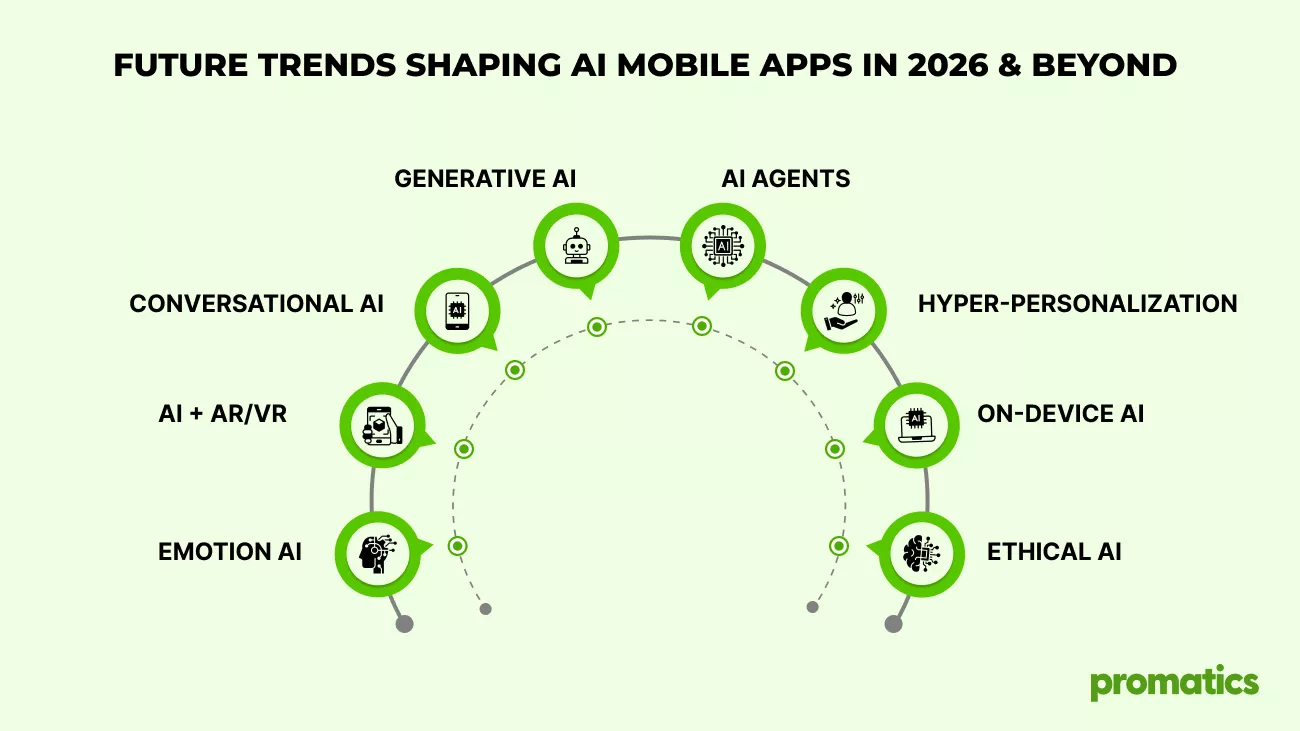
Here are some of the biggest future trends shaping AI in mobile development in 2026 and beyond:
1. Generative AI-Powered Mobile Apps
Generative AI is becoming one of the most transformative trends in mobile development. Mobile apps are increasingly integrating AI models capable of generating text, images, videos, code, summaries, and personalized content in real time.
Businesses are using generative AI to build:
- AI assistants and copilots
- Content creation tools
- AI-powered customer support
- Personalized shopping experiences
- Smart productivity applications
This trend is redefining how users interact with mobile apps.
2. AI Agents & Autonomous Workflows
AI agents are expected to play a major role in the future of mobile applications. Instead of simply responding to commands, AI agents can independently perform tasks, automate workflows, make decisions, and complete multi-step actions on behalf of users.
Examples include:
- AI scheduling assistants
- Autonomous shopping assistants
- AI workflow automation
- Smart travel planning apps
- AI-powered business operations
AI agents are making mobile apps more proactive and intelligent.
3. On-Device AI Processing
Modern mobile applications are increasingly shifting toward on-device AI processing rather than relying entirely on cloud infrastructure.
This trend offers several benefits:
- Faster performance
- Reduced latency
- Better privacy and security
- Offline AI functionality
- Lower cloud dependency
With advancements in mobile chipsets and edge computing, on-device AI is expected to become a standard feature in future mobile apps.
4. Hyper-Personalized User Experiences
AI will continue to push personalization to new levels. Future mobile apps will analyze user behavior, preferences, habits, location, and interaction patterns in real time to deliver highly customized experiences.
This includes:
- Personalized recommendations
- Adaptive app interfaces
- Dynamic content delivery
- Predictive notifications
- Smart user journeys
Businesses that deliver hyper-personalized experiences are likely to see higher engagement and customer retention.
5. Voice & Conversational AI Growth
Voice search, conversational AI, and natural language interactions will continue to grow rapidly in mobile applications.
Future mobile apps will increasingly support:
- Human-like AI conversations
- Multilingual voice assistants
- Voice-enabled app navigation
- Real-time speech recognition
- AI-powered customer support
As NLP technologies improve, conversational mobile experiences will become more natural and seamless.
6. AI-Powered Cybersecurity
As mobile apps collect more user data, AI-driven cybersecurity will become increasingly important.
Future AI security systems will help:
- Detect fraud in real time
- Prevent cyber threats
- Identify suspicious behavior
- Improve biometric authentication
- Strengthen app security systems
AI will play a critical role in protecting user privacy and sensitive business data.
7. AI + AR/VR Integration
The combination of AI with augmented reality (AR) and virtual reality (VR) is expected to create highly immersive mobile experiences.
Industries like retail, gaming, healthcare, education, and real estate are already leveraging AI-powered AR/VR applications for:
- Virtual shopping experiences
- Interactive learning
- Smart navigation
- AI-powered gaming environments
- Virtual product visualization
This trend will significantly transform mobile user experiences in the coming years.
8. Emotion AI & Sentiment Analysis
Future AI-powered apps may increasingly analyze emotions, facial expressions, voice tones, and user sentiment to create more emotionally intelligent interactions.
Emotion AI can help businesses:
- Improve customer experiences
- Deliver empathetic support
- Personalize interactions more effectively
- Analyze customer satisfaction in real time
This technology is expected to become more common in customer service, healthcare, and entertainment apps.
9. AI-Driven App Development Automation
AI is also transforming the app development process itself.
Developers are increasingly using AI tools for:
- Automated coding assistance
- UI/UX generation
- AI-powered testing
- Bug detection
- Performance optimization
- Faster deployment workflows
This trend is helping businesses reduce development time and improve software quality.
10. Ethical & Responsible AI Development
As AI adoption grows, businesses are becoming more focused on ethical AI practices, transparency, explainable AI, and responsible data usage.
Future AI mobile applications will increasingly prioritize:
- Data privacy
- AI transparency
- Bias reduction
- Regulatory compliance
- Responsible automation
Building trustworthy AI systems will become essential for long-term user adoption and business credibility.
The future of AI in mobile development is not just about smarter features. It is about creating intelligent, adaptive, and deeply personalized digital ecosystems that continuously evolve alongside user needs and technological advancements.
Businesses that embrace these AI trends early will be better positioned to innovate faster, improve customer experiences, and maintain a strong competitive advantage in the evolving mobile landscape.
Conclusion
Artificial intelligence is redefining the future of mobile app development. What once were simple applications are now evolving into intelligent digital experiences capable of understanding user behavior, automating processes, delivering personalized interactions, and driving smarter business outcomes.
From AI chatbots and predictive analytics to generative AI and intelligent automation, businesses are increasingly investing in AI-powered mobile applications to enhance customer experiences, improve operational efficiency, and accelerate digital growth.
But building a successful AI-powered app requires more than integrating advanced features. It demands the right strategy, scalable technology, seamless user experience, and deep development expertise. At Promatics Technologies, we help startups, enterprises, and growing brands build innovative AI-powered mobile applications tailored for modern business needs. From AI strategy and UI/UX design to development, integration, and deployment, our team delivers scalable and future-ready mobile solutions that create real business impact. Ready to turn your app idea into an intelligent digital experience? Connect with our experts and start building the future of mobile innovation today.