Retail eCommerce App Development: A Complete Business & Technology Guide

TL;DR
- Modern eCommerce apps focus on AI personalization, seamless checkout, and omnichannel experiences.
- Cloud-native and microservices architectures help platforms scale efficiently.
- Real-time inventory, secure payments, and smart search are essential retail features.
- Flutter, React Native, Node.js, and AWS are widely used in eCommerce development.
- AI recommendations, chatbots, and voice commerce are shaping digital shopping experiences.
- The right tech stack and development strategy are critical for scalability and growth.
The global eCommerce industry is entering a new phase of rapid growth, and 2026 is expected to become a landmark year for digital commerce. Online shopping is no longer just about convenience. It has become a major part of how consumers discover, compare, and purchase products across industries. Today, more than 33% of the global population shops online, and the eCommerce market has already reached a valuation of $7.4 trillion. Industry forecasts suggest it will surpass $8 trillion by 2027. Additionally, analysts estimate that over 42% of the world’s population will make at least one online purchase this year, reflecting the growing scale and influence of digital retail.
From ultra-fast grocery delivery services to luxury purchases completed through smartphones, eCommerce platforms have evolved into core revenue engines for businesses of every size. Brands are no longer treating digital storefronts as optional channels. Instead, they are becoming central to customer engagement, sales growth, and long-term business expansion.
Consumer expectations are also changing rapidly. AI-powered recommendations, personalized notifications, social commerce features, and seamless checkout experiences are now standard expectations for modern shoppers. Mobile commerce continues to grow significantly, with mobile shopping sales projected to reach nearly $856 billion by 2027. At the same time, advancements in cloud infrastructure, secure payment gateways, and logistics networks have made launching and scaling online stores more accessible than ever.
For businesses planning to enter or expand within the digital commerce market, understanding the complete eCommerce app development process is essential. From selecting the right business model and core features to building scalable architectures and secure systems, every decision plays a crucial role in creating a successful retail eCommerce platform.
This guide explores everything businesses need to know about retail eCommerce app development in 2026, including market trends, app types, essential features, system architecture, technology stacks, AI-powered enhancements, scalability strategies, and future industry trends shaping the next generation of digital commerce.
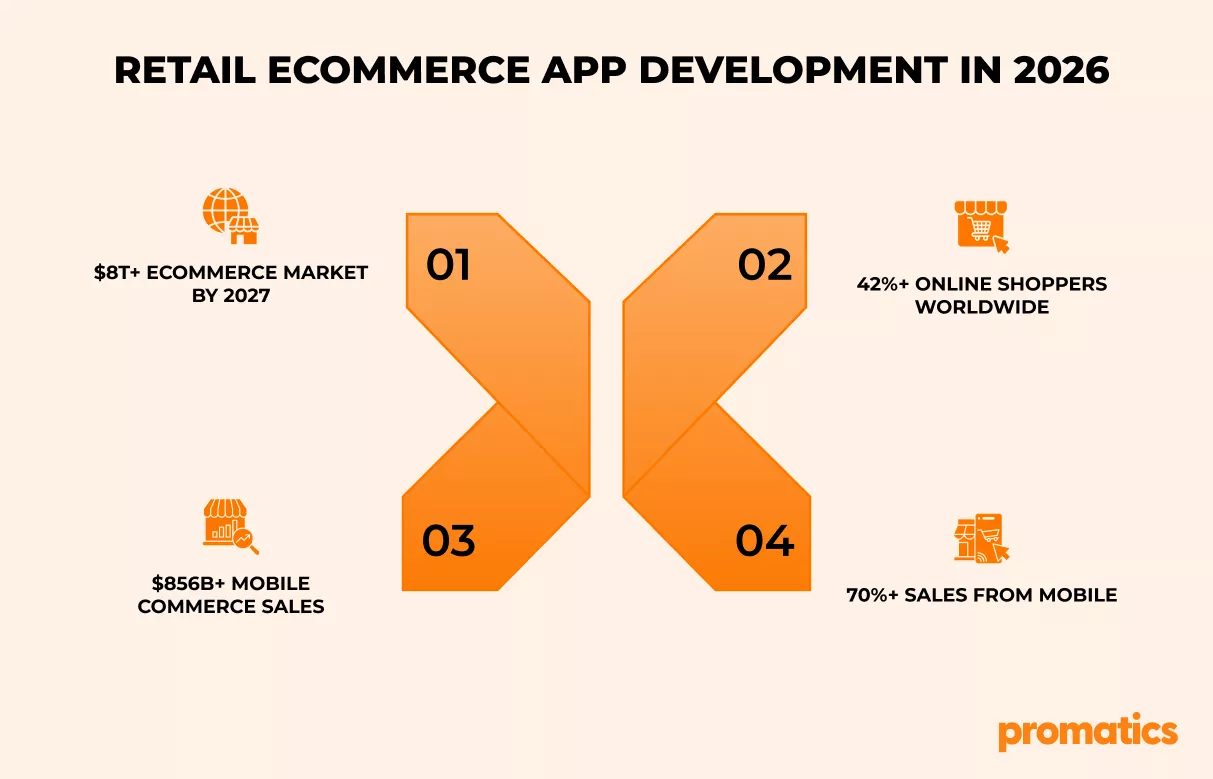
Retail eCommerce Market Insights & Statistics
The global retail industry is undergoing one of the biggest digital transformations in history, and eCommerce apps are now at the center of this shift. From AI-powered shopping experiences to creator-led commerce and hyper-personalized recommendations, modern retail is rapidly evolving beyond traditional online stores.Businesses looking to stay competitive are increasingly investing in scalable, AI-driven retail platforms through experienced eCommerce app development companies that can deliver personalized and omnichannel shopping experiences.
According to industry reports, the global retail eCommerce market is expected to reach nearly USD 15.8 trillion by 2033, growing at a CAGR of 11.7%. This growth is being fueled by rising smartphone adoption, digital payments, faster delivery expectations, and increasing consumer preference for online shopping experiences.
At the same time, Deloitte reports that modern consumers now prioritize convenience, personalization, speed, and value more than ever before. Retailers are increasingly investing in AI-driven commerce, omnichannel experiences, loyalty programs, and real-time customer engagement to stay competitive in this rapidly changing market.
Key Retail eCommerce Market Statistics
- The global retail eCommerce market is projected to grow from USD 8.14 trillion in 2026 to USD 15.82 trillion by 2033.
- Cross-border eCommerce is expected to reach USD 4.85 trillion by 2033, highlighting the growing demand for global online shopping experiences.
- AI in eCommerce is expected to grow at a CAGR of 25.7% through 2033 as retailers adopt AI-powered recommendations, automation, and predictive analytics. Many brands are also leveraging AI development services to enhance personalization, conversational commerce, and shopping automation.
- Deloitte’s retail outlook highlights personalization, connected commerce, and data-driven retail strategies as major growth drivers shaping the future of retail.
- India’s eCommerce market is expected to witness a massive USD 250 billion expansion, driven largely by Gen Z consumers, creator-led shopping, and non-metro digital adoption.
- Studies show consumers spend significantly more with brands that offer seamless omnichannel experiences, easy checkout, and personalized engagement.
- AI-driven retail traffic surged dramatically during major shopping events as conversational commerce and AI-assisted buying experiences continue to rise globally.
Emerging Trends Reshaping Retail eCommerce
Today’s retail eCommerce ecosystem is no longer limited to websites and mobile apps. Social commerce, live shopping, voice-assisted buying AI shopping agents, and creator-driven marketplaces are redefining how consumers discover and purchase products online.
Retailers are also shifting toward hyper-personalized shopping journeys powered by machine learning, predictive analytics, and customer behavior tracking. Deloitte’s research further highlights that retailers focusing on customer-centric digital experiences, loyalty ecosystems, and operational agility are more likely to sustain long-term growth.
As competition intensifies, scalable retail eCommerce apps are becoming essential for brands looking to improve customer retention, increase conversions, and build future-ready digital commerce ecosystems.
The eCommerce App Boom Businesses Can’t Afford to Ignore in 2026
Online Shopping Beyond Traditional Retail
eCommerce is no longer limited to B2C shopping alone. Businesses across B2B, D2C, marketplaces, and subscription models are rapidly moving online to meet changing customer expectations. Consumers now purchase everything from groceries and fashion to electronics, furniture, and even vehicles through digital platforms.
What was once considered a convenience has now become an essential part of everyday consumer behavior.
Voice Commerce Is Growing Rapidly
Voice-enabled shopping is becoming increasingly popular with the adoption of smart speakers like Alexa and Google Home. Ecommerce transactions through smart speakers were valued at nearly $2 billion in the US and UK a few years ago and are expected to reach approximately $40 billion within the next year.
Additionally, nearly 90 million Americans are expected to use smart speakers regularly, while around 75% of US households are projected to own a smart speaker by 2025.
These trends highlight the growing importance of voice search and conversational commerce in modern eCommerce experiences.
AI Is Making Digital Shopping More Personalized
Artificial intelligence and machine learning are transforming how businesses engage with customers online. AI-powered systems analyze customer behavior, browsing patterns, and purchase history to deliver personalized product recommendations, improve customer experiences, and automate marketing strategies.
Modern eCommerce businesses are increasingly using AI to:
- Recommend relevant products
- Improve search experiences
- Automate customer support
- Optimize marketing campaigns
- Increase customer engagement
Personalization Is Becoming a Competitive Advantage
Modern consumers expect personalized shopping experiences tailored to their preferences. Studies show that nearly 72% of customers engage more with personalized messaging and recommendations. Businesses are now using customer data, browsing history, and CRM systems to deliver targeted offers, personalized content, and customized shopping journeys that improve loyalty and retention.
Chatbots and Real-Time Support Are Essential
Customers expect instant assistance while shopping online. AI-powered chatbots help businesses provide quick responses, order updates, product recommendations, and customer support in real time. In fact, nearly 80% of businesses were projected to integrate chatbot systems to improve customer engagement and streamline support operations.
Omnichannel Commerce Is the New Standard
Today’s consumers shop across multiple platforms, including websites, mobile apps, social media, and physical stores. According to a Harvard Business Review survey, nearly 73% of shoppers use multiple channels during their buying journey. As a result, businesses are investing in omnichannel commerce strategies that offer seamless experiences through features like real-time inventory synchronization, cross-platform order tracking, and flexible delivery options.
Types of eCommerce App to Build for Your Business in 2026
As the eCommerce industry continues to evolve, businesses are adopting different types of eCommerce applications to meet varying customer needs and shopping preferences. Each type of app is built to support specific business models, transaction processes, and user experiences. Selecting the right eCommerce app model helps businesses improve customer interaction, streamline operations, and create more effective digital commerce experiences.
| Type of eCommerce App | Description | Examples |
| B2C (Business-to-Consumer) | Businesses sell products directly to customers through online platforms. | Amazon, Walmart |
| B2B (Business-to-Business) | Platforms for transactions between businesses, suppliers, and wholesalers. | Alibaba, ThomasNet |
| C2C (Consumer-to-Consumer) | Users buy and sell products directly with each other. | eBay, Etsy |
| Social Commerce Apps | Shopping experiences integrated within social media platforms. | Instagram Shopping, Facebook Marketplace |
| Subscription-Based Apps | Apps offering products or services through recurring subscriptions. | Birchbox, Blue Apron |
Businesses planning to launch scalable digital commerce platforms often partner with experienced eCommerce app development companies to identify the right commerce model, architecture, and feature set based on long-term business goals.
Essential Steps in eCommerce App Development
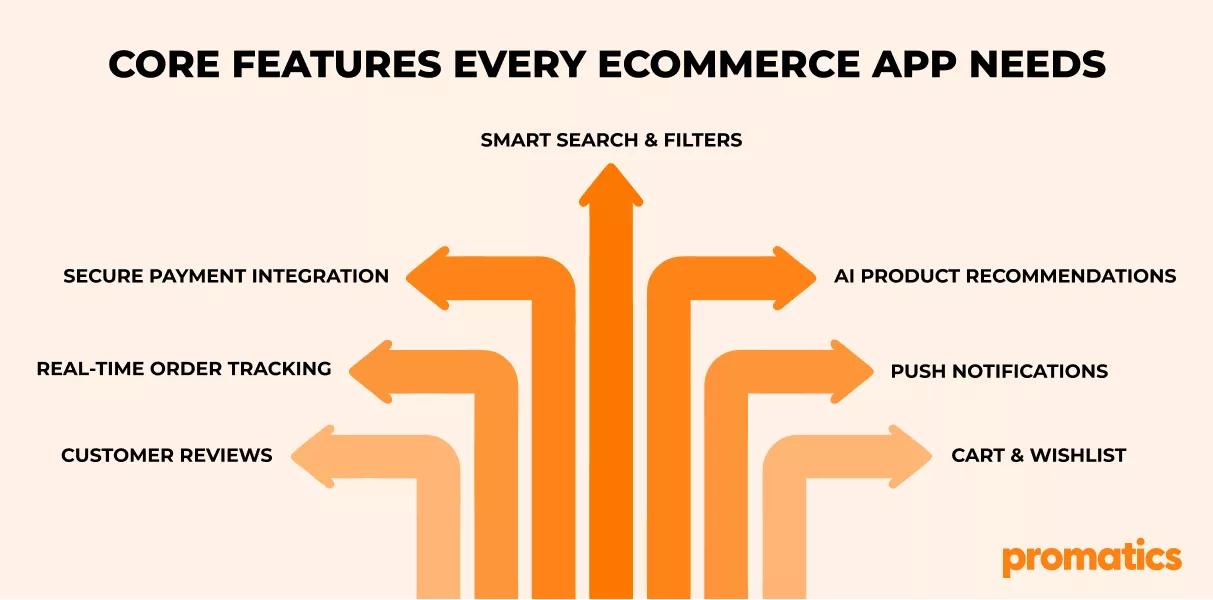
1. UI/UX Design
A clean and user-friendly interface helps customers browse products easily and complete purchases without confusion. Mobile responsiveness, intuitive navigation, and fast-loading pages are important for improving user experience and retention.
2. Smart Product Search & Filters
Advanced search functionality with filters, auto-suggestions, and category sorting helps users quickly find relevant products. Efficient search systems improve product discovery and increase conversion rates.
3. Secure Payment Gateway Integration
Integrating secure payment gateways such as Stripe, PayPal, or Razorpay ensures safe and smooth online transactions. Strong payment security helps build customer trust and reduces transaction failures.
4. Multiple Payment Options
Supporting multiple payment methods such as cards, UPI, wallets, net banking, and BNPL services provides flexibility for users and improves checkout convenience.
5. Seamless Checkout Process
A simplified checkout process with guest checkout, saved addresses, and quick payment flows helps reduce cart abandonment and improves overall purchase completion rates.
6. Real-Time Order Tracking
Order tracking features allow customers to monitor shipment progress and delivery updates directly within the app, improving transparency and customer satisfaction.
7. AI-Powered Product Recommendations
AI recommendation systems analyze customer behavior and display personalized product suggestions to improve engagement, product discovery, and average order value.
8. Shopping Cart & Wishlist Functionality
Cart and wishlist features help users save products, manage purchases, and return to products later, improving convenience and repeat visits.
9. Push Notifications & Alerts
Push notifications help businesses engage users through personalized offers, order updates, abandoned cart reminders, and promotional campaigns.
10. Product Reviews & Ratings
Customer reviews and ratings improve product transparency and help users make informed purchasing decisions, increasing trust within the platform.
11. Inventory & Stock Management
Real-time inventory management helps businesses maintain accurate stock availability, prevent overselling, and improve operational efficiency.
12. Customer Support & Chatbots
Live chat and AI-powered chatbots help resolve customer queries quickly, improving support experiences and customer satisfaction.
13. Security & Data Protection
Security features such as SSL encryption, secure APIs, authentication systems, and fraud detection mechanisms help protect sensitive customer and payment data.
14. Performance & Scalability
Optimized application performance and scalable cloud infrastructure ensure smooth user experiences even during high-traffic periods and business growth.
Technical Foundations Behind Scalable eCommerce Apps
Modern eCommerce apps require a strong technical foundation to deliver fast, secure, and seamless shopping experiences at scale. From handling high traffic during sales to ensuring real-time inventory updates, the right technologies play a critical role in app performance and growth.
Cloud Infrastructure
Cloud platforms like AWS and Google Cloud help apps scale automatically during traffic spikes while maintaining speed and reliability.
Microservices Architecture
Modern apps use microservices to separate features like payments, inventory, and user management, making updates and scaling more efficient.
API-Driven Development
APIs enable smooth integration with payment gateways, CRM systems, logistics providers, and third-party platforms.
AI & Personalization
AI-powered recommendation engines deliver personalized product suggestions, smart search results, and targeted offers based on user behavior.
Real-Time Data Processing
Real-time technologies ensure accurate inventory updates, order tracking, and dynamic pricing for a better customer experience.
Security & Payment Protection
Advanced encryption, secure payment gateways, and PCI DSS compliance help protect customer and transaction data.
Cross-Platform Technologies
Frameworks like Flutter and React Native allow businesses to build high-performing apps for both Android and iOS with faster development cycles.
Performance Optimization
CDNs, caching, and image optimization improve app speed, which directly impacts user engagement and conversions.
Together, these technologies help businesses build scalable, future-ready eCommerce applications that support long-term growth.
Why eCommerce App Development Matters for Business Growth
Faster Shopping Experience
eCommerce apps provide smoother navigation, faster loading speeds, and simplified checkout experiences that improve customer satisfaction and reduce cart abandonment.
AI-Powered Personalization
AI-driven recommendations and personalized offers help businesses improve engagement, increase repeat purchases, and strengthen customer loyalty.
Higher Sales & Conversions
Mobile apps streamline the buying journey with secure payments, quick checkout, and mobile-friendly experiences that improve conversions.
Better Customer Retention
Push notifications help businesses reconnect with users through offers, order updates, abandoned cart reminders, and promotional campaigns.
Customer Insights & Analytics
eCommerce apps collect valuable customer data that helps businesses improve marketing, inventory planning, and personalization strategies.
Omnichannel Experience
Mobile apps help businesses create connected shopping experiences across websites, marketplaces, social media, and physical stores.
Improved Operational Efficiency
Integrations with CRM, inventory, logistics, and payment systems help automate workflows and support business scalability.
Competitive Advantage
A feature-rich eCommerce app helps brands deliver better shopping experiences and stay competitive in the growing digital commerce market.
System Architecture for Retail eCommerce Apps
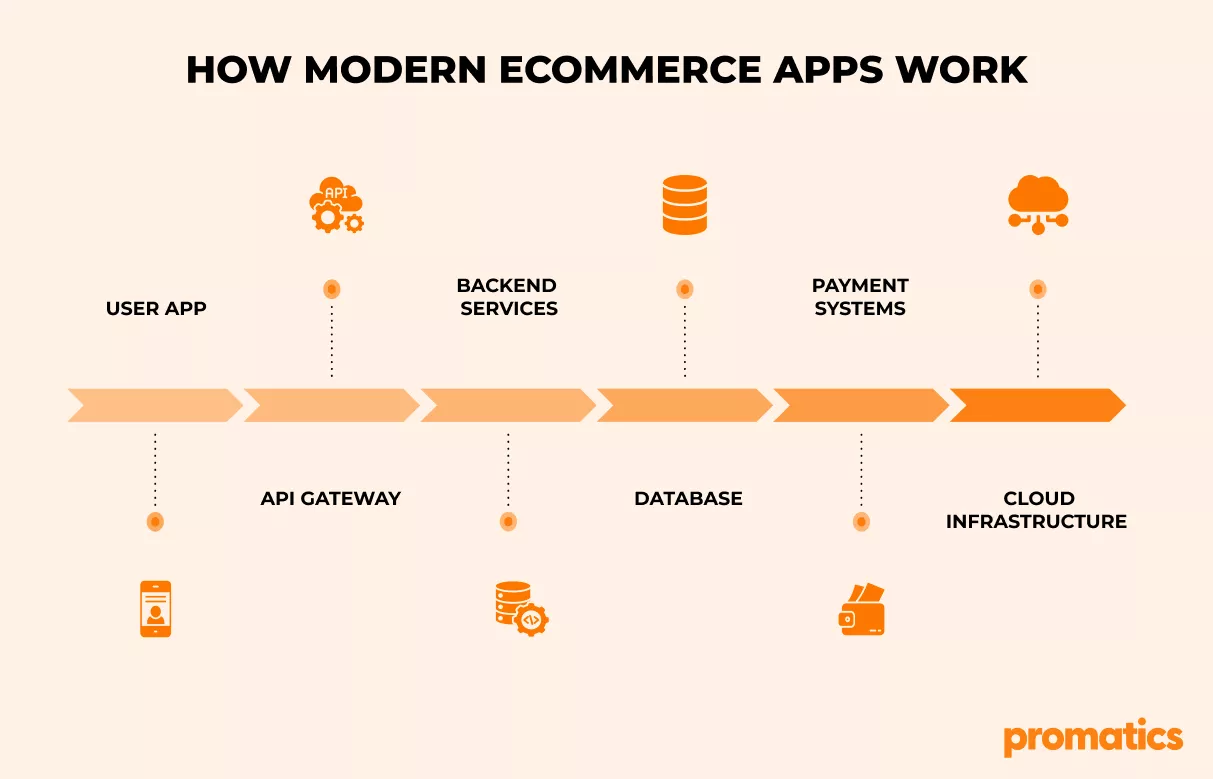
A strong system architecture helps retail eCommerce applications manage high traffic, secure transactions, real-time inventory updates, and seamless customer experiences. It defines how frontend applications, backend services, databases, APIs, and third-party integrations work together to ensure scalability, performance, and reliability.
Frontend Layer
The frontend layer includes mobile apps, websites, and PWAs where users interact with the platform. It handles product browsing, shopping carts, and user experiences across devices. Technologies like React, Flutter, and React Native are commonly used for responsive interfaces.
API Gateway
The API gateway acts as the communication bridge between frontend applications and backend services. It manages request routing, authentication, security, and load balancing while simplifying system communication.
Backend Services
The backend layer manages core business operations such as:
- User authentication
- Product catalogs
- Cart management
- Payments
- Order processing
- Inventory management
Many modern platforms use microservices architecture for better scalability and flexibility.
Database & Storage
eCommerce platforms store large volumes of customer, product, and transaction data. SQL databases like MySQL and PostgreSQL are commonly used for transactional data, while MongoDB and Redis support flexible storage and caching.
Caching & CDN
Caching systems and CDNs improve application speed by reducing server load and accelerating content delivery. This helps maintain fast loading times during high traffic periods.
Third-Party Integrations
Modern eCommerce apps integrate with payment gateways, shipping providers, CRM systems, analytics tools, and marketing platforms to automate operations and improve customer experiences.
Security & Compliance
Security layers protect customer and payment data through encryption, secure APIs, authentication systems, and fraud detection mechanisms. Compliance with standards such as PCI DSS and GDPR also helps maintain platform trust and security.
Cloud Infrastructure & Scalability
Cloud platforms like AWS, Azure, and Google Cloud help businesses scale resources dynamically, improve application availability, and manage traffic spikes efficiently. Features such as auto-scaling and load balancing support long-term scalability.
Why Architecture Matters
A well-designed architecture improves performance, scalability, operational efficiency, and customer experience. It also helps businesses support future growth, omnichannel commerce, AI integrations, and high transaction volumes more effectively.
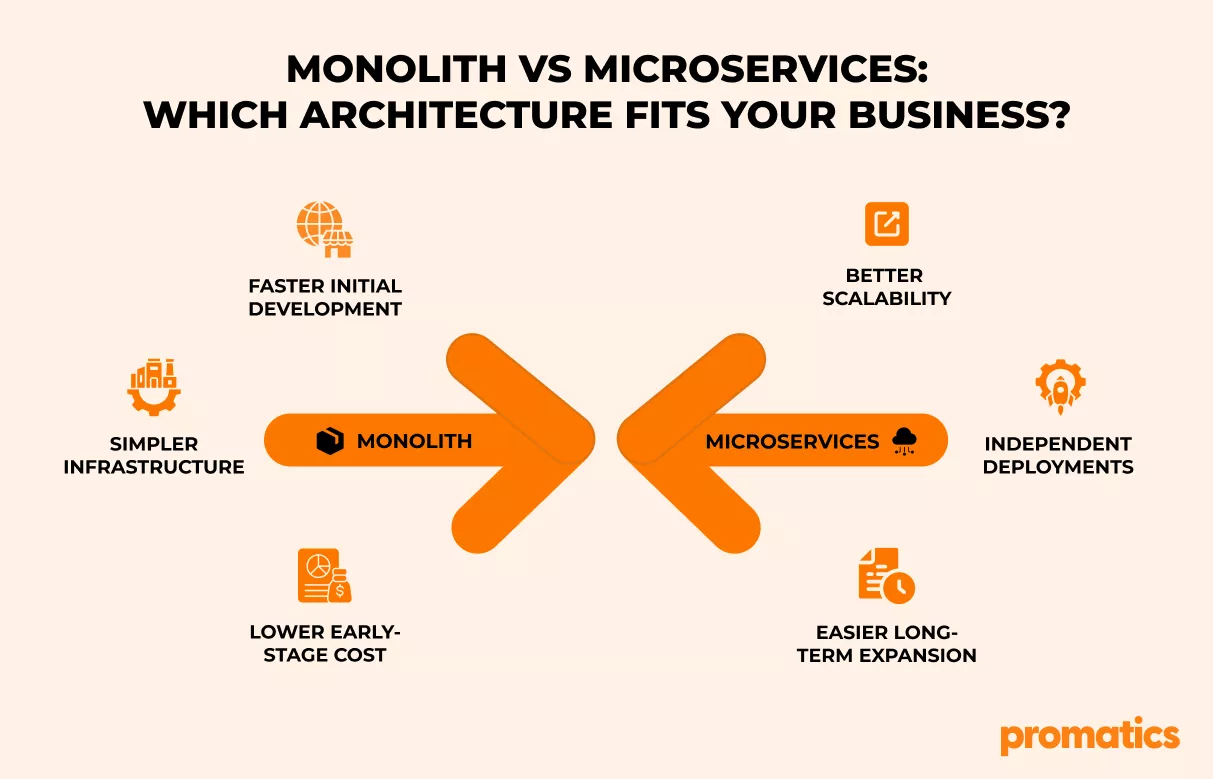
Monolith vs Microservices Architecture: Which is Better for Retail eCommerce Apps?
Choosing the right architecture is important for building scalable and high-performing retail eCommerce applications. While monolithic architecture offers simpler development and deployment, microservices architecture provides greater flexibility and scalability for growing businesses.
| Comparison Factor | Monolithic Architecture | Microservices Architecture |
| Architecture | Single unified codebase | Multiple independent services |
| Development | Faster and simpler initially | More complex setup and management |
| Scalability | Entire application scales together | Services scale independently |
| Deployment | Full application redeployment required | Independent service deployments |
| Maintenance | Becomes difficult as the app grows | Easier long-term maintenance |
| Performance | Harder to optimize individual modules | Specific services can be optimized separately |
| Technology Stack | Usually limited to one stack | Supports multiple technologies |
| Fault Isolation | One issue can affect the full system | Issues remain isolated to individual services |
| Infrastructure | Simpler infrastructure management | Requires advanced cloud and DevOps setup |
| Development Cost | Lower initial cost | Higher setup and operational cost |
Which Architecture Should You Choose?
- Monolithic architecture is suitable for startups, MVPs, and small eCommerce businesses looking for faster development and lower initial costs.
- Microservices architecture is better for enterprise eCommerce platforms that require scalability, high availability, AI integrations, and frequent feature updates.
As retail eCommerce platforms continue to scale, many businesses are increasingly adopting microservices architecture to support long-term flexibility, performance optimization, and omnichannel commerce experiences.
Choosing the Right Tech Stack for eCommerce App Development
The technology stack plays a major role in the performance, scalability, security, and flexibility of an eCommerce application. A well-planned stack helps businesses manage high traffic, secure transactions, real-time inventory, and seamless shopping experiences across web and mobile platforms.
| Technology Area | Common Technologies | Purpose |
| Frontend Development | React.js, Next.js, Vue.js, Angular | Build responsive and interactive user interfaces. |
| Mobile App Development | Flutter, React Native, Swift, Kotlin | Develop Android and iOS mobile applications. |
| Backend Development | Node.js, Python, Java, PHP | Manage APIs, authentication, and business logic. |
| Database Management | MySQL, PostgreSQL, MongoDB, Firebase | Store product, customer, and transaction data. |
| Cloud Infrastructure | AWS, Google Cloud, Microsoft Azure | Support hosting, scalability, and application availability. |
| API Integration | REST APIs, GraphQL | Connect frontend, backend, and third-party services. |
| Payment Integration | Stripe, PayPal, Razorpay | Enable secure online payment processing. |
| Search & Recommendations | Elasticsearch, Algolia | Improve product search and recommendations. |
| Security Technologies | SSL, JWT, OAuth, 2FA | Protect customer accounts and payment data. |
| Analytics & Tracking | Google Analytics, Mixpanel, Firebase Analytics | Track user behavior and business performance. |
| DevOps & Deployment | Docker, Kubernetes, Jenkins | Automate deployment and infrastructure management. |
| AI & Automation | OpenAI APIs, TensorFlow, AI Chatbots | Support personalization and automation features. |
Choosing the Right Stack
The ideal tech stack depends on business goals, scalability needs, budget, and required features. Startups often prefer lightweight and faster development stacks, while enterprise eCommerce platforms usually require scalable cloud infrastructure, microservices, and AI-powered systems for long-term growth.
Core APIs That Drive Modern eCommerce Applications
APIs (Application Programming Interfaces) are the backbone of modern eCommerce applications. They allow different systems, services, and platforms to communicate with each other seamlessly. From product management and payments to shipping and analytics, APIs help businesses deliver smooth, scalable, and connected shopping experiences across web and mobile platforms.
Modern retail eCommerce apps commonly use REST APIs and GraphQL APIs to support real-time communication, third-party integrations, and omnichannel operations.
Product APIs
Product APIs manage product details such as names, descriptions, pricing, categories, and images. They help keep product information consistent across websites, mobile apps, and marketplaces.
Authentication APIs
Authentication APIs handle user registration, login, password management, and account security. These APIs help maintain secure customer access and personalized user experiences.
Cart & Checkout APIs
These APIs manage shopping carts, checkout workflows, saved addresses, and order summaries to simplify the purchasing process and improve conversions.
Payment Gateway APIs
Payment APIs connect the platform with services such as Stripe, PayPal, and Razorpay to process secure online transactions and support multiple payment methods.
Inventory Management APIs
Inventory APIs synchronize stock availability, warehouse updates, and product quantities in real time to prevent overselling and maintain accurate inventory data.
Order Management APIs
These APIs manage order processing, status tracking, invoices, returns, and fulfillment workflows to improve operational efficiency.
Shipping & Logistics APIs
Shipping APIs integrate courier and logistics services to provide real-time delivery tracking, shipping calculations, and automated order updates.
Search & Recommendation APIs
Search APIs improve product discovery through faster search results, filters, autocomplete suggestions, and personalized recommendations.
Analytics APIs
Analytics APIs collect customer behavior, sales, and engagement data to help businesses improve marketing performance and decision-making.
Third-Party Integration APIs
These APIs connect eCommerce platforms with CRM systems, ERP software, marketing tools, and external services to create a more connected commerce ecosystem.
Why APIs Matter in eCommerce
Well-designed APIs improve scalability, simplify integrations, and support faster feature development. As modern eCommerce platforms continue to evolve, APIs play a major role in enabling flexible architectures, omnichannel experiences, AI integrations, and real-time commerce operations.
Building a Strong Database Architecture for eCommerce Apps
Database design plays a major role in the performance, scalability, and reliability of an eCommerce application. A well-structured database helps businesses manage products, customers, inventory, orders, payments, and analytics efficiently while ensuring fast and secure access to data.
Modern retail eCommerce platforms often use a combination of SQL and NoSQL databases to handle both structured and flexible data requirements.
Product Database
Product databases store information such as product names, pricing, descriptions, images, categories, and specifications. This helps maintain organized and accurate product catalogs across the platform.
Customer Database
Customer databases manage user profiles, addresses, preferences, and purchase history to support personalized shopping experiences and account management.
Inventory Database
Inventory databases track stock availability, warehouse updates, and product quantities in real time to improve inventory accuracy and prevent overselling.
Order Management Database
These databases store order details, invoices, payment records, delivery status, and return information to support smooth order processing and tracking.
Payment Data Management
Payment databases securely manage transaction records and payment confirmations to support reliable and secure online payment processing.
Analytics & Reporting Data
Analytics databases collect sales, customer behavior, and performance data to support reporting, forecasting, and business intelligence strategies.
Search & Recommendation Data
Search and recommendation systems store user interactions, browsing history, and recommendation data to improve product discovery and personalization features.
Common Databases Used in eCommerce
Modern eCommerce applications commonly use:
- MySQL & PostgreSQL for transactional and structured data
- MongoDB for flexible product catalogs
- Redis for caching and high-speed data access
- Firebase for real-time synchronization
Why Database Architecture Matters
A strong database architecture improves application speed, scalability, and operational efficiency. As eCommerce businesses grow, efficient data management becomes essential for handling large product catalogs, customer interactions, transactions, and real-time operations across multiple platforms.
Smart Search & Product Discovery in eCommerce Apps
Search and product discovery systems help customers find relevant products quickly and improve overall shopping experiences. Modern eCommerce platforms use AI-powered search, filters, and personalized recommendations to increase engagement, product discovery, and conversion rates.
| Component | Role in eCommerce Applications |
| Product Search Engine | Helps users search products using keywords, categories, and product attributes. |
| Advanced Filters & Sorting | Allows filtering by price, brand, ratings, size, color, and availability. |
| Autocomplete & Suggestions | Provides real-time search suggestions for faster product discovery. |
| AI-Powered Recommendations | Suggests products based on browsing behavior and purchase history. |
| Personalized Discovery | Displays customized product recommendations for individual users. |
| Visual Search | Enables users to search products using images instead of text. |
| Voice Search Integration | Supports voice-based product searches on mobile and smart devices. |
| Trending & Popular Products | Highlights best-selling and trending products to improve engagement. |
Caching Strategy for High Performance
Caching is a critical performance optimization technique in eCommerce application development that helps reduce server load, improve response times, and deliver faster user experiences. In high-traffic retail eCommerce platforms, caching allows frequently accessed data such as product pages, search results, pricing, and user sessions to be stored temporarily for quicker retrieval instead of repeatedly querying the database.
An effective caching strategy improves scalability, enhances application speed, and ensures seamless shopping experiences during peak traffic periods like festive sales and promotional campaigns.
| Caching Type | Description | Importance in eCommerce Applications |
| Browser Caching | Stores static resources like images, CSS, and JavaScript files in the user’s browser. | Reduces page load times and improves frontend performance. |
| Server-Side Caching | Temporarily stores frequently requested data on the server. | Minimizes database queries and improves backend efficiency. |
| Database Caching | Caches frequently accessed database queries and records. | Accelerates product retrieval and order processing. |
| CDN (Content Delivery Network) Caching | Distributes cached content across global servers. | Improves website speed and reduces latency for global users. |
| Application-Level Caching | Stores business logic and computed results within the application layer. | Enhances API and application response times. |
| Session Caching | Stores temporary user session data such as carts and login sessions. | Improves customer experience during browsing and checkout. |
| Search Result Caching | Saves frequently searched product queries and filters. | Delivers faster search experiences and reduces processing time. |
Event-Driven Architecture
Event-driven architecture is a modern software design approach where different services and components communicate through events in real time. Instead of relying on tightly connected systems, applications react to specific actions or “events” such as order placement, payment confirmation, inventory updates, or shipment tracking.
In retail eCommerce applications, event-driven architecture helps improve scalability, flexibility, and responsiveness by enabling systems to process actions asynchronously and independently.
| Component | Description | Role in eCommerce Applications |
| Event Producers | Services that generate events when an action occurs. | Example: Order service generating an “Order Placed” event after checkout. |
| Event Consumers | Services that respond to generated events. | Example: Inventory and shipping services reacting to order events. |
| Event Broker / Message Queue | Middleware that manages event communication between services. | Ensures reliable and real-time data exchange across systems. |
| Asynchronous Processing | Tasks are processed independently without waiting for immediate responses. | Improves application speed and reduces system bottlenecks. |
| Real-Time Notifications | Sends instant updates to customers and internal systems. | Enables live order tracking, payment alerts, and inventory updates. |
| Workflow Automation | Automatically triggers connected processes after an event occurs. | Simplifies order fulfillment and customer communication. |
Payment System Architecture
Payment system architecture is the backbone of any retail eCommerce application because it ensures secure, fast, and reliable online transactions. From processing customer payments to managing fraud detection and transaction verification, a well-designed payment infrastructure directly impacts customer trust, checkout experience, and overall business revenue.
Modern eCommerce platforms are expected to support multiple payment methods, real-time transaction processing, subscription billing, and global payment operations while maintaining the highest security standards.
Key Components of Payment System Architecture
Payment Gateway Integration
Payment gateways such as Stripe, PayPal, and Razorpay are integrated to process online payments securely. These gateways handle payment authorization and transaction communication between the customer and the bank.
Checkout System
The checkout flow manages the final purchase process, including cart review, address details, shipping options, and payment confirmation. A simple and fast checkout process helps improve conversions and reduce cart abandonment.
Transaction Management
This component records payment details, invoices, refunds, and transaction history. It helps businesses manage payment operations and customer support more effectively.
Multi-Payment Method Support
Modern eCommerce applications usually support various payment options such as:
- Credit & Debit Cards
- UPI Payments
- Digital Wallets
- Net Banking
- Buy Now Pay Later (BNPL)
Providing multiple payment methods improves customer convenience and flexibility.
Security & Fraud Prevention
Payment systems use encryption, tokenization, and authentication methods to protect customer payment information. Fraud detection systems also help identify suspicious transactions and reduce security risks.
Technologies Commonly Used
Some commonly used technologies and services in payment system architecture include:
- Stripe
- PayPal
- Razorpay
- SSL/TLS Encryption
- PCI DSS Compliance
- Tokenization Systems
Best Practices for Payment Architecture
- Use secure payment gateways and encrypted communication.
- Keep the checkout process simple and user-friendly.
- Support multiple payment options for different customer preferences.
- Implement fraud detection and authentication mechanisms.
- Ensure scalability to handle high transaction volumes during peak sales periods.
- Maintain compliance with payment security standards.
A reliable payment system architecture helps create secure and seamless shopping experiences for customers while supporting efficient transaction management for businesses. As eCommerce platforms continue to grow, payment systems are becoming more flexible, scalable, and integrated with modern digital payment technologies.
Inventory Management Systems
Inventory management systems are responsible for monitoring product availability, tracking stock movement, and ensuring smooth order fulfillment across eCommerce platforms. In retail eCommerce applications, inventory management directly affects customer experience because inaccurate stock information can lead to canceled orders, delayed deliveries, and operational inefficiencies.
Modern eCommerce businesses often manage inventory across multiple warehouses, online stores, and marketplaces, making real-time inventory synchronization essential.
Core Features of an Inventory Management System
Real-Time Inventory Tracking
Whenever a customer places an order, returns a product, or inventory is restocked, the system automatically updates stock availability. This ensures customers always see accurate product availability across websites and mobile apps.
Multi-Warehouse Management
Retail businesses often store products in different warehouses or fulfillment centers. Inventory systems help distribute stock efficiently and optimize delivery operations based on location and product availability.
Automated Stock Alerts
Inventory platforms can automatically notify businesses when product quantities fall below a certain level. This helps prevent stockouts and supports timely restocking decisions.
Product & Order Synchronization
Inventory systems are closely connected with product catalogs and order management systems. Once an order is confirmed, stock levels are instantly adjusted to maintain consistency across all sales channels.
Returns & Restocking
Modern systems also manage returned products by updating stock levels after inspection and restocking processes.
Key Considerations for eCommerce Inventory Systems
Instead of relying on manual inventory handling, modern retail businesses increasingly automate stock management to improve efficiency and reduce operational errors.
Some important considerations include:
- Real-time synchronization across platforms
- Support for omnichannel inventory management
- Integration with shipping and logistics systems
- Inventory forecasting and analytics
- Scalable infrastructure for growing product catalogs
Security Best Practices
Security is one of the most critical aspects of eCommerce application development because these platforms handle sensitive customer information, payment data, and business transactions daily. A secure eCommerce application helps protect users from data breaches, fraud, unauthorized access, and cyberattacks while also maintaining customer trust and regulatory compliance.
As retail eCommerce platforms continue to grow, businesses must implement strong security practices across applications, databases, APIs, payment systems, and cloud infrastructure.
Secure User Authentication
User authentication systems should include strong password policies, encrypted credential storage, and multi-factor authentication (MFA) to reduce the risk of unauthorized access. Many modern eCommerce applications also use OAuth and JWT-based authentication for secure session management.
Data Encryption
Sensitive information such as customer details, login credentials, and payment data should always be encrypted both during transmission and storage. SSL/TLS encryption helps secure communication between users and servers, while database encryption protects stored information from unauthorized access.
Secure Payment Processing
Payment systems should follow PCI DSS compliance standards to ensure secure handling of cardholder data. Businesses should also use tokenization techniques to avoid storing sensitive payment information directly on their servers.
API Security
Since modern eCommerce applications rely heavily on APIs, securing API endpoints is essential. Proper authentication, rate limiting, API gateways, and access control mechanisms help prevent misuse and unauthorized data access.
Protection Against Common Cyber Threats
eCommerce platforms are frequent targets for attacks such as:
- SQL Injection
- Cross-Site Scripting (XSS)
- Distributed Denial-of-Service (DDoS)
- Brute Force Attacks
- Credential Stuffing
Implementing firewalls, input validation, request filtering, and monitoring systems helps reduce these risks.
Infrastructure & Cloud Security
Cloud infrastructure should be configured with proper access controls, network security policies, and continuous monitoring systems. Businesses should also regularly update servers, frameworks, and third-party libraries to patch security vulnerabilities.
Regular backups and disaster recovery planning are also important to protect against unexpected failures or cyber incidents.
Best Practices for eCommerce Application Security
Use Role-Based Access Control
Restrict system access based on user roles and responsibilities to reduce internal security risks.
Perform Regular Security Audits
Frequent vulnerability testing and penetration testing help identify security weaknesses before attackers can exploit them.
Monitor Suspicious Activities
Real-time monitoring systems can detect unusual login attempts, fraudulent transactions, and abnormal traffic behavior.
Keep Software Updated
Outdated plugins, frameworks, and dependencies often create security vulnerabilities. Regular updates help maintain application security.
Educate Teams on Security Practices
Development and operational teams should follow secure coding standards and security-first development practices.
Importance of Security in eCommerce Applications
Security directly impacts customer trust, business reputation, and long-term platform reliability. Even a small security breach can lead to financial losses, operational disruptions, and customer dissatisfaction.
As eCommerce ecosystems become more connected through APIs, cloud infrastructure, and third-party integrations, implementing strong security practices is no longer optional. Businesses must continuously invest in proactive security strategies to protect both customer data and digital commerce operations.
Performance Optimization Techniques
Performance optimization is essential for building fast, responsive, and scalable eCommerce applications. Slow-loading pages, delayed search results, or lag during checkout can negatively affect user experience and increase cart abandonment rates. In retail eCommerce, even small performance improvements can significantly impact customer engagement, conversions, and retention.
Modern eCommerce platforms use a combination of frontend, backend, database, and infrastructure optimization techniques to maintain smooth performance under high traffic conditions.
Frontend Optimization
Frontend optimization focuses on improving how quickly content loads and becomes interactive for users.
Some commonly used techniques include:
- Compressing and optimizing images
- Minifying CSS, JavaScript, and HTML files
- Lazy loading images and product content
- Using browser caching for static assets
- Reducing unnecessary third-party scripts
Frameworks like React.js and Next.js are also widely used to improve rendering performance and page speed.
Backend Performance Improvements
Backend optimization ensures the application can process requests efficiently, especially during high-traffic periods.
Important backend optimization strategies include:
- Implementing caching systems like Redis
- Optimizing API response times
- Using asynchronous processing for background tasks
- Load balancing across multiple servers
- Reducing unnecessary database queries
Microservices and event-driven architectures are also commonly used to improve scalability and system efficiency.
Database Optimization
Databases play a major role in overall application performance because they handle products, orders, customer information, and transactions.
Key database optimization techniques include:
- Database indexing for faster queries
- Query optimization
- Database sharding for scalability
- Read replicas for handling high traffic
- Efficient schema design and normalization
Using in-memory databases and caching layers can further reduce database load.
CDN & Caching Strategies
Content Delivery Networks (CDNs) distribute static assets across global servers to reduce latency and improve loading speed for users in different locations.
Caching techniques help store frequently accessed data temporarily, reducing server requests and improving response times. Common caching approaches include:
- Browser caching
- Server-side caching
- API caching
- Search result caching
Technologies such as Cloudflare, Redis, and Varnish are often used for performance optimization.
Mobile Performance Optimization
Since a large portion of eCommerce traffic comes from mobile devices, mobile optimization is equally important.
Best practices include:
- Responsive design implementation
- Lightweight mobile interfaces
- Faster mobile API responses
- Optimized media delivery
- Reducing app startup time
Monitoring & Performance Testing
Continuous monitoring helps businesses identify bottlenecks and maintain application stability.
Performance monitoring tools commonly used in eCommerce applications include:
- Google Lighthouse
- New Relic
- Datadog
- GTmetrix
- Apache JMeter
Regular load testing and stress testing help ensure the application performs well during peak traffic periods and large-scale sales events.
Scalability Strategies
Scalability is an important aspect of eCommerce application development because retail platforms often experience changing traffic patterns, growing product catalogs, and increasing transaction volumes over time. A scalable architecture ensures that the application can handle higher workloads without affecting performance, reliability, or user experience.
As businesses expand, scalability becomes essential for supporting more customers, additional services, and larger operational requirements across web and mobile platforms.
Horizontal vs. Vertical Scaling
There are two common approaches to application scaling:
- Vertical Scaling
Vertical scaling increases the power of an existing server by adding more CPU, memory, or storage resources. This approach is simpler initially but has hardware limitations over time.
- Horizontal Scaling
Horizontal scaling distributes workloads across multiple servers or instances. This method is more flexible and is commonly used in modern cloud-based eCommerce systems to handle high traffic efficiently.
Microservices-Based Scalability
Many modern eCommerce applications use microservices architecture to improve scalability. Instead of scaling the entire application, businesses can scale individual services independently based on demand.
For example:
- Product search services can scale during high browsing activity
- Payment services can scale during checkout spikes
- Recommendation engines can scale separately during promotional campaigns
This approach improves resource utilization and operational flexibility.
Cloud Infrastructure & Auto Scaling
Cloud platforms such as AWS, Google Cloud, and Microsoft Azure provide scalable infrastructure that automatically adjusts resources based on traffic and usage patterns.
Auto-scaling systems help:
- Manage traffic spikes during sales events
- Reduce downtime risks
- Optimize infrastructure costs
- Maintain application performance during peak demand
Cloud-native deployments also improve global accessibility and application availability.
Database Scalability
As eCommerce platforms grow, databases must efficiently manage increasing volumes of products, users, and transactions.
Common database scaling strategies include:
- Database sharding
- Read replicas
- Query optimization
- Distributed databases
- In-memory caching systems like Redis
These techniques help reduce database bottlenecks and improve response times.
Load Balancing & Traffic Distribution
Load balancers distribute incoming traffic across multiple servers to prevent overloading any single instance. This improves:
- Application availability
- Performance stability
- Fault tolerance
- User experience during traffic surges
Load balancing is especially important during seasonal sales, flash deals, and high-traffic campaigns.
Caching for Scalability
Caching helps reduce repeated database and API requests by temporarily storing frequently accessed data.
Common caching strategies include:
- Product page caching
- Search result caching
- Session caching
- CDN-based content caching
Efficient caching reduces server load and improves scalability across large user bases.
Event-Driven & Asynchronous Processing
Background tasks such as email notifications, payment confirmations, and inventory updates can be processed asynchronously using event-driven systems and message queues.
This reduces system congestion and improves application responsiveness during heavy operational workloads.
Technologies commonly used include:
- Apache Kafka
- RabbitMQ
- AWS SQS
- Redis Pub/Sub
DevOps & Deployment Strategy
DevOps and deployment strategies play an important role in modern eCommerce application development by improving collaboration between development and operations teams, automating deployment processes, and ensuring faster software delivery. In retail eCommerce platforms, where frequent updates, feature releases, and high availability are essential, a strong DevOps approach helps maintain application stability and operational efficiency.
A well-planned deployment strategy also reduces downtime, improves scalability, and enables businesses to respond quickly to changing customer and market requirements.
Role of DevOps in eCommerce Applications
DevOps focuses on automating development, testing, deployment, and infrastructure management processes. This helps teams release updates more efficiently while maintaining application reliability.
In eCommerce platforms, DevOps practices support:
- Faster feature releases
- Continuous application monitoring
- Improved collaboration between teams
- Automated testing and deployment
- Better scalability and infrastructure management
Continuous Integration & Continuous Deployment (CI/CD)
CI/CD pipelines automate the process of building, testing, and deploying applications.
Continuous Integration (CI)
CI ensures that developers can frequently merge code changes into a shared repository while automated testing verifies code quality and stability.
Continuous Deployment (CD)
CD automates the release process, allowing updates and new features to be deployed quickly with minimal manual intervention.
CI/CD pipelines help reduce deployment errors and improve release efficiency, especially for large eCommerce platforms with frequent updates.
Common CI/CD tools include:
- Jenkins
- GitHub Actions
- GitLab CI/CD
- CircleCI
- Azure DevOps
Containerization & Orchestration
Modern eCommerce applications often use containers to package applications and dependencies into lightweight, portable environments.
Docker
Docker helps maintain consistent environments across development, testing, and production systems.
Kubernetes
Kubernetes manages container orchestration, scaling, load balancing, and service deployment across distributed infrastructure.
Containerization improves scalability, deployment consistency, and infrastructure management efficiency.
Cloud-Based Deployment
Most modern eCommerce platforms use cloud infrastructure for flexible and scalable deployments.
Popular cloud platforms include:
- AWS
- Google Cloud Platform
- Microsoft Azure
Cloud deployments help businesses:
- Scale resources dynamically
- Improve application availability
- Reduce infrastructure management overhead
- Support global traffic distribution
Monitoring & Infrastructure Management
Continuous monitoring helps teams identify performance issues, server bottlenecks, and operational failures before they affect users.
Monitoring tools commonly used in eCommerce environments include:
- Datadog
- New Relic
- Prometheus
- Grafana
Infrastructure as Code (IaC) tools such as Terraform and Ansible are also widely used to automate infrastructure provisioning and configuration management.
Deployment Best Practices
Automate Testing
Automated testing helps identify bugs and compatibility issues before deployment.
Use Blue-Green or Canary Deployments
These deployment strategies reduce downtime and minimize risks during application updates.
Maintain Rollback Mechanisms
Rollback systems allow teams to quickly restore previous versions if deployment issues occur.
Ensure Security in Deployment Pipelines
Secure access controls, encrypted secrets management, and vulnerability scanning help protect deployment environments.
Monitor Application Performance Continuously
Ongoing monitoring helps maintain stable application performance after deployments.
Monitoring & Observability
Monitoring and observability are essential for maintaining the performance, reliability, and stability of modern eCommerce applications. Since retail eCommerce platforms handle continuous user activity, transactions, API requests, and third-party integrations, businesses need real-time visibility into system performance and operational health.
These practices help development and operations teams identify issues quickly, reduce downtime, optimize system performance, and improve customer experiences.
What is Monitoring?
Monitoring focuses on tracking predefined system metrics and operational data such as:
- Server performance
- API response times
- Database usage
- Application uptime
- Traffic spikes
- Error rates
Monitoring tools continuously collect this information and generate alerts when abnormal behavior or performance issues occur.
For example, if checkout response times suddenly increase during a sale event, monitoring systems can notify teams before the issue affects a large number of customers.
What is Observability?
Observability goes beyond basic monitoring by helping teams understand why an issue is happening. It provides deeper insights into application behavior using:
- Logs
- Metrics
- Distributed tracing
Observability helps teams analyze complex systems, especially in microservices-based eCommerce architectures where multiple services communicate with each other.
Key Components of Observability
Logs
Logs record detailed application events, user actions, system errors, and operational activities. They help developers troubleshoot issues and investigate failures.
Metrics
Metrics provide measurable performance data such as CPU usage, memory consumption, API latency, and request volumes.
Distributed Tracing
Tracing tracks how requests move across different services and APIs. This is especially useful for identifying bottlenecks in microservices environments.
Why Monitoring Matters in eCommerce Applications
Retail eCommerce platforms require continuous monitoring because even minor performance issues can affect customer experiences and sales.
Effective monitoring helps businesses:
- Detect system failures early
- Reduce downtime
- Improve application performance
- Identify infrastructure bottlenecks
- Maintain stable checkout experiences
- Monitor payment and transaction systems
- Handle traffic spikes during seasonal sales
Common Monitoring & Observability Tools
Modern eCommerce applications commonly use tools such as:
- Datadog
- New Relic
- Grafana
- Prometheus
- ELK Stack (Elasticsearch, Logstash, Kibana)
- Splunk
- OpenTelemetry
These tools provide dashboards, alerting systems, log management, and performance analytics for better operational visibility.
Testing Strategy
Testing is an essential part of eCommerce application development because it helps ensure that the platform performs reliably across different devices, browsers, user flows, and traffic conditions. Since eCommerce applications handle product browsing, user authentication, payments, and order processing, even small issues can directly affect customer experience and business operations.
A strong testing strategy helps identify bugs early, improve application stability, and reduce deployment risks during updates or feature releases.
Functional Testing
Functional testing verifies whether application features work as expected. This includes testing core functionalities such as:
- User registration and login
- Product search and filtering
- Cart and checkout workflows
- Payment processing
- Order management
- Wishlist and recommendation features
The goal is to ensure that every feature performs correctly from the user’s perspective.
Performance Testing
Retail eCommerce platforms often experience high traffic during sales campaigns and festive seasons. Performance testing helps evaluate how the application behaves under different traffic conditions.
This includes:
- Load testing
- Stress testing
- Scalability testing
- Response time analysis
Performance testing helps identify bottlenecks before they affect real users.
Security Testing
Since eCommerce applications process sensitive customer and payment information, security testing is critical.
Security testing focuses on:
- Authentication and authorization checks
- Payment security validation
- API security testing
- Vulnerability scanning
- Protection against SQL injection and XSS attacks
Regular security testing helps reduce the risk of data breaches and cyber threats.
UI/UX Testing
UI and UX testing ensure that the application interface remains user-friendly and responsive across devices and browsers.
This includes testing:
- Mobile responsiveness
- Navigation flows
- Page layouts
- Form interactions
- Accessibility standards
A smooth and intuitive interface improves customer engagement and reduces friction during shopping.
API Testing
Modern eCommerce platforms rely heavily on APIs for communication between services, mobile apps, payment gateways, and third-party integrations.
API testing verifies:
- API response accuracy
- Authentication mechanisms
- Error handling
- Data consistency
- Response performance
This is especially important in microservices-based architectures.
Automation Testing
Automation testing helps speed up repetitive testing tasks and improves testing efficiency during continuous deployments.
Automated tests are commonly used for:
- Regression testing
- Smoke testing
- API testing
- Checkout workflows
- Cross-browser testing
Popular testing automation tools include Selenium, Cypress, Playwright, and Postman.
Cross-Platform & Device Testing
eCommerce users access platforms through multiple devices, browsers, and operating systems. Cross-platform testing ensures consistent performance and functionality across:
- Android and iOS devices
- Desktop and mobile browsers
- Different screen sizes and resolutions
Common Offline Features in eCommerce Apps
Offline Product Browsing
Previously viewed products, categories, and images can be stored locally on the device so users can continue browsing without an active internet connection.
Cached Search Results
Frequently searched products and recently viewed items can be cached locally to improve loading speed and accessibility.
Wishlist & Cart Persistence
Items added to carts or wishlists remain stored even if the user loses connectivity temporarily.
Background Synchronization
Once the internet connection is restored, the application automatically syncs user activity, cart updates, and saved preferences with the server.
Push Notifications & Local Storage
Apps can continue displaying scheduled notifications and locally stored content without relying entirely on real-time internet access.
Technologies Used for Offline Support
Modern mobile eCommerce applications use several technologies to implement offline functionality, including:
- Local databases such as SQLite and Realm
- Service Workers for Progressive Web Apps (PWAs)
- IndexedDB for browser-based offline storage
- Firebase Offline Persistence
- Local caching systems in Flutter and React Native apps
These technologies help store and retrieve data efficiently while maintaining synchronization with backend systems.
Best Practices for Offline eCommerce Experiences
Cache Essential Data
Store only important information such as product details, cart data, and recently viewed items to optimize storage efficiency.
Use Background Syncing
Automatically synchronize offline activities once connectivity returns.
Handle Connectivity Changes Gracefully
The app should clearly indicate online and offline states to users without disrupting navigation.
Prioritize Security
Sensitive information such as payment data should never be stored insecurely on local devices.
Optimize Data Synchronization
Efficient synchronization mechanisms help reduce duplicate actions and data conflicts.
Compliance & Regulatory Requirements
Modern eCommerce platforms collect large amounts of customer information, including names, addresses, contact details, and purchase history. Businesses must follow data privacy regulations that govern how this information is collected, stored, and processed.
Some commonly followed regulations include:
- GDPR (General Data Protection Regulation)
- CCPA (California Consumer Privacy Act)
- DPDP Act (India’s Digital Personal Data Protection Act)
These regulations focus on user consent, data transparency, secure storage, and customer rights related to personal information.
Payment Security Compliance
Since eCommerce applications process online payments, they must follow payment security standards to protect financial data.
PCI DSS Compliance
PCI DSS (Payment Card Industry Data Security Standard) helps ensure secure handling of cardholder information during payment processing.
Businesses are generally expected to:
- Encrypt payment data
- Restrict access to sensitive information
- Maintain secure payment environments
- Monitor transaction activity regularly
Consumer Protection Requirements
eCommerce businesses must also comply with consumer protection laws related to:
- Transparent pricing
- Refund and return policies
- Product information accuracy
- Delivery commitments
- Customer support accessibility
Clear communication and transparent policies help improve customer trust and reduce disputes.
Best Practices for Maintaining Compliance
Implement Strong Data Security Measures
Encryption, access control, and secure authentication systems help protect customer information.
Maintain Clear Privacy Policies
Businesses should clearly explain how customer data is collected and used.
Regularly Audit Systems & Processes
Compliance requirements evolve over time, making regular audits and updates important.
Monitor Regulatory Changes
eCommerce regulations can vary across countries and industries, so businesses must stay updated with changing legal requirements.
Work with Certified Payment Providers
Using compliant payment gateways simplifies payment security management and reduces operational complexity.
Analytics & Business Intelligence
Analytics and business intelligence (BI) help eCommerce businesses understand customer behavior, monitor platform performance, and make data-driven decisions. Modern retail eCommerce applications generate large amounts of data from user interactions, product searches, purchases, inventory movement, and marketing campaigns. Proper analytics systems help businesses transform this data into meaningful insights that support growth and operational efficiency.
By using analytics and BI tools, businesses can improve customer experiences, optimize sales strategies, and identify performance trends across web and mobile platforms.
Role of Analytics in eCommerce Applications
Analytics systems collect and process data from different parts of the eCommerce platform, including:
- Website and app traffic
- Customer browsing behavior
- Product performance
- Cart abandonment rates
- Conversion funnels
- Sales and revenue trends
This information helps businesses understand how users interact with the platform and where improvements are needed.
Key Areas of eCommerce Analytics
Customer Behavior Analysis
Businesses can track customer journeys, session duration, product interactions, and purchase patterns to better understand user preferences and improve personalization strategies.
Sales & Revenue Tracking
Analytics platforms monitor revenue performance, average order value, conversion rates, and product sales trends to support business planning and growth decisions.
Marketing Performance Analysis
Marketing analytics help evaluate the effectiveness of campaigns across channels such as search engines, social media, email marketing, and paid advertisements.
Inventory & Product Analytics
Tracking product demand, stock movement, and sales performance helps businesses optimize inventory management and product planning.
Operational Performance Monitoring
Analytics systems also provide insights into application performance, order fulfillment efficiency, and customer service operations.
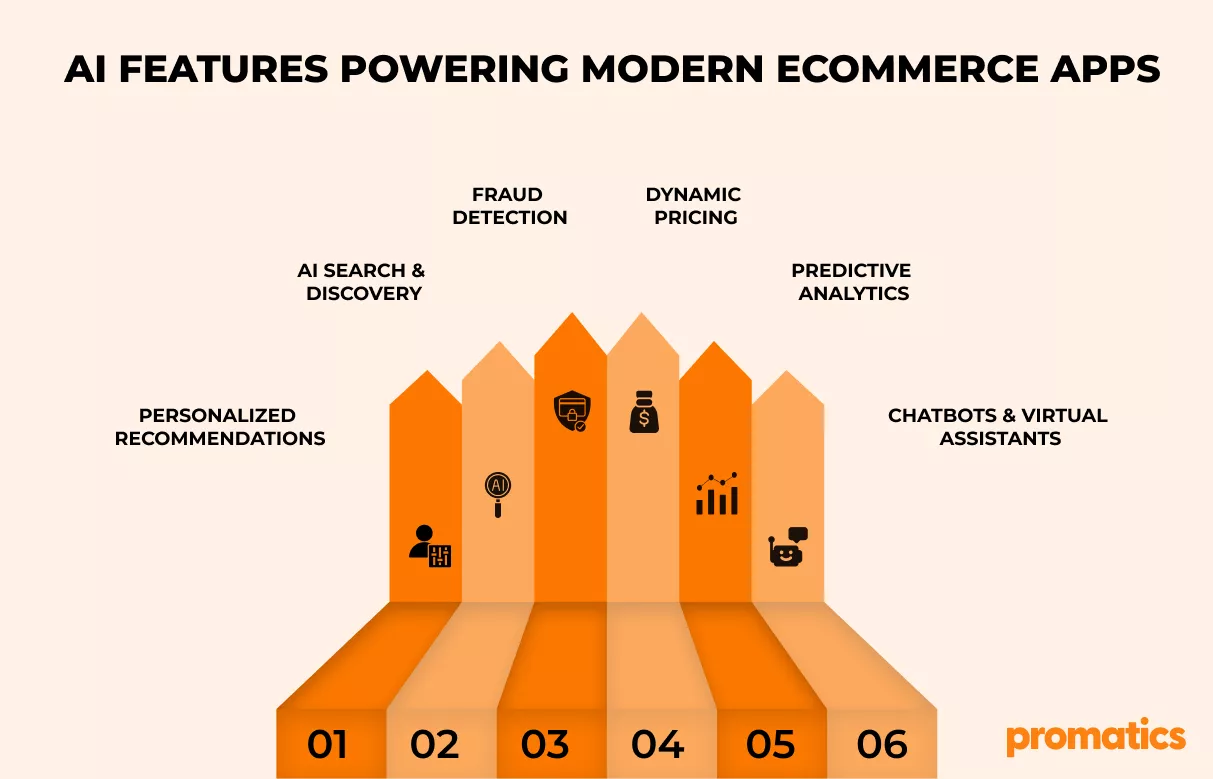
Advanced AI Enhancements in eCommerce Apps
Artificial intelligence is increasingly becoming an important part of modern eCommerce applications. AI technologies help businesses automate operations, improve customer experiences, personalize shopping journeys, and make better business decisions using real-time data and predictive insights.
From intelligent product recommendations to AI-powered customer support, advanced AI capabilities are transforming how users interact with retail eCommerce platforms across web and mobile channels.
Personalized Product Recommendations
AI recommendation engines analyze customer behavior, browsing history, purchase patterns, and preferences to suggest relevant products in real time. Personalized recommendations help improve product discovery, increase engagement, and support cross-selling opportunities.
These recommendation systems are commonly used on:
- Homepage product feeds
- “Recommended for You” sections
- Related product suggestions
- Cart and checkout pages
AI-Powered Search & Discovery
Traditional keyword-based search systems are increasingly being replaced with AI-driven search experiences.
AI-enhanced search systems can:
- Understand natural language queries
- Provide smarter autocomplete suggestions
- Improve search relevance
- Support visual and voice search
- Deliver personalized search results
This helps customers find products more quickly and improves overall shopping experiences.
Chatbots & Virtual Shopping Assistants
AI-powered chatbots and virtual assistants help automate customer support and engagement processes.
These systems can assist users with:
- Product recommendations
- Order tracking
- Frequently asked questions
- Return and refund requests
- Personalized shopping guidance
Modern conversational AI tools can provide 24/7 support while reducing operational workload for customer service teams.
Predictive Analytics & Demand Forecasting
AI models can analyze historical sales data, seasonal trends, and customer behavior patterns to forecast product demand and inventory requirements.
This helps businesses:
- Optimize stock management
- Reduce overstocking and shortages
- Improve supply chain planning
- Predict future purchasing trends
Predictive analytics also supports more informed business decision-making.
Dynamic Pricing Optimization
AI systems can automatically adjust product pricing based on:
- Market demand
- Competitor pricing
- Inventory availability
- Customer behavior
- Seasonal trends
Dynamic pricing strategies help businesses remain competitive while maximizing revenue opportunities.
Fraud Detection & Security
AI-based fraud detection systems help identify suspicious transactions and unusual user behavior in real time.
Machine learning models can detect:
- Payment fraud patterns
- Account takeover attempts
- Abnormal purchasing activity
- Bot-driven attacks
These systems improve payment security while reducing false transaction declines.
Visual Search & Image Recognition
AI-powered visual search allows users to search for products using images instead of text queries.
This is especially useful in categories such as:
- Fashion
- Furniture
- Home décor
- Lifestyle products
Image recognition models help improve product discovery and simplify the shopping process.
AI-Driven Marketing Automation
AI tools also support marketing optimization by analyzing customer engagement and campaign performance.
Businesses use AI for:
- Personalized email campaigns
- Customer segmentation
- Automated retargeting
- Product recommendation ads
- Predictive customer retention strategies
These systems help improve marketing efficiency and customer engagement.
Challenges of AI Integration in eCommerce
While AI offers many benefits, implementation also introduces challenges such as:
- Managing large volumes of data
- Maintaining customer privacy
- Training accurate AI models
- Infrastructure and processing costs
- Avoiding biased recommendations or predictions
Businesses must ensure that AI systems are transparent, secure, and aligned with customer expectations.
Common Challenges in eCommerce App Development
Building a modern eCommerce app involves challenges related to scalability, security, performance, integrations, and evolving customer expectations. To deliver smooth and reliable shopping experiences, businesses need scalable and future-ready solutions, often supported by experienced custom software development companies.
Managing Scalability
One of the biggest challenges in eCommerce app development is handling increasing traffic, growing product catalogs, and rising transaction volumes. During sales events or seasonal campaigns, applications may experience sudden traffic spikes that can affect performance and system stability if the infrastructure is not properly optimized.
Businesses often address this challenge using cloud infrastructure, caching systems, load balancing, and scalable architectures such as microservices.
Maintaining Application Performance
Slow-loading pages, delayed search results, and checkout latency can negatively impact customer experience and conversion rates.
Performance-related challenges commonly include:
- Large product catalogs
- Heavy API requests
- Database bottlenecks
- Poor frontend optimization
- High server load during peak traffic
Continuous performance optimization and monitoring are important for maintaining fast and responsive user experiences.
Ensuring Payment Security
eCommerce platforms process sensitive customer and payment information, making them common targets for cyber threats and fraudulent activities.
Some major security challenges include:
- Payment fraud
- Data breaches
- Unauthorized access
- API vulnerabilities
- Account takeover attempts
Businesses must implement strong authentication systems, encrypted payment processing, fraud detection mechanisms, and compliance standards such as PCI DSS.
Managing Complex Integrations
Modern eCommerce applications often integrate with multiple third-party services such as:
- Payment gateways
- Shipping providers
- CRM systems
- ERP platforms
- Marketing automation tools
- Analytics systems
Managing these integrations while maintaining stable performance and data consistency can become technically complex.
Real-Time Inventory Synchronization
Maintaining accurate inventory information across websites, mobile apps, warehouses, and marketplaces is another major challenge.
Without proper synchronization:
- Overselling may occur
- Customers may see incorrect stock availability
- Order fulfillment issues may increase
Real-time inventory management systems and event-driven architectures help reduce these issues.
Delivering Consistent User Experience
Users expect seamless shopping experiences across mobile apps, websites, tablets, and different browsers.
Challenges often include:
- Responsive design consistency
- Mobile performance optimization
- Cross-platform compatibility
- Simplified navigation and checkout flows
Improving usability and accessibility is important for maintaining customer engagement and retention.
Handling High Development & Maintenance Costs
Building and maintaining scalable eCommerce platforms requires continuous investment in:
- Infrastructure
- Security
- Cloud services
- Feature updates
- Monitoring systems
- Technical support
As platforms grow, operational and maintenance complexity also increases.
Data Management & Analytics Challenges
Large-scale eCommerce applications generate massive amounts of customer, product, and operational data. Managing this data efficiently while maintaining accuracy, security, and real-time accessibility can become difficult.
Businesses also need proper analytics systems to extract meaningful insights from collected data.
Adapting to Changing Customer Expectations
Customer behavior and digital commerce trends continue to evolve rapidly. Businesses must continuously adapt to:
- AI-driven personalization
- Faster delivery expectations
- Omnichannel experiences
- Voice and visual search
- Mobile-first shopping behavior
Keeping up with these expectations requires ongoing technological upgrades and innovation.
Maintenance & Post-Launch Support
Launching an eCommerce application is only the beginning of the development lifecycle. After deployment, continuous maintenance and post-launch support are necessary to ensure stable performance, security, scalability, and smooth user experiences. As customer expectations, technologies, and market trends evolve, eCommerce platforms require regular updates and ongoing optimization.
A strong maintenance strategy helps businesses reduce downtime, fix issues quickly, improve performance, and keep the platform aligned with changing business requirements.
Why Post-Launch Support Matters
After launch, eCommerce applications continue to handle:
- Customer traffic
- Product updates
- Payment transactions
- API integrations
- Security threats
- Feature enhancements
Without proper maintenance, applications may experience performance degradation, security vulnerabilities, compatibility issues, or operational disruptions over time.
Key Areas of eCommerce Maintenance
Performance Monitoring & Optimization
Continuous monitoring helps identify slow-loading pages, server bottlenecks, API delays, and database performance issues. Regular optimization ensures the platform remains fast and responsive as traffic grows.
Security Updates & Vulnerability Fixes
Security threats constantly evolve, making regular security patches and vulnerability management essential. Businesses should continuously update frameworks, plugins, APIs, and server configurations to maintain platform security.
Bug Fixes & Technical Support
Post-launch support teams handle unexpected errors, system failures, checkout issues, and user-reported problems to ensure uninterrupted platform functionality.
Feature Enhancements
As customer expectations change, businesses often introduce new features such as:
- AI-powered recommendations
- New payment methods
- Loyalty programs
- Advanced search capabilities
- Omnichannel integrations
Regular feature improvements help platforms remain competitive.
Infrastructure & Scalability Management
As user traffic and product catalogs increase, infrastructure resources may need upgrades or scaling adjustments. Cloud-based scaling and load balancing help maintain application stability during growth.
Importance of Customer Support
Customer support is also an important part of post-launch operations. Businesses must address:
- Order-related queries
- Payment issues
- Refund and return requests
- Technical support concerns
Providing responsive support improves customer satisfaction and trust.
How Much Does eCommerce App Development Cost?
The cost of eCommerce app development can vary depending on the app’s features, platform requirements, integrations, scalability goals, and overall business complexity. A basic shopping application with standard features generally requires a lower investment, while enterprise-grade platforms with AI capabilities, custom workflows, and advanced integrations demand higher development resources.
On average:
- Basic eCommerce apps may cost around $10,000–$25,000
- Mid-scale platforms typically range between $25,000–$60,000
- Enterprise eCommerce solutions can exceed $100,000+
Some major factors that influence development cost include:
- Custom UI/UX design
- Android and iOS platform support
- Payment gateway integrations
- AI-powered personalization
- Real-time inventory systems
- Third-party API integrations
- Cloud infrastructure and scalability
Many businesses reduce initial costs by starting with an MVP and gradually scaling features based on customer demand and business growth.
For businesses looking to build scalable and modern digital commerce platforms, Promatics Technologies offers expertise in custom eCommerce app development, AI-powered retail solutions, mobile app development, and cloud-native commerce architectures. Businesses can also explore their mobile app development services for building scalable retail applications tailored to evolving digital commerce needs.
Future Trends in eCommerce App Development
The eCommerce industry continues to evolve rapidly as businesses adopt new technologies to improve customer experiences, optimize operations, and support large-scale digital commerce. Modern eCommerce applications are moving beyond traditional online shopping platforms toward more intelligent, personalized, and connected ecosystems.
As customer expectations continue to change, several emerging trends are shaping the future of eCommerce app development.
AI-Driven Personalization
Artificial intelligence is becoming a core part of modern eCommerce platforms. Businesses are increasingly using AI to deliver personalized product recommendations, dynamic pricing, intelligent search experiences, and automated customer interactions.
AI-powered systems help analyze customer behavior in real time, allowing platforms to create more tailored shopping experiences across web and mobile applications.
Conversational Commerce & AI Assistants
Chatbots and virtual shopping assistants are becoming more advanced with generative AI and natural language processing capabilities.
Future eCommerce applications are expected to support:
- AI shopping assistants
- Conversational product discovery
- Voice-based ordering
- Automated customer support
- Personalized buying recommendations
These technologies help simplify customer interactions and improve engagement.
Voice & Visual Search
Traditional text-based search is gradually expanding into voice and image-based product discovery.
Voice commerce allows users to search and place orders using voice assistants, while visual search enables customers to upload images to find similar products.
These features are becoming increasingly important for:
- Fashion retail
- Furniture shopping
- Lifestyle and beauty products
- Mobile commerce experiences
Headless & API-First Commerce
Many businesses are adopting headless commerce architectures where the frontend experience is separated from the backend commerce engine.
This approach provides:
- Greater flexibility in frontend design
- Faster omnichannel deployment
- Easier third-party integrations
- Improved scalability across devices and platforms
API-first development is also becoming standard for supporting connected commerce ecosystems.
Augmented Reality (AR) & Virtual Shopping
AR technologies are improving online shopping experiences by allowing customers to visualize products before purchasing.
Common use cases include:
- Virtual try-ons for fashion and eyewear
- Furniture placement previews
- Cosmetic product simulations
- Interactive product demonstrations
AR helps reduce purchase uncertainty and improve customer confidence.
Faster & Smarter Payment Experiences
Payment systems are evolving toward faster, more seamless checkout experiences.
Emerging trends include:
- One-click checkout
- Embedded finance
- Buy Now Pay Later (BNPL)
- Biometric authentication
- Digital wallets and contactless payments
Reducing friction during checkout remains a major focus for eCommerce businesses.
Omnichannel Commerce
Customers increasingly expect consistent shopping experiences across:
- Websites
- Mobile apps
- Social commerce platforms
- Physical retail stores
- Marketplaces
Future eCommerce applications will continue focusing on unified omnichannel experiences with synchronized inventory, customer profiles, and order management systems.
Sustainable & Ethical Commerce Technologies
Sustainability is becoming an important consideration in retail technology strategies.
Businesses are increasingly adopting:
- Sustainable supply chain tracking
- Eco-friendly packaging insights
- Carbon footprint reporting
- Ethical sourcing transparency
Technology is helping brands provide more visibility into sustainable commerce practices.
Advanced Automation & Predictive Systems
Automation technologies are improving operational efficiency across inventory management, logistics, marketing, and customer engagement.
Future systems will increasingly rely on:
- Predictive demand forecasting
- Automated fulfillment workflows
- AI-driven inventory optimization
- Smart logistics routing
- Autonomous customer engagement systems
These technologies help businesses improve scalability and operational decision-making.
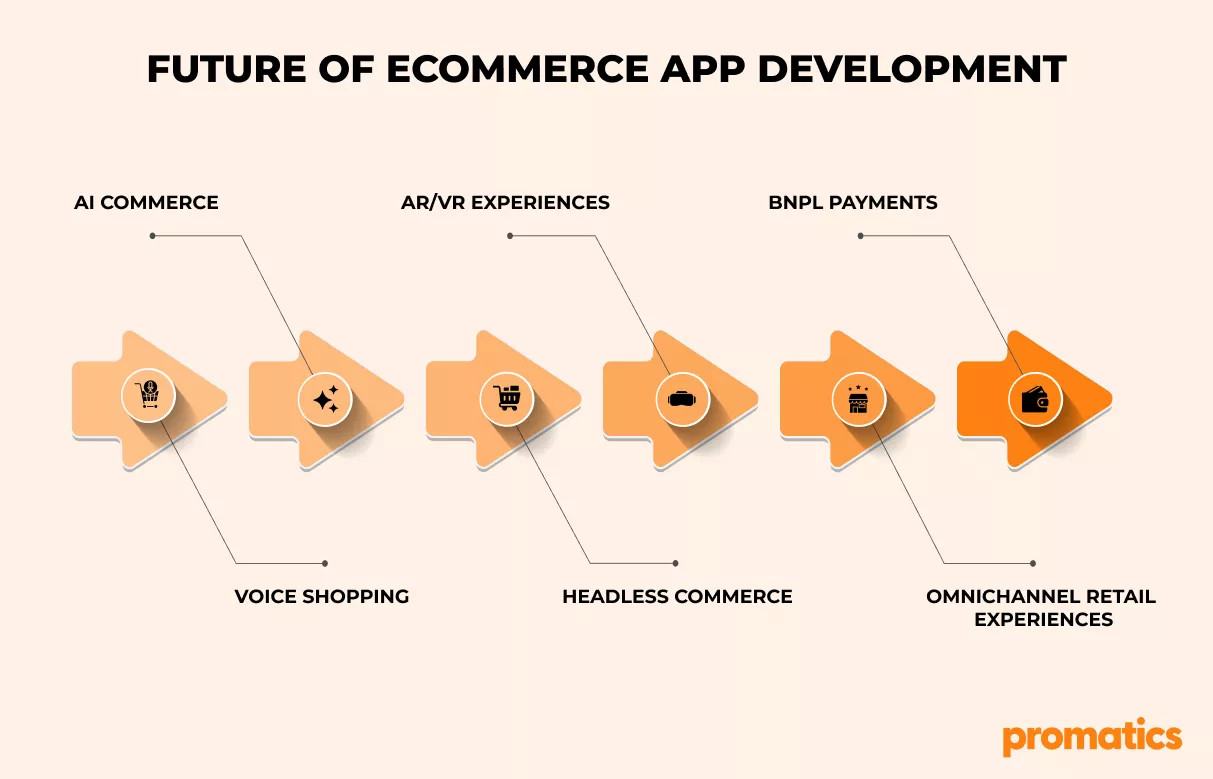
Conclusion
Retail commerce is entering a new era where speed, personalization, AI, and seamless customer experiences define business success. Consumers now shop across mobile apps, websites, social platforms, and marketplaces expecting fast, connected, and intuitive buying journeys at every touchpoint.
For businesses, this shift creates a massive opportunity to build scalable eCommerce platforms that improve customer engagement, increase conversions, and support long-term digital growth.
Whether you are launching a new shopping app, modernizing an existing platform, or building an AI-powered commerce ecosystem, the right technology strategy can directly impact your growth and competitive advantage.
Want to create a scalable, AI-driven, and customer-focused eCommerce platform? Partner with Promatics Technologies and explore their custom eCommerce app development services to build high-performance retail applications designed for modern digital shoppers.
