AI-Powered Quick Commerce App Development: Features, Cost & Tech Stack (Blinkit/Swiggy Model)

TL;DR
- Quick commerce is transforming online shopping with ultra-fast deliveries powered by hyperlocal logistics and automation.
- Platforms like Blinkit, Zepto, and Swiggy Instamart are driving the growing demand for instant delivery experiences.
- Modern quick commerce apps rely on real-time tracking, smart inventory management, AI-driven automation, and scalable cloud infrastructure.
- Building a successful Q-commerce platform requires the right technology stack, seamless logistics, and optimized delivery operations.
- Development costs vary based on app complexity, features, integrations, automation level, and scalability requirements.
Quick commerce is rapidly transforming online shopping as consumers increasingly expect groceries, medicines, and daily essentials to be delivered within minutes. This growing demand has fueled the rise of platforms like Blinkit, Swiggy Instamart, and Zepto, where speed and convenience drive customer loyalty.
The global quick commerce market reached USD 184.55 billion in 2025 and is projected to grow significantly by 2034, driven by rising demand for instant delivery and hyperlocal commerce solutions. India is also emerging as one of the fastest-growing Q-commerce markets due to increasing smartphone adoption and urban lifestyles.
Building a successful quick commerce platform requires more than a basic delivery app. Modern Q-commerce platforms rely on automation, real-time analytics, smart inventory management, route optimization, and scalable cloud infrastructure to deliver seamless customer experiences.
In this blog, we’ll explore quick commerce app development, including key features, development costs, technology stack, AI integrations, and the essential technologies needed to build scalable Blinkit- or Instamart-like delivery platforms.
Quick Commerce Industry Snapshot (2026–2030)
- The global quick commerce market is expected to surpass USD 385 billion by 2034, driven by rising demand for instant delivery services.
- Most leading Q-commerce platforms now target average delivery times of 10–30 minutes in urban markets.
- India is projected to remain one of the fastest-growing quick commerce markets due to rapid smartphone adoption and expanding hyperlocal delivery networks.
- Groceries, medicines, and daily essentials continue to dominate quick commerce orders worldwide.
- AI-powered route optimization is helping platforms reduce delivery delays and improve operational efficiency at scale.
- Hyperlocal dark stores are becoming the backbone of modern quick commerce ecosystems by enabling faster fulfillment.
- By 2030, advanced technologies like predictive analytics, autonomous delivery systems, and smart warehouses are expected to further transform the quick commerce industry.
What is Quick Commerce?
Quick commerce, also known as Q-commerce, is a rapidly growing segment of eCommerce focused on delivering products within minutes instead of days. Unlike traditional online shopping models that rely on scheduled deliveries, Q-commerce platforms are designed for instant fulfillment and convenience-driven purchases.
At its core, Q-commerce operates through hyperlocal delivery networks powered by dark stores, micro-fulfillment centers, and nearby warehouses strategically located close to customers. This infrastructure helps businesses process orders faster, optimize delivery routes, and significantly reduce fulfillment times.
Modern quick commerce platforms rely on technologies like artificial intelligence, real-time analytics, smart inventory management, and route optimization to streamline operations and improve delivery efficiency. These technologies help businesses forecast demand, manage inventory in real time, reduce delays, and create more personalized customer experiences.
Unlike traditional eCommerce platforms that mainly focus on bulk or planned purchases, Q-commerce primarily caters to urgent and high-frequency orders such as groceries, medicines, snacks, beverages, and daily essentials consumers need immediately.
Key Characteristics of Quick Commerce
Ultra-Fast Delivery
Q-commerce platforms are designed to deliver products within 10–60 minutes, offering faster and more convenient shopping experiences.
Hyperlocal Operations
Products are stored in nearby dark stores and micro-fulfillment centers to reduce delivery time and improve operational efficiency.
Small & Frequent Orders
Quick commerce mainly focuses on daily essentials, groceries, snacks, medicines, and other convenience-driven purchases customers need immediately.
Smart Logistics & Automation
Advanced technologies help optimize delivery routes, manage inventory, forecast demand, and streamline real-time operations for faster fulfillment.
Common Use Cases of Quick Commerce
Grocery Delivery
Fresh fruits, vegetables, dairy products, beverages, and pantry essentials delivered within minutes.
Food & Snack Delivery
Ready-to-eat meals, restaurant orders, snacks, and beverages for instant consumption needs.
Daily Essentials
Medicines, toiletries, household products, baby care items, and personal care essentials delivered on demand.
The rapid growth of Q-commerce reflects changing consumer expectations around speed and convenience. What once seemed like a premium service is now becoming a standard part of modern online shopping experiences.
How Quick Commerce Works?
Quick commerce platforms are built to deliver products within minutes using hyperlocal infrastructure, smart logistics, and real-time inventory management. Unlike traditional eCommerce models that rely on centralized warehouses and longer delivery timelines, Q-commerce focuses on speed, operational efficiency, and instant fulfillment.
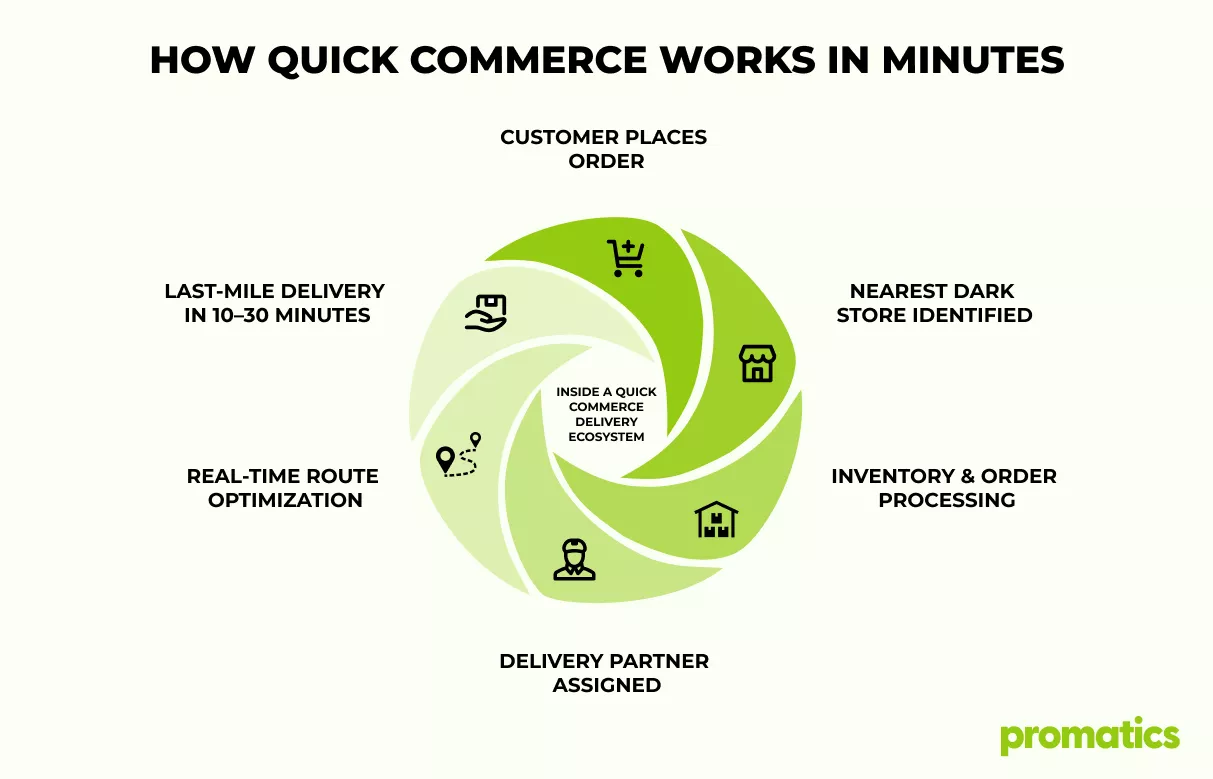
Here’s how a typical quick commerce platform works:
1. Customers Place Orders Through the App
Users browse products, view real-time availability, and place orders through the mobile app. Smart recommendation systems also suggest products based on user behavior, location, and purchase history.
2. The Platform Identifies the Nearest Dark Store
Once the order is placed, the system automatically selects the nearest dark store or fulfillment center with available inventory. The selection is based on factors like:
- Product availability
- Customer location
- Delivery distance
- Rider availability
- Traffic conditions
3. Inventory & Order Processing
Warehouse staff quickly pick, pack, and prepare orders for dispatch. Real-time inventory systems help reduce stock issues, improve warehouse efficiency, and speed up fulfillment operations.
4. Delivery Partner Assignment
The platform assigns the nearest available delivery partner using smart route optimization systems. These systems analyze traffic conditions and delivery distance to identify the fastest route.
5. Last-Mile Delivery
Delivery partners pick up orders from nearby dark stores and complete deliveries within 10–30 minutes, depending on the service area. Customers can track the entire process in real time through GPS-enabled tracking.
6. Continuous Automation & Optimization
Advanced automation helps improve delivery speed, inventory allocation, demand forecasting, personalized recommendations, fraud detection, and operational efficiency in real time.
By combining hyperlocal fulfillment, real-time logistics, and intelligent automation, quick commerce platforms deliver faster shopping experiences while optimizing operational performance.
Quick Commerce vs Traditional Online Shopping: Key Differences Explained
Online shopping has evolved far beyond traditional delivery models. While traditional eCommerce platforms focus on scheduled deliveries and large product catalogs, quick commerce is built for speed, convenience, and instant fulfillment.
Unlike conventional online retail platforms that rely on centralized warehouses and longer shipping timelines, Q-commerce uses hyperlocal dark stores, real-time inventory systems, and smart logistics to deliver products within minutes.
Understanding the differences between these models helps businesses choose the right strategy, infrastructure, and technology stack for their digital commerce goals.
| Factor | Quick Commerce (Q-Commerce) | Traditional eCommerce |
| Delivery Time | 10–60 minutes | 1–7 days |
| Business Model | Instant and convenience-based purchases | Planned and scheduled shopping |
| Inventory Storage | Dark stores and micro-fulfillment centers | Centralized warehouses |
| Order Size | Small and frequent orders | Bulk and larger purchases |
| Product Categories | Groceries, medicines, snacks, essentials | Electronics, fashion, furniture, and more |
| Customer Intent | Urgent and immediate needs | Planned shopping behavior |
| Logistics Approach | Real-time logistics and route optimization | Standard shipping networks |
| Delivery Radius | Hyperlocal service areas | Nationwide or global delivery |
| Technology Dependency | High reliance on automation and real-time tracking | Moderate automation dependency |
| Operational Complexity | Fast inventory turnover and rapid fulfillment | Flexible fulfillment timelines |
| Customer Expectations | Instant delivery and live tracking | Wider product selection and pricing |
| Infrastructure Requirement | Multiple local delivery hubs and dark stores | Large centralized warehouses |
| Common Use Cases | Daily essentials and emergency purchases | Planned and non-urgent purchases |
| Scalability Model | City-by-city hyperlocal expansion | Large-scale centralized expansion |
| Profitability Challenges | Higher last-mile delivery costs | Lower delivery pressure and optimized margins |
Why Is Quick Commerce Gaining Popularity?
Quick commerce is transforming online shopping by making instant delivery a part of everyday life. Consumers now expect groceries, medicines, snacks, and daily essentials to arrive within minutes, not days. What once felt like a premium convenience has quickly become a standard expectation.
Several factors are driving the rapid growth of quick commerce worldwide:
Busy Urban Lifestyles
Modern consumers prefer faster and more convenient shopping experiences that save time and reduce unnecessary store visits.
Rising Smartphone & Internet Usage
Increased smartphone adoption and affordable internet access have made mobile shopping more accessible and convenient than ever.
Growth of Digital Payments
UPI, digital wallets, and online banking have simplified transactions, encouraging faster and more frequent online purchases.
Changing Customer Expectations
Today’s shoppers, especially Gen Z and millennials, prefer instant services, real-time tracking, and on-demand product availability.
Hyperlocal Delivery Networks
Dark stores and micro-fulfillment centers located near customers help businesses reduce delivery times and improve operational efficiency.
Smart Logistics & Automation
Advanced technologies help optimize routes, manage inventory, forecast demand, and streamline delivery operations in real time.
Demand for Instant Convenience
From emergency medicines to late-night grocery orders, consumers increasingly prefer immediate fulfillment over traditional delivery timelines.
As customer expectations continue to evolve, businesses investing in quick commerce solutions can build scalable and future-ready delivery platforms designed for speed, convenience, and operational efficiency.
Key Features of a Quick Commerce App
A successful quick commerce app requires a seamless ecosystem connecting customers, delivery partners, and administrators in real time. From smart product discovery to efficient logistics management, every feature plays a key role in improving customer experiences and operational efficiency.
Below are the essential features businesses should include while developing a modern quick commerce platform.
Customer App Features
User Registration & Secure Login
Simple onboarding with email, mobile number, OTP verification, and social logins ensures faster access and secure authentication.
Smart Product Search & Filters
Advanced search options help users quickly find products using keywords, categories, predictive suggestions, and smart filters.
Personalized Product Recommendations
Recommendation systems analyze browsing behavior and purchase history to display relevant products and improve engagement.
Real-Time Order Tracking
Modern eCommerce app development services focus on real-time tracking, personalized shopping experiences, and seamless checkout systems to improve customer retention. GPS-enabled tracking allows users to monitor orders live, enhancing convenience, transparency, and trust.
Multiple Payment Options
Support for UPI, digital wallets, cards, net banking, and cash on delivery ensures seamless checkout experiences.
Push Notifications
Real-time alerts keep users updated about order status, offers, discounts, and delivery updates.
Ratings & Reviews
Customers can review products and delivery experiences, helping businesses improve service quality and customer trust.
Scheduled & Instant Delivery
Users can choose between scheduled deliveries or ultra-fast instant deliveries based on convenience.
Delivery Partner App Features
Smart Order Assignment
The system automatically assigns orders to nearby delivery partners based on availability and delivery priority.
GPS Navigation & Route Optimization
Integrated navigation helps delivery agents identify the fastest routes while reducing delays and fuel consumption.
Earnings Dashboard
Delivery partners can track earnings, incentives, completed orders, and payout history in real time.
Delivery Status Updates
Delivery agents can update order status instantly, including picked up, on the way, or delivered.
In-App Communication
Built-in chat and calling features enable smooth communication between customers, riders, and support teams.
Admin Panel Features
Inventory Management
Admins can monitor stock levels across dark stores and warehouses in real time to avoid stock shortages.
Order & Delivery Management
Centralized dashboards help manage orders, assign deliveries, and track fulfillment performance efficiently.
Dark Store Management
Businesses can manage multiple dark stores, optimize stock allocation, and improve delivery efficiency.
Analytics & Reporting
Advanced dashboards provide insights into customer behavior, sales performance, delivery metrics, and operational efficiency.
Customer Management
Admins can manage customer profiles, support requests, loyalty programs, and user engagement activities.
Vendor & Pricing Management
The platform allows businesses to manage vendors, supplier inventories, pricing strategies, offers, and promotional campaigns efficiently.
Technology Stack Required for Quick Commerce App Development
Building a scalable quick commerce platform requires a strong technology stack that supports real-time operations, fast deliveries, seamless user experiences, and efficient logistics management. Choosing the right technologies helps businesses improve scalability, performance, security, and operational efficiency.
Below are the core technologies commonly used in modern quick commerce app development.
Frontend Technologies
Frontend technologies help create fast, responsive, and user-friendly mobile experiences across devices and platforms.
Flutter
Businesses often choose cross-platform app development frameworks like Flutter and React Native to reduce development time and launch apps faster.
React Native
React Native supports scalable mobile app development with reusable components and seamless third-party integrations.
Swift (iOS)
Swift is widely used for native iOS app development because of its high performance, security, and smooth Apple ecosystem compatibility.
Kotlin (Android)
Kotlin helps build scalable and stable Android applications with modern architecture and improved app performance.
Backend Technologies
Backend systems manage APIs, databases, authentication, inventory, and real-time order processing.
Node.js
Node.js is ideal for real-time applications and high-traffic platforms due to its fast and event-driven architecture.
Python
Python is commonly used for automation, machine learning, predictive analytics, and backend development.
Java
Java offers enterprise-level scalability, reliability, and security for large-scale commerce platforms.
GoLang
GoLang is known for its speed and concurrency handling, making it suitable for logistics and delivery management systems.
Database Solutions
Databases help manage customer information, product catalogs, inventory, and transactions efficiently.
PostgreSQL
A reliable relational database commonly used for scalable enterprise applications.
MongoDB
A flexible NoSQL database suitable for handling large-scale and dynamic commerce data.
Redis
Redis improves application performance through fast caching and real-time data processing.
Cloud & Infrastructure
Cloud infrastructure ensures scalability, security, and uninterrupted platform performance.
AWS
AWS provides scalable cloud hosting, storage, analytics, and deployment solutions.
Microsoft Azure
Azure offers enterprise-grade cloud infrastructure and AI-powered services.
Google Cloud Platform
Google Cloud supports scalable app hosting, analytics, and machine learning capabilities.
Docker & Kubernetes
These tools simplify container management, DevOps automation, and infrastructure scalability.
AI & Analytics Technologies
Advanced technologies help improve personalization, automation, and operational efficiency.
TensorFlow
Used for machine learning models, recommendation systems, and predictive analytics.
OpenAI APIs
Support intelligent chatbots, smart product search, and conversational shopping experiences.
Machine Learning Frameworks
Help automate demand forecasting, customer segmentation, inventory optimization, and fraud detection.
Real-Time Analytics Tools
Enable businesses to monitor delivery performance, customer behavior, and operational insights instantly.
Third-Party Integrations
Third-party integrations improve platform functionality and streamline operations.
Payment Gateways
Enable secure digital payments through UPI, wallets, cards, and net banking.
Google Maps APIs
Support live tracking, route optimization, and hyperlocal delivery operations.
SMS & Notification Services
Help businesses send OTP verification, delivery updates, and promotional notifications.
CRM & ERP Integrations
Streamline customer management, inventory tracking, vendor operations, and business workflows.
Step-by-Step Process to Build a Quick Commerce App
Building a successful quick commerce platform requires more than just a mobile app. Businesses need the right combination of technology, logistics infrastructure, automation, and user experience to compete in the growing hyperlocal delivery market.
Below is the step-by-step process for building a scalable Blinkit- or Instamart-like quick commerce platform.
1. Market Research & Competitor Analysis
The first step is understanding customer behavior, market demand, and industry trends. Businesses should analyze competitors like Blinkit, Zepto, and Swiggy Instamart to identify pricing strategies, delivery models, customer expectations, and market gaps.
This stage helps define:
- Target audience
- Delivery locations
- Revenue opportunities
- Operational challenges
2. Business Model Selection
Choosing the right business model is essential for scalability and profitability. Businesses can select from:
- Inventory-led models
- Hyperlocal marketplace models
- Dark store-based fulfillment
- Hybrid commerce models
A clear business model helps optimize logistics, vendor management, and delivery operations.
3. UI/UX Design Planning
An intuitive and mobile-friendly interface improves customer engagement and conversions. The design process focuses on:
- Smooth navigation
- Faster checkout
- Real-time tracking
- Personalized shopping experiences
Responsive and user-centric design plays a major role in customer retention.
4. Frontend & Backend Development
This stage involves building customer apps, delivery partner apps, admin dashboards, APIs, databases, and cloud infrastructure.
Frontend technologies ensure smooth user experiences, while backend systems manage:
- Orders
- Payments
- Inventory
- Authentication
- Real-time delivery operations
5. Automation & AI Integration
Modern quick commerce platforms use automation to improve operational efficiency and customer experiences.
Advanced technologies help with:
- Demand forecasting
- Smart recommendations
- Route optimization
- Inventory management
- Delivery allocation
6. API & Payment Gateway Integration
Third-party integrations improve platform functionality and operational workflows.
Common integrations include:
- Payment gateways
- GPS tracking systems
- SMS notifications
- CRM & ERP tools
- Cloud storage services
7. Testing & Quality Assurance
Before launch, the platform undergoes extensive testing to ensure:
- Security
- Scalability
- Performance
- Bug-free functionality
This includes usability testing, payment testing, load testing, and security audits.
8. Deployment & Launch
Once testing is completed, the app is deployed on app stores and cloud servers. Businesses must also focus on:
- Server optimization
- Compliance checks
- App Store optimization
- Launch strategies
A strong launch plan helps attract early users and improve market visibility.
9. Ongoing Maintenance & Scaling
Post-launch maintenance is essential for long-term stability and growth. Businesses must continuously monitor:
- User behavior
- Delivery performance
- Server performance
- Security updates
- Feature enhancements
As demand grows, the platform should be scalable enough to support multiple cities, higher traffic, and expanding delivery networks.
Quick Commerce App Development Cost Breakdown
The cost of developing a quick commerce app depends on several factors, including app complexity, features, platform selection, integrations, and scalability requirements. Businesses planning to build a Blinkit- or Instamart-like platform must carefully evaluate both development and infrastructure costs to ensure long-term growth and operational efficiency.
Below are the major factors that influence quick commerce app development costs.
| Cost Factor | Description |
| App Complexity | Advanced platforms with real-time analytics, automation, and multi-location operations require higher development investment. |
| Number of Features | Features like live tracking, smart recommendations, route optimization, and dark store management increase development effort and scalability requirements. |
| Automation & AI Integration | Technologies such as predictive analytics, chatbots, demand forecasting, and personalization systems increase development and infrastructure costs. |
| Platform Selection | Native Android and iOS apps generally cost more than cross-platform solutions like Flutter or React Native. |
| UI/UX Customization | Custom interfaces, animations, and personalized user experiences increase design and development costs. |
| Third-Party Integrations | Integrations with payment gateways, maps, CRM tools, ERP systems, and cloud APIs add to platform complexity and licensing costs. |
| Cloud Infrastructure | Hosting, storage, real-time databases, and server scalability significantly impact long-term operational costs. |
| Security & Compliance | Data protection, secure payment systems, and compliance implementation also contribute to overall development expenses. |
Estimated Quick Commerce App Development Cost
The cost of building a quick commerce app varies based on platform complexity, features, automation level, integrations, and infrastructure requirements. Startups can begin with an MVP, while large enterprises often invest in scalable platforms with advanced automation and real-time logistics systems.
| App Type | Estimated Cost | Description |
| MVP Quick Commerce App | $15,000 – $40,000 | Includes a basic customer app, delivery partner app, admin panel, order management, and essential delivery features for startups. |
| Mid-Level Quick Commerce Platform | $40,000 – $100,000 | Includes advanced features like smart recommendations, analytics dashboards, real-time tracking, and scalable backend systems. |
| Enterprise-Grade Quick Commerce App | $100,000 – $300,000+ | Includes advanced automation, multi-store management, hyperlocal logistics, real-time analytics, and enterprise-level scalability. |
Additional Operational Costs
Apart from development costs, businesses must also consider ongoing operational expenses required to maintain and scale the platform efficiently.
| Operational Cost | Description |
| Cloud Hosting | Costs depend on server usage, storage, traffic volume, and scalability requirements. |
| Maintenance & Updates | Regular updates, security patches, bug fixes, and feature improvements are essential for long-term stability. |
| Delivery Infrastructure | Expenses related to dark stores, warehouses, rider fleets, and logistics management significantly impact operations. |
| Marketing & Customer Acquisition | Businesses need to invest in digital marketing, referral programs, paid advertising, and retention strategies to scale effectively. |
| Customer Support | Support teams, live chat systems, and issue resolution tools are necessary for maintaining customer satisfaction. |
| Security & Compliance | Data protection, fraud prevention, and payment security systems add to recurring operational costs. |
Challenges in Quick Commerce App Development
Building a scalable and profitable quick commerce platform comes with several technical, operational, and logistical challenges. Since customers expect deliveries within minutes, businesses must maintain speed, accuracy, and seamless operations while managing rising infrastructure and operational costs.
Below are some of the biggest challenges businesses face during quick commerce app development and scaling.
| Challenge | Description |
| Managing Ultra-Fast Deliveries | Delivering products within 10–30 minutes requires efficient logistics networks, smart route planning, and optimized dark store operations. Even small delays can impact customer satisfaction. |
| High Operational Costs | Expenses related to warehouses, rider fleets, fuel, infrastructure, and logistics management can significantly affect profitability. |
| Real-Time Inventory Management | Maintaining accurate inventory visibility across multiple dark stores and warehouses can be challenging during high-demand periods. |
| Scaling Hyperlocal Operations | Expanding into multiple cities requires scalable infrastructure, localized inventory planning, and efficient fulfillment systems. |
| Delivery Partner Management | Managing rider allocation, route optimization, availability, and communication becomes more complex as operations grow. |
| Maintaining Profitability | Balancing fast delivery expectations with operational costs, discounts, and customer acquisition spending remains a major challenge. |
| Data Security & Compliance | Quick commerce platforms handle sensitive customer and payment data, making security, compliance, and fraud prevention essential. |
| Customer Retention | Maintaining consistent delivery experiences, competitive pricing, and service quality is critical for long-term customer loyalty. |
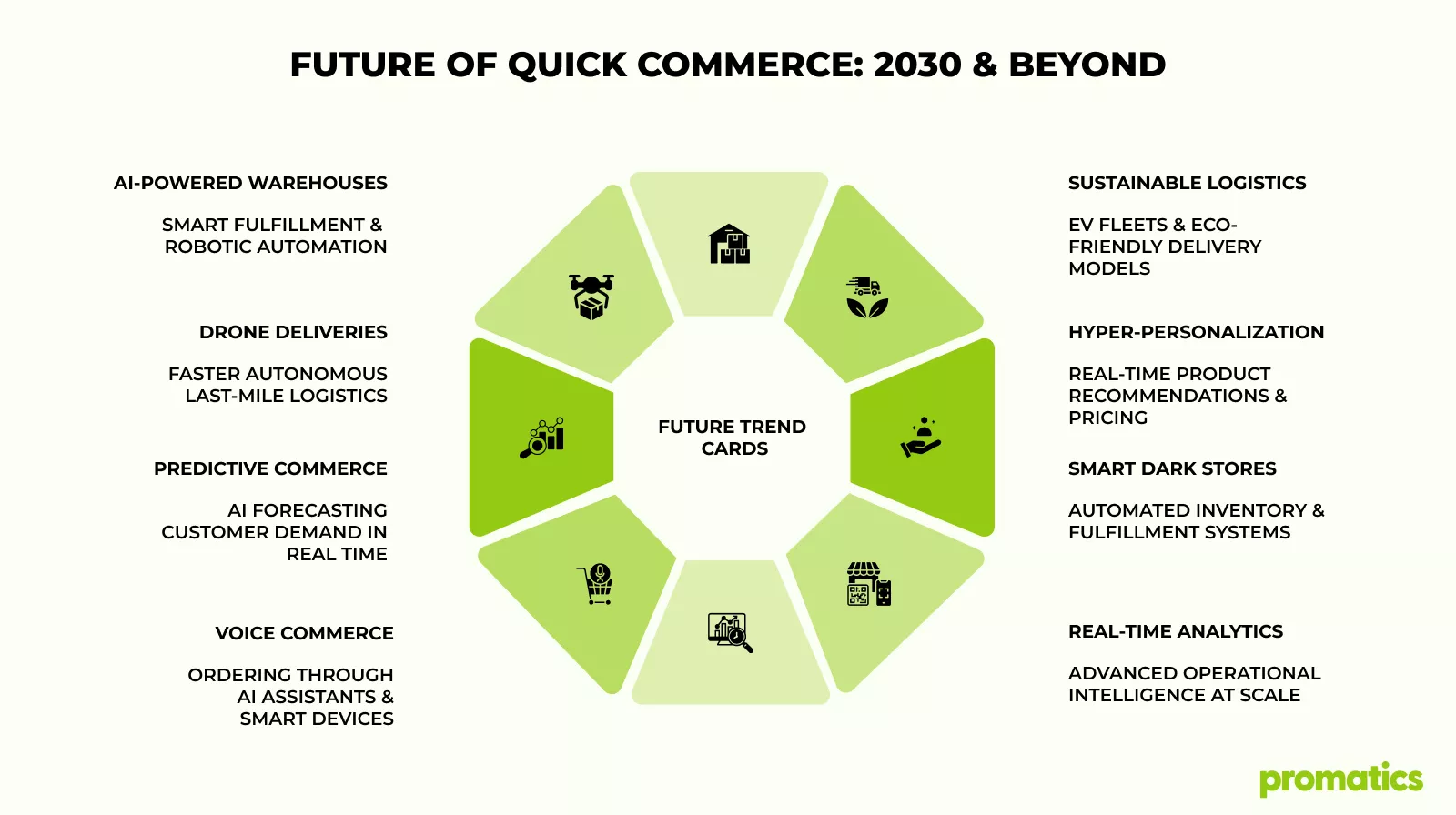
Future Trends in Quick Commerce
- Warehouse Automation
Smart warehouses, automated picking systems, and robotics are helping businesses improve fulfillment speed and operational efficiency. - Drone & Autonomous Deliveries
Drones, robotic deliveries, and self-driving vehicles are expected to transform last-mile delivery operations in the future. - Predictive Demand Forecasting
Advanced analytics and automation help businesses predict customer demand, optimize inventory, and reduce stock shortages. - Voice Commerce Integration
Voice-enabled shopping and AI assistants are making product search and ordering faster and more convenient. - Sustainable Delivery Models
Businesses are adopting electric vehicles, optimized delivery routes, and eco-friendly packaging to build sustainable delivery ecosystems. - Advanced Personalization
Modern recommendation systems help deliver personalized offers, smart product suggestions, and customized shopping experiences in real time. - Hyperlocal Expansion
Quick commerce platforms are rapidly expanding into smaller cities and local markets through hyperlocal delivery networks. - Real-Time Analytics & Automation
Businesses are increasingly using real-time analytics to improve logistics, customer engagement, inventory planning, and operational decision-making.
Why Businesses Should Invest in Quick Commerce Apps
- Growing Demand for Instant Delivery
Modern consumers expect faster and more convenient shopping experiences with deliveries completed within minutes. - Competitive Advantage in Digital Retail
Quick commerce helps businesses stand out by offering speed, convenience, and seamless customer experiences. - Higher Customer Retention
Faster deliveries, live tracking, and personalized offers encourage repeat purchases and long-term customer loyalty. - Improved Operational Efficiency
Smart automation helps streamline inventory management, route optimization, and delivery operations. - New Revenue Opportunities
Quick commerce platforms create opportunities through subscriptions, partnerships, hyperlocal expansion, and cross-selling. - Better Customer Experience
Real-time updates, faster fulfillment, and smooth app experiences improve overall customer satisfaction. - Scalable Business Growth
Businesses can expand rapidly across multiple locations using hyperlocal delivery networks and scalable infrastructure.
Conclusion
Quick commerce is reshaping digital retail by delivering faster, smarter, and more convenient shopping experiences. As demand for instant delivery continues to grow, businesses investing in scalable quick commerce solutions can improve customer retention, operational efficiency, and long-term growth.
Whether you are a startup or an enterprise, building a feature-rich quick commerce app can create a strong competitive advantage in today’s fast-moving digital market.
Promatics Technologies helps businesses build scalable quick commerce applications with modern UI/UX, real-time logistics, automation, and secure payment integrations. Connect with our experts to turn your quick commerce idea into a high-performing digital platform.