10 Innovative Ideas for Quick-Commerce Apps: Revolutionizing On-Demand Delivery

TL;DR
- Explores profitable quick commerce app ideas across multiple industries.
- Covers business models, monetization, and customer demand.
- Highlights essential features for rapid delivery experiences.
- Discusses technology stack and scalability considerations.
- Helps entrepreneurs validate and launch successful Q-commerce apps.
In today’s fast-paced world, convenience is king. Consumers expect immediate gratification, and businesses are constantly seeking ways to meet these demands. This relentless pursuit of speed and efficiency has given rise to quick commerce (q-commerce), a revolutionary evolution of e-commerce that prioritizes rapid delivery, often within minutes. Unlike traditional online shopping, which might involve waiting days for a package, q-commerce focuses on delivering everyday essentials, groceries, and even specialized items in under an hour, sometimes as quickly as 10-15 minutes.
The rapid proliferation of smartphones and the increasing sophistication of mobile applications have been pivotal in driving new opportunities within the quick commerce space. These apps serve as the primary interface between consumers and q-commerce providers, enabling seamless ordering, real-time tracking, and personalized experiences. They are the backbone of this expedited delivery model, transforming how we access goods and services.
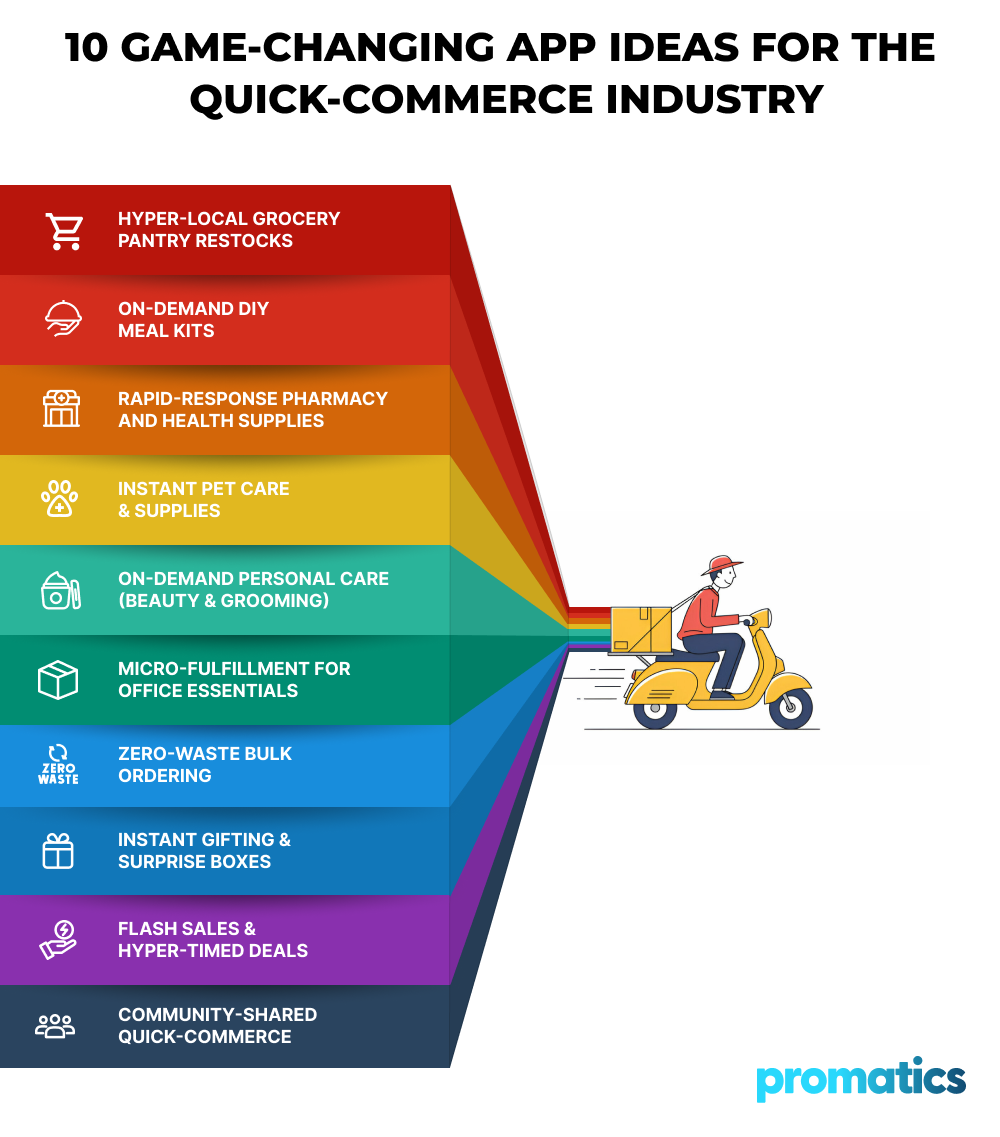
This article will delve into the exciting world of quick commerce apps, uncovering 10 cutting-edge concepts that have the potential to redefine on-demand delivery. From hyper- local grocery restocks to instant gifting, these innovative ideas leverage technology to provide unparalleled speed and convenience, offering a glimpse into the future of retail.
Promatics, a leading mobile and web development agency, is at the forefront of crafting intuitive and dynamic mobile applications designed to elevate user experience and bring visionary concepts to fruition in this rapidly expanding market
Idea 1: Hyper-Local Grocery Pantry Restocks
Imagine a world where your pantry never runs out of essentials. This first innovative idea for a quick commerce app centers on predictive restocking of staples, delivered to your doorstep in under 15 minutes. The core concept is to anticipate your needs before you even realize them, ensuring a seamless and uninterrupted supply of everyday items.
Key features of such an app would include AI-driven consumption forecasting and a one- tap reorder system. The AI would analyze your past purchasing habits, seasonal trends, and even external factors like weather to accurately predict when you’re likely to need more milk, bread, or eggs. When the system identifies a potential shortage, it would proactively suggest a reorder, allowing you to confirm with a single tap. This eliminates the need for last-minute grocery runs and ensures you always have what you need.
From a technological standpoint, implementing this idea requires sophisticated demand- prediction models that can process vast amounts of data in real-time. Geofencing technology would be crucial for pinpointing your exact location and dispatching deliveries from the nearest micro-fulfillment center or dark store. Furthermore, seamless inventory synchronization between the app and the physical stock is paramount to prevent out-of- stock situations and ensure accurate delivery times. These technological considerations are vital for the success of a truly efficient hyper-local grocery delivery service.
The business benefits of this model are significant. By ensuring customers always have their staples, the app can lead to an increased basket size over time, as users become more reliant on the service for their regular needs. More importantly, it fosters improved customer retention. The sheer convenience and reliability of never running out of essentials create a strong bond with the user, making them less likely to switch to competitors. This predictive and proactive approach to grocery delivery represents a significant leap forward in quick commerce.
Idea 2: On-Demand DIY Meal Kits
For those who love to cook but lack the time for grocery shopping, the on-demand DIY meal kit concept offers a compelling solution. This quick commerce idea focuses on delivering fresh, pre-portioned ingredients and recipes directly to your door within minutes, allowing you to prepare a home-cooked meal without the hassle of planning or shopping.
Key features would include an interactive recipe walkthrough and AR guidance for prep. The app could guide users step-by-step through the cooking process with engaging visuals and clear instructions. Augmented Reality (AR) integration could overlay virtual instructions onto your physical cooking space, showing you exactly where to cut, how much to measure, or even demonstrating complex techniques, making cooking accessible and enjoyable for everyone, regardless of their culinary skill level.
Technologically, this concept relies heavily on dynamic route optimization to ensure ingredients arrive fresh and on time. Given the perishable nature of the goods, efficient logistics are paramount. AR SDK integration would be necessary to power the interactive cooking experience, requiring robust mobile app development expertise. The ability to seamlessly blend the digital and physical cooking environments is crucial for this idea’s success in the quick commerce market.
The business benefits are multifaceted. The opportunity for upsells on premium kits (e.g., gourmet ingredients, special occasion meals) can significantly boost revenue. Furthermore, the app can gather valuable data-driven recipe recommendations based on user preferences, cooking success rates, and ingredient consumption. This data can then be leveraged to personalize future meal kit offerings, enhance user engagement, and refine inventory management, making it a highly attractive model for quick commerce providers..
Idea 3: Rapid-Response Pharmacy and Health Supplies
Access to essential medications and health supplies can be critical, especially in urgent situations. This quick commerce concept addresses that need by offering 10-15 minute delivery of over-the-counter (OTC) medications, first-aid essentials, and other health-related products. This service would be invaluable for individuals who are unwell, lack transportation, or simply need immediate access to health items.
Key features would include digital prescription upload and pharmacist chat support. Users could securely upload their prescriptions directly through the app, which would then be verified by a licensed pharmacist. The chat support feature would allow users to consult with a pharmacist for minor health queries, medication interactions, or product recommendations, adding a crucial layer of professional guidance to the rapid delivery service.
From a technical perspective, this idea demands stringent security measures for secure document upload to protect sensitive patient information. Compliance checks with healthcare regulations (e.g., HIPAA in the US, GDPR in Europe) are non-negotiable.
Additionally, for certain medications, cold-chain tracking would be essential to maintain product integrity during transit, ensuring that temperature-sensitive items arrive safely and effectively. These technical complexities highlight the need for robust and reliable app development.
This quick commerce model offers significant business benefits, primarily the ability to capture timely, recurring orders. When someone needs medication, the need is often immediate and ongoing. By providing a reliable and rapid service, the app can become a go- to solution for health emergencies and routine refills. Furthermore, opportunities exist to partner with clinics and healthcare providers, integrating the app into their patient care pathways and expanding its reach within the healthcare ecosystem. This niche in q- commerce has immense potential for growth and societal impact.
Idea 4: Instant Pet Care & Supplies
Pet owners often face urgent needs for their beloved companions, whether it’s a sudden shortage of food, a forgotten treat, or even emergency pet medication. The Instant Pet Care & Supplies quick-commerce app concept aims to cater to these immediate demands, delivering essential pet products within minutes. This service would be a lifesaver for busy pet parents, ensuring their furry, feathered, or scaled friends are always well-cared for.
Key features of such an app would include pet profiles, allowing owners to store information about their pets’ dietary needs, preferences, and medical history. Auto-refill subscriptions for recurring purchases like food or litter would add immense convenience, ensuring supplies never run out. Crucially, tele-vet chat integration would provide immediate access to veterinary advice for non-emergency situations, offering peace of mind and quick guidance when needed.
From a technical standpoint, the app would require robust user-profile management to handle detailed pet information. Implementing subscription billing systems would be essential for managing recurring orders. The integration of chatbots or live chat functionalities for tele-vet services would also be a key technical consideration, requiring secure and reliable communication channels. These technical elements are vital for creating a seamless and trustworthy pet supply delivery service.
This quick commerce model presents a highly attractive business opportunity due to its potential for high-value recurring revenue. Pet owners are often dedicated and consistent in their purchases, leading to predictable income streams. Furthermore, by providing a reliable and comprehensive service, the app can cultivate strong brand loyalty among pet owners, making it their preferred choice for all pet-related needs. The emotional connection pet owners have with their animals translates into a willingness to invest in their well-being, making this a lucrative segment within the q-commerce market.
Idea 5: On-Demand Personal Care (Beauty & Grooming)
In an era where self-care is paramount, the demand for immediate access to beauty and grooming essentials is on the rise. The On-Demand Personal Care quick-commerce app concept aims to fulfill this need by providing rapid delivery of personal care kits, ranging from shaving supplies to skincare products. This service would be particularly appealing to individuals who prioritize convenience and immediate access to their grooming routines.
Key features of such an app would include guided routines and AR “try-before-you- buy” functionalities. Users could access personalized routines based on their skin type or grooming needs, complete with step-by-step instructions. The integration of Augmented Reality (AR) would allow users to virtually try on makeup, test different hairstyles, or see how a skincare product might look on their skin before making a purchase, enhancing the shopping experience and reducing returns. Subscriptions for frequently used products would also offer added convenience.
Technologically, this concept requires sophisticated AR face/skin mapping capabilities to provide accurate virtual try-on experiences. Seamless e-commerce integration is crucial for managing product catalogs, processing payments, and handling order fulfillment efficiently. The ability to deliver a highly visual and interactive shopping experience is key to the success of this quick commerce venture.
From a business perspective, this model offers excellent opportunities for cross-sell incentives. Once a user is engaged with a particular product or routine, the app can suggest complementary items, increasing the average order value. Moreover, the app can collect valuable data for tailored recommendations, allowing for highly personalized product suggestions based on user preferences, purchase history, and AR try-on results. This data- driven approach can significantly enhance customer satisfaction and loyalty within the personal care delivery market.
Idea 6: Micro-Fulfillment for Office Essentials
In the modern workplace, efficiency and convenience are paramount. The Micro- Fulfillment for Office Essentials quick-commerce app concept targets businesses, offering rapid delivery (10-20 minutes) of stationery, snacks, beverages, and other crucial office supplies. This service would streamline office operations, ensuring that companies always have the necessary resources without the need for extensive inventory management or last- minute runs to the store.
Key features would include a team ordering portal, allowing multiple employees to place orders under a single company account. Budget controls could be implemented to manage spending and ensure adherence to company policies. An auto-restock feature, similar to the grocery pantry concept, could predict and automatically reorder frequently used items, further enhancing efficiency and preventing supply shortages.
Technologically, this idea necessitates robust multi-user roles and permissions to accommodate different levels of access and approval within an organization. Enterprise invoicing capabilities would be essential for handling corporate billing and expense tracking. Furthermore, bulk-order routing optimization would be critical for efficiently delivering larger quantities of items to various office locations, requiring sophisticated logistics management within the quick commerce framework.
This quick commerce model offers significant business benefits through B2B recurring contracts. Once a company integrates this service into its operations, it is likely to become a long-term client, providing a stable and predictable revenue stream. The ability to offer volume discounts for bulk purchases would further incentivize businesses to utilize the service, making it a cost-effective and highly convenient solution for managing office supplies. This specialized office supply delivery niche within q-commerce holds substantial potential for growth.
Idea 7: Zero-Waste Bulk Ordering
As environmental consciousness grows, so does the demand for sustainable consumption. The Zero-Waste Bulk Ordering quick-commerce app concept taps into this trend by offering eco-friendly bulk goods, such as grains, spices, and cleaning supplies, delivered in reusable containers. This innovative approach not only provides convenience but also significantly reduces packaging waste, appealing to a growing segment of environmentally- minded consumers.
Key features of this app would include smart container deposits and a track-and-return system. Users would pay a deposit for the reusable containers, which would be refunded upon their return. The app would facilitate the tracking of these containers, making it easy for users to manage their returns and for the service to ensure a closed-loop system. This encourages responsible consumption and minimizes environmental impact within the quick commerce ecosystem.
Technologically, implementing this idea requires RFID container tracking or similar technologies to efficiently manage the inventory of reusable containers. A robust deposit management system would be essential for handling financial transactions related to deposits and refunds. Furthermore, route clustering algorithms would be crucial for optimizing delivery and collection routes, ensuring efficiency and minimizing the carbon footprint of the bulk delivery service. These technical considerations are vital for the operational success and environmental integrity of the app.
The business benefits of this model are clear: it allows companies to appeal to green consumers, a rapidly expanding market segment willing to pay a premium for sustainable options. By offering a zero-waste solution, businesses can differentiate themselves and build a strong brand image. Additionally, by eliminating single-use packaging, there is a significant opportunity to reduce packaging costs in the long run, contributing to both profitability and environmental stewardship. This forward-thinking q-commerce idea aligns with global sustainability goals and offers a unique value proposition
Idea 8: Instant Gifting & Surprise Boxes
The joy of giving is often amplified by spontaneity. The Instant Gifting & Surprise Boxes quick-commerce app concept capitalizes on this by offering curated gift boxes, ranging from gourmet snacks to unique gadgets, delivered within the hour. This service would be perfect for last-minute celebrations, forgotten anniversaries, or simply brightening someone’s day with an unexpected treat.
Key features would include a personalization quiz and live courier tracking. The personalization quiz would help users select the perfect gift based on the recipient’s interests, occasion, and budget. Once an order is placed, live courier tracking would allow both the sender and recipient to monitor the delivery in real-time, adding to the excitement and anticipation. The inclusion of digital gift cards would also provide flexibility and convenience for recipients.
Technologically, this idea requires a sophisticated personalization engine to effectively match gifts with recipients based on quiz responses and potentially past purchase data. Real-time ETA (Estimated Time of Arrival) capabilities are crucial for managing expectations and ensuring the timely delivery of gifts. A payment-split API could also be integrated to allow multiple people to contribute to a single gift, making group gifting effortless within the quick commerce framework.
This quick commerce model offers significant business benefits, including the potential for premium pricing due to the immediate gratification and personalized nature of the service. The unique and delightful experience of receiving an instant surprise gift can also generate considerable viral word-of-mouth marketing, as recipients share their positive experiences. This concept transforms the act of gifting into an immediate and memorable event, making it a highly attractive and profitable niche within the q-commerce market.
Idea 9: Flash Sales & Hyper-Timed Deals
Capitalizing on urgency and impulse, the Flash Sales & Hyper-Timed Deals quick- commerce app concept introduces limited-time offers with ultra-fast delivery, often within 30 minutes. This model creates a sense of excitement and scarcity, driving immediate purchases and high engagement. It’s particularly effective for clearing inventory, launching new products, or creating buzz around specific items
Key features would include prominent countdown timers for each deal, clearly indicating the remaining time to purchase. Push notifications would be essential for alerting users to new flash sales as they go live, ensuring they don’t miss out on time-sensitive opportunities. Additionally, low-stock alerts would further incentivize quick decisions, creating a compelling reason for immediate action within the quick commerce environment.
Technologically, this idea demands a robust infrastructure capable of handling sudden surges in demand. High-throughput push APIs are necessary to deliver notifications instantly to a large user base. A dynamic pricing engine would be crucial for adjusting prices in real-time based on demand, inventory levels, and the duration of the flash sale. The ability to manage rapid transactions and ensure swift fulfillment is paramount for the success of this q-commerce model.
The business benefits are substantial. Flash sales can generate significant spikes in app engagement, as users frequently check for new deals and respond quickly to notifications. This model is also highly effective for inventory clearance, allowing businesses to move products quickly and efficiently. By creating a sense of urgency and exclusivity, this quick commerce concept can drive rapid sales cycles and maximize revenue from limited-time offers.
Idea 10: Community-Shared Quick-Commerce
Building on the principles of sharing economy and local empowerment, the Community- Shared Quick-Commerce app concept envisions a network of neighbor-run mini-hubs where locals can pick up and deliver items quickly. This decentralized model leverages community resources to reduce last-mile delivery costs and foster local engagement, offering a sustainable and cost-effective alternative to traditional quick commerce services.
Key features would include peer ratings for both deliverers and mini-hub operators, building trust and accountability within the community. The app would facilitate the creation of micro-fulfillment zones, allowing individuals to volunteer their homes or small businesses as temporary storage and pickup points. In-app messaging would enable seamless communication between users, deliverers, and hub operators, ensuring smooth coordination and efficient delivery within the quick commerce network.
Technologically, this idea requires a sophisticated user-matching algorithm to connect those who need items with those who can deliver them, based on proximity and availability. Escrow payments would be essential to ensure secure transactions and protect both buyers and sellers. Robust trust & safety checks would also be critical for vetting participants and maintaining a secure and reliable community-driven platform. These technical considerations are vital for building a scalable and trustworthy community delivery service.
The business benefits of this model are significant. It dramatically reduces last-mile cost, as deliveries are handled by local community members rather than dedicated couriers, making the service more economically viable. Furthermore, it actively builds local engagement, fostering a sense of community and mutual support. This innovative quick commerce concept not only provides a convenient delivery solution but also strengthens local economies and promotes sustainable practices.
Implementing Best Practices
Developing a successful quick commerce app, regardless of the innovative idea, requires meticulous planning and adherence to best practices in technology and user experience. Promatics, with its expertise in mobile and web development, emphasizes several critical considerations for bringing these visions to life.
Choosing the Right Tech Stack: Native vs. Cross-Platform
One of the foundational decisions in app development is selecting the appropriate tech stack. For quick commerce apps, where performance and user experience are paramount, this choice is even more critical. Native app development (e.g., Swift/Kotlin for iOS/Android) offers superior performance, access to device-specific features, and a highly optimized user experience. This can be crucial for features requiring low latency, complex animations, or deep hardware integration, such as AR guidance or real-time tracking.
However, native development often means building and maintaining two separate codebases, increasing development time and cost.
Alternatively, cross-platform frameworks like React Native or Flutter allow developers to write a single codebase that can be deployed on both iOS and Android. While offering faster development cycles and reduced costs, they might introduce minor performance compromises or limitations in accessing certain native functionalities. The choice between native and cross-platform depends on the specific app’s requirements, budget, and desired level of performance and user experience. For quick commerce apps, a careful balance must be struck to ensure speed and reliability without excessive development overhead.
Building Resilient Micro-Services: Inventory, Payments, Routing
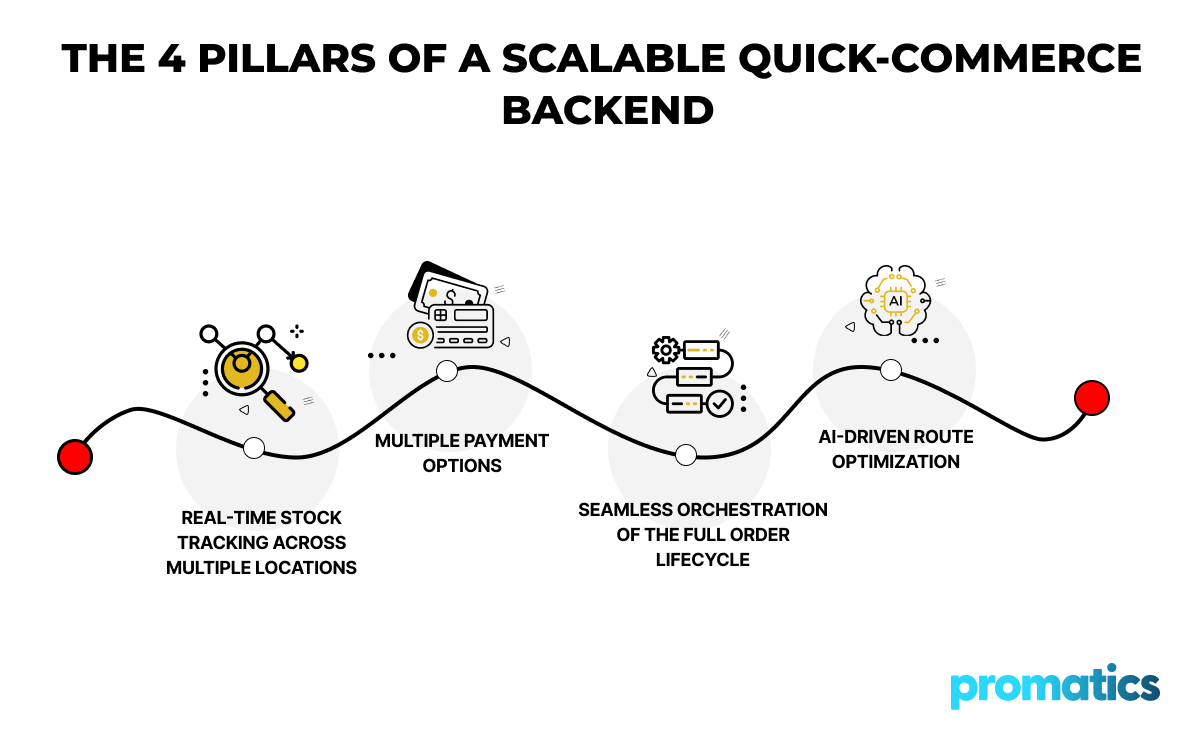
The backend infrastructure of a quick commerce app is its operational heart. To handle the high volume of rapid transactions and complex logistics, a micro-services architecture is highly recommended. This approach breaks down the application into smaller, independent services that communicate with each other, making the system more scalable, resilient, and easier to maintain. Key micro-services for a q-commerce app would include:
- Inventory Management: Real-time tracking of stock levels across multiple dark stores or fulfillment centers. This service must be highly accurate and responsive to prevent overselling or missed orders.
- Payment Processing: Secure and efficient handling of various payment methods, including credit cards, digital wallets, and potentially escrow systems for community- shared models. This service requires robust security measures and compliance with financial regulations.
- Order Management: Orchestrating the entire order lifecycle, from placement to fulfillment and delivery. This service integrates with inventory, payment, and routing systems.
- Dynamic Routing and Logistics: Optimizing delivery routes for speed and efficiency, considering factors like traffic, delivery windows, and courier availability. This is crucial for meeting the promised rapid delivery times of quick commerce.
Ensuring Ultra-Low Latency: Caching, Edge Computing
Speed is the defining characteristic of quick commerce. Every millisecond counts, from the moment a user taps the ‘buy’ button to the delivery at their door. To achieve ultra-low latency, several strategies are essential:
- Caching: Storing frequently accessed data closer to the user reduces the need to fetch it from distant servers. This can include product catalogs, user preferences, and even pre- calculated delivery routes. Effective caching significantly speeds up app responsiveness.
- Edge Computing: Processing data closer to the source, at the ‘edge’ of the network, rather than sending it all the way to a centralized cloud server. For quick commerce, this means deploying computing resources in micro-fulfillment centers or local data hubs, minimizing data travel time and enabling faster decision-making for logistics and order processing.
- Optimized Database Queries: Ensuring that database interactions are highly efficient and retrieve only the necessary data. Poorly optimized queries can introduce significant delays
- Content Delivery Networks (CDNs): Distributing static assets like images and videos across a global network of servers. When a user requests content, it’s delivered from the closest server, reducing load times and improving overall app performance.
Prioritizing UX for “One-Tap” Ordering
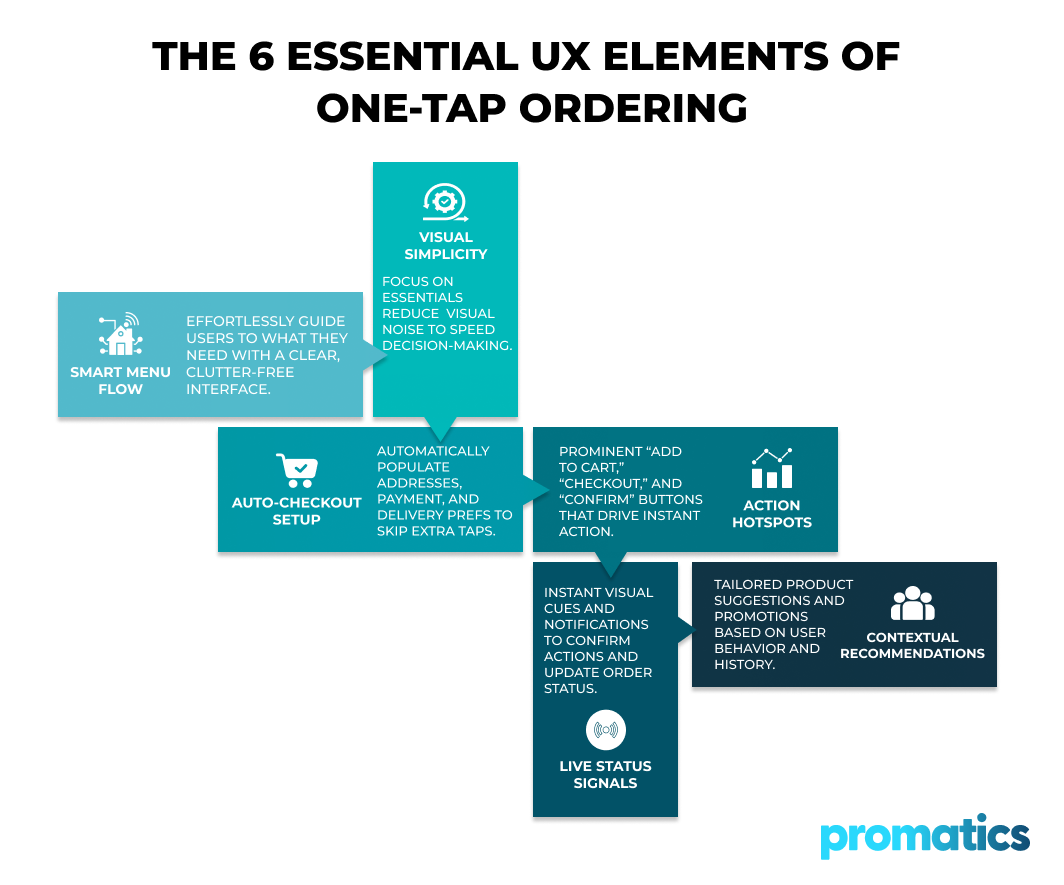
The user experience (UX) in a quick commerce app must be exceptionally intuitive and streamlined. The goal is to minimize friction and enable users to complete their orders with as few taps as possible. This concept, often referred to as “one-tap” ordering, is crucial for converting impulse purchases and ensuring a smooth, satisfying experience
Key UX considerations include:
- Intuitive Navigation: A clear and uncluttered interface that allows users to quickly find what they need without confusion.
- Minimalist Design: Reducing visual clutter and focusing on essential information to prevent cognitive overload.
- Pre-filled Information: Storing user addresses, payment details, and preferred delivery times to eliminate repetitive data entry.
- Clear Call-to-Actions (CTAs): Prominently displaying buttons for adding to cart, checking out, and confirming orders.
- Real-time Feedback: Providing immediate visual cues and notifications to confirm actions, update order status, and communicate delivery progress. This builds trust and reduces anxiety.
- Personalization: Leveraging user data to offer tailored product recommendations and promotions, making the shopping experience more relevant and efficient.
By meticulously addressing these implementation best practices, businesses can build quick commerce apps that are not only innovative in concept but also robust, performant, and user-friendly, setting the stage for success in this competitive market. Promatics excels in guiding clients through these critical development phases, ensuring a solid foundation for their q-commerce ventures.
Conclusion
The landscape of e-commerce is continuously evolving, and quick commerce stands at the forefront of this transformation, driven by consumer demand for speed and convenience.
The 10 innovative app ideas explored in this article—from hyper-local grocery restocks and on-demand meal kits to instant gifting and community-shared models—demonstrate the vast potential within this rapidly expanding sector. Each concept, while unique in its offering, shares the common goal of delivering goods and services with unprecedented speed, redefining the boundaries of on-demand delivery.
For businesses looking to enter or expand within the quick commerce market, the key lies in identifying which of these innovative ideas, or a combination thereof, best aligns with their target market, operational capabilities, and long-term vision. Success in this competitive arena hinges not only on a compelling concept but also on robust technological implementation, a focus on ultra-low latency, and an intuitive user experience that prioritizes “one-tap” ordering.
Promatics, with its deep expertise in mobile and web application development, is uniquely positioned to help businesses navigate the complexities of the quick commerce landscape. We understand the nuances of building scalable micro-services, optimizing for speed, and crafting user-centric designs that drive engagement and conversion. Whether you are an entrepreneur with a groundbreaking idea or an established business seeking to innovate, the time to act is now.
Ready to turn your quick-commerce vision into reality? Get in touch with Promatics today to discuss how our expert team can help you design, develop, and deploy a cutting-edge app that stands out in the fast-paced world of on-demand delivery. Let us help you build the future of q-commerce.
