What Are AI Agents? Top Reasons Enterprises Are Adopting Them Fast
TL;DR
- AI agents are autonomous systems that can reason, plan, make decisions, and complete tasks with minimal human input.
- Unlike chatbots or assistants, AI agents can use tools, APIs, databases, and external systems to automate workflows.
- This blog explains how AI agents work using LLMs, memory systems, task planning, APIs, and continuous learning.
- Common AI agent types include reflex agents, goal-based agents, learning agents, utility-based agents, and LLM-powered agents.
- Businesses across healthcare, finance, eCommerce, and enterprise operations are adopting AI agents to improve automation and productivity.
Businesses are moving beyond basic automation and entering a new era of intelligent, autonomous AI systems capable of handling complex workflows with minimal human involvement. Businesses are now entering the era of agentic AI systems, intelligent software capable of reasoning, planning, making decisions, and executing tasks autonomously.
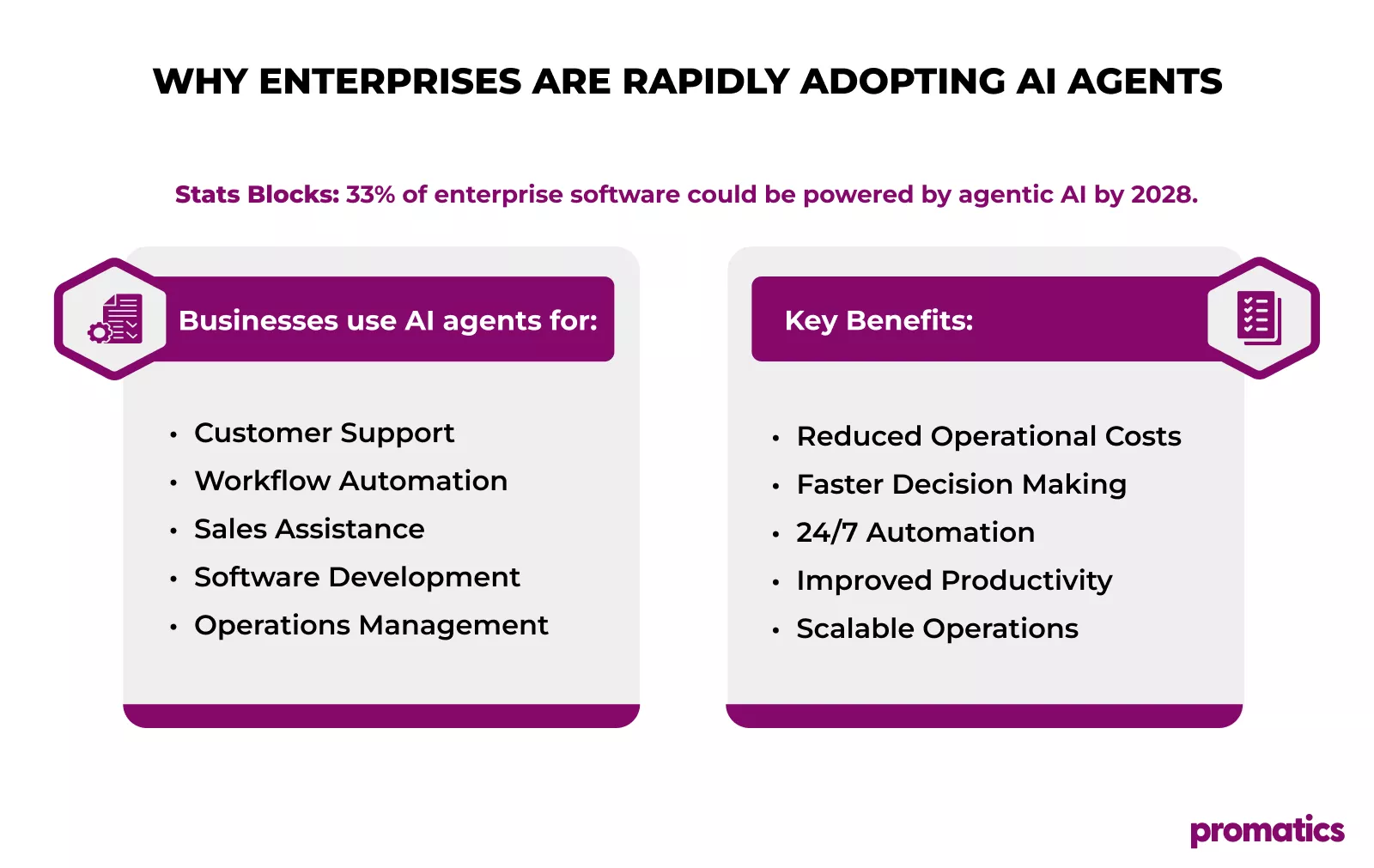
According to Gartner, by 2028, nearly 33% of enterprise software applications will include agentic AI, compared to less than 1% in 2024.This shift is why AI agents have become one of the most talked-about technologies in 2026. From automating customer support and software development to managing enterprise workflows and business operations, AI agents are transforming how organizations operate at scale.
But despite the growing hype, many people still confuse AI agents with traditional AI chatbots or assistants.
In reality, AI agents are far more advanced.
Unlike conventional AI systems that only respond to prompts, AI agents can understand goals, break tasks into steps, interact with tools and APIs, make decisions, and complete complex workflows with minimal human involvement.
So before the conversation gets even louder, let’s break it down in the simplest way possible: what AI agents actually are, how they work, why enterprises are rapidly adopting them, and how businesses can successfully implement AI agents in real-world operations.
What Are AI Agents?
AI agents are intelligent systems designed to complete tasks autonomously with minimal human involvement. They can create and manage workflows, use available tools, analyze data, make decisions, and take actions based on the goals assigned to them.
Unlike traditional software development that only follows fixed instructions, AI agents can understand context, adapt to situations, and perform multi-step tasks more efficiently. These smart systems work like digital assistants or problem-solvers that continuously process information, respond intelligently, and help automate complex workflows. For example, an AI agent can automatically analyze customer queries, generate responses, update CRM systems, and assign support tickets without manual intervention.
Understanding the term “AI Agent”
An AI agent is like a smart digital assistant that does far more than simply respond to prompts or answer questions. Instead of just providing information, unlike traditional AI systems that mainly provide responses, AI agents can take actions, coordinate tasks, and execute workflows independently.
Unlike traditional AI tools that rely on continuous human instructions, AI agents can handle multiple steps automatically. They are capable of analyzing information, making decisions, adapting to situations, and executing tasks without needing constant supervision. For example, an AI agent can search the web, generate reports, organize data, send emails, update files, or coordinate workflows on its own.
This ability to think through processes and perform actions autonomously is what makes AI agents one of the most exciting advancements in modern artificial intelligence.
Understanding the Difference Between AI Chatbots, Assistants, and AI Agents
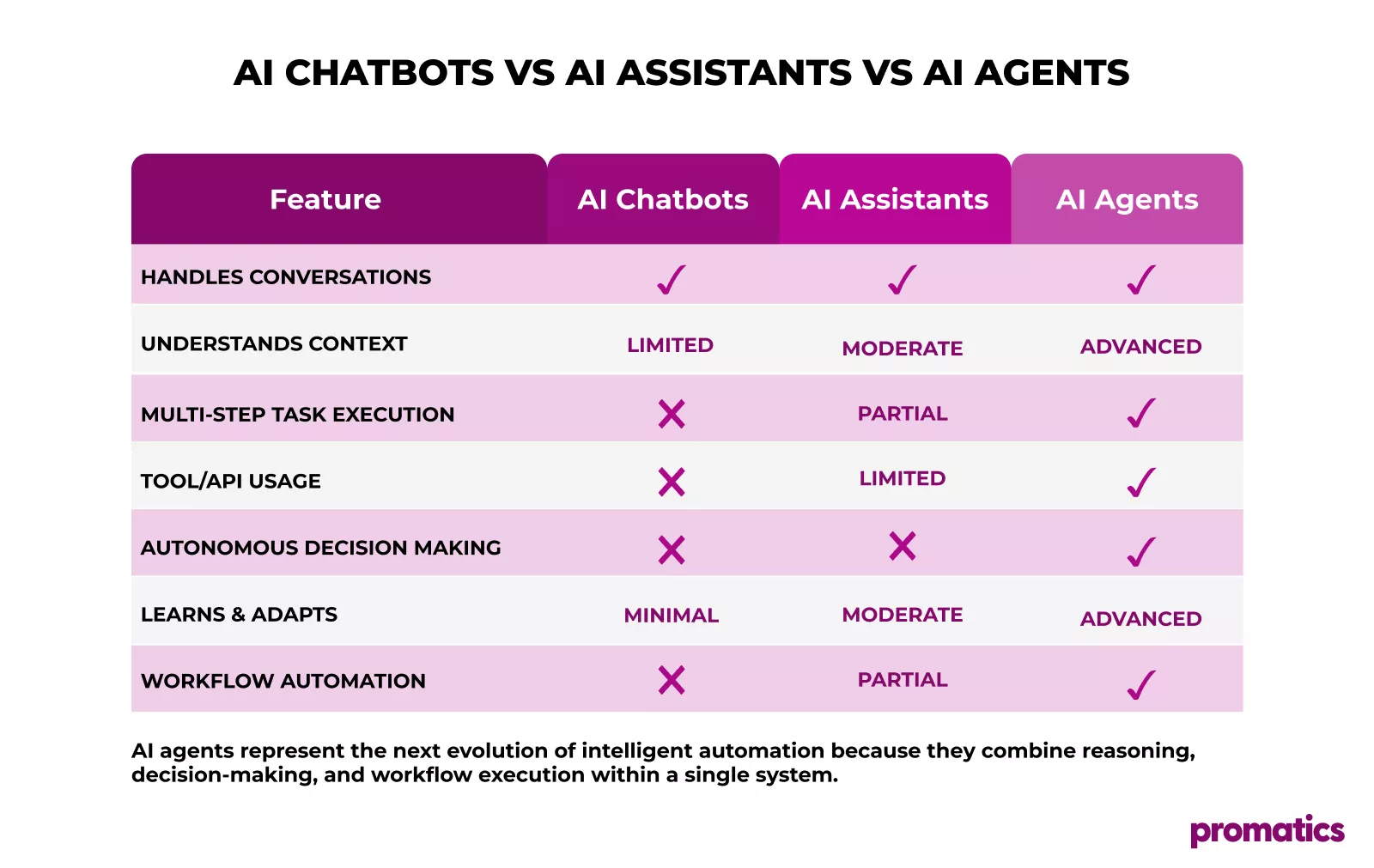
AI chatbots, AI assistants, and AI agents may sound similar, but they differ significantly in terms of intelligence, autonomy, and capabilities.
- AI Chatbots
AI chatbots are designed mainly for conversations. They use natural language processing to understand user queries and provide automated responses. However, they are typically limited to short-term interactions and predefined tasks, making them useful for customer support, FAQs, or simple conversations.
- AI Assistants
AI assistants are more advanced and interactive. They can help users perform tasks based on voice or text commands, but they still rely heavily on human guidance. Assistants can suggest actions, organize information, or automate small workflows, but users usually remain in control of decision-making.
- AI Agents
AI agents operate with the highest level of autonomy. Instead of waiting for instructions at every step, they can independently plan tasks, analyze information, make decisions, and take actions to achieve a specific goal. They are capable of handling complex workflows, using multiple tools, and completing multi-step tasks with minimal human involvement.
Also Read : AI Trends in FinTech 2026: Intelligent Automation and AI Agents
Key Characteristics : Autonomy, Reasoning, and Learning
AI agents stand out from traditional AI systems because of their advanced capabilities and ability to operate with greater independence. Here are some of the core features that make them so powerful:
Autonomy
AI agents can work independently without requiring constant human supervision. They analyze situations, evaluate available information, and decide the next course of action on their own.
Goal-Oriented Thinking
Unlike basic AI tools that simply execute commands, AI agents focus on achieving specific objectives. They can plan actions, prioritize tasks, and adjust workflows to reach the desired outcome more efficiently.
Reasoning Capabilities
AI agents combine data, context, and learned knowledge to make intelligent decisions. This allows them to solve problems, evaluate different possibilities, and choose actions that deliver the best results.
Learning and Adaptation
One of the most impressive qualities of AI agents is their ability to improve over time. By learning from past interactions and experiences, they can refine their responses, optimize workflows, and become more effective with continued use.
Perception and Awareness
AI agents gather and process information from multiple sources to better understand their environment. This helps them stay updated, respond accurately, and make context-aware decisions.
Proactive Behavior
Advanced AI agents do not just react to commands. They can anticipate potential outcomes, identify upcoming needs, and take proactive steps before problems even occur.
Together, these capabilities enable AI agents to manage complex, multi-step tasks with a level of intelligence and efficiency that traditional AI tools simply cannot match.
How Do AI Agents Work?
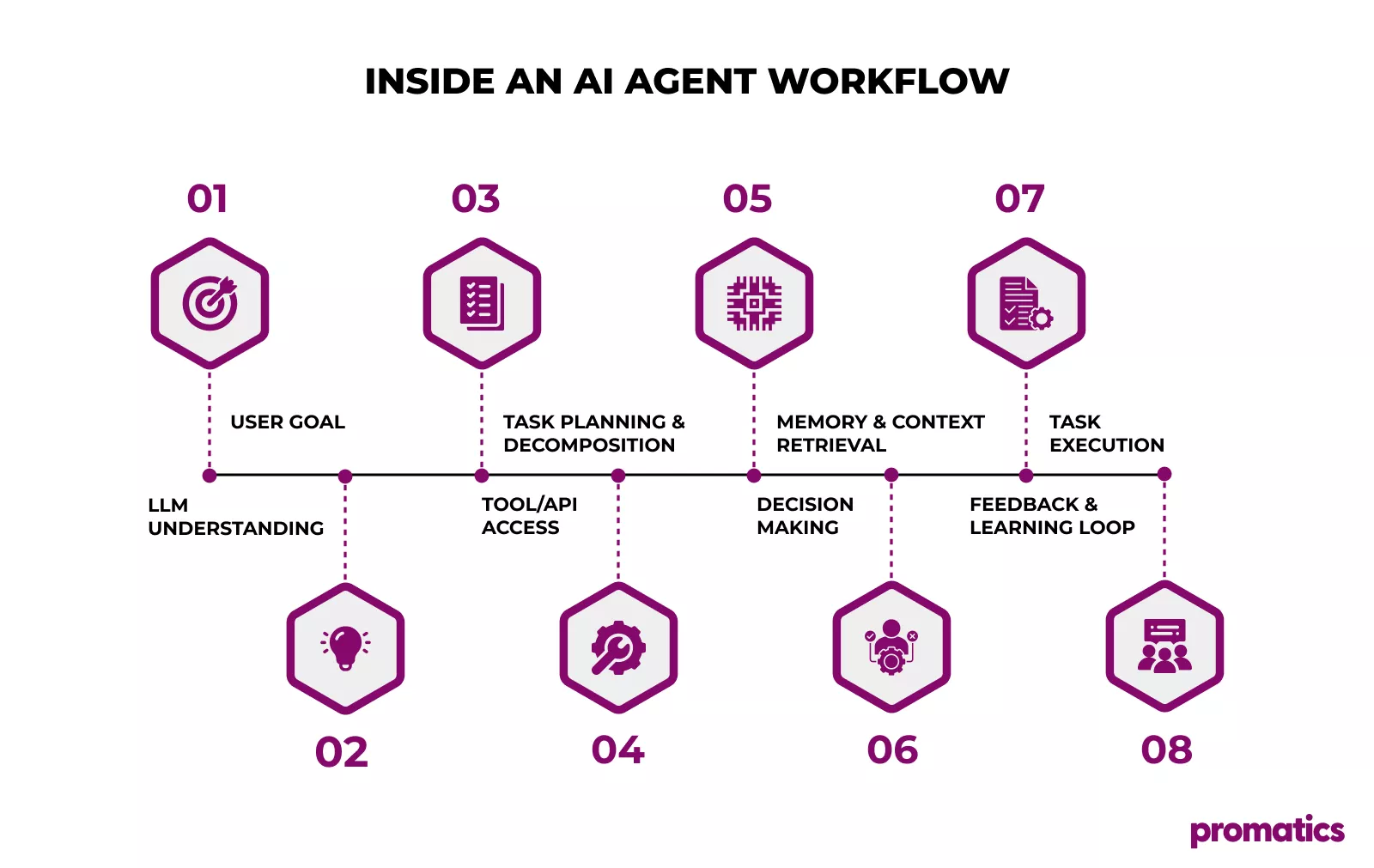
AI agents operate through a combination of intelligent systems that help them understand information, plan actions, make decisions, and continuously learn from outcomes. At their core, these systems rely on advanced technologies that process data, analyze context, and execute tasks autonomously with minimal human involvement.
How Modern AI Agents Understand, Plan, and Execute Tasks
AI agents operate through a combination of technologies that allow them to observe, reason, act, and continuously improve. Their functionality is built on interconnected systems that help them process information, make decisions independently, and adapt over time.
1. The Role of Large Language Models (LLMs)
Large Language Models (LLMs) act as the core intelligence behind AI agents, functioning as their central reasoning engine. These models enable agents to understand instructions, interpret context, and generate human-like responses. By processing natural language inputs, LLMs help AI agents analyze tasks, coordinate actions, and respond to complex queries more effectively.
2. Planning and Task Decomposition
To handle complex objectives efficiently, AI agents rely on structured planning methods. They begin by identifying the primary goal and then break larger tasks into smaller, manageable steps. For example, if an agent is asked to plan a trip, it may divide the task into booking flights, reserving hotels, organizing transportation, and creating a travel itinerary. This step-by-step approach improves accuracy and execution.
3. Using Tools and APIs
AI agents become significantly more capable when connected to external tools, databases, and APIs. Through tool-calling capabilities, they can access search engines, calculators, cloud platforms, business systems, and real-time data sources. This allows them not only to retrieve information but also to perform actions within external systems. As a result, AI agents move beyond simple conversation and become capable of executing real-world tasks.
4. Memory Types: Short-Term, Long-Term, and Episodic
AI agents use different forms of memory that resemble aspects of human cognition:
- Short-term memory (STM): Works like a temporary workspace that stores recent interactions and contextual information for immediate decision-making.
- Long-term memory (LTM): Stores information across sessions using databases, vector stores, or knowledge graphs for future use.
- Episodic memory: Retains records of specific past interactions and experiences, helping agents learn from previous outcomes.
- Semantic memory: Contains structured factual knowledge and generalized information about the world.
- Procedural memory: Stores learned processes, workflows, and repeated task sequences that can be executed automatically.
5. Learning from Feedback and Improving Performance
AI agents continuously improve through feedback-driven learning mechanisms. After completing tasks, they evaluate outcomes and use feedback to measure the effectiveness of their decisions. Techniques like reinforcement learning help agents refine their behavior using rewards and penalties. Over time, this cycle of action, evaluation, and adjustment enables AI agents to become more accurate, efficient, and reliable.
From Reactive to Autonomous: Types of AI Agents
AI agents may seem highly complex at first, but they become much easier to understand when categorized by how they process information, make decisions, and learn from interactions. Some agents follow simple predefined rules, while others can reason, plan, adapt, and operate autonomously using advanced AI models.
As AI technology continues to evolve, different types of agents are being used across automation, customer service, business operations, healthcare, software development, and many other industries.
Here are the most common types of AI agents shaping modern AI systems in 2025 and beyond:
1. Simple Reflex Agents
Simple reflex agents are the most fundamental type of AI agents, designed to respond to specific situations using predefined rules and conditions. They respond only to the current situation without storing memories or learning from past experiences. Their decisions are based entirely on predefined rules using an “if this, then that” logic structure. These agents work well in predictable environments where responses remain straightforward and repetitive.
2. Model-Based Reflex Agents
Model-based reflex agents are more advanced because they maintain a small internal representation of their environment. Unlike simple reflex agents, they can use previous information and environmental changes to make more informed decisions. This additional context allows them to operate more effectively in dynamic situations.
3. Goal-Based Agents
Goal-based agents make decisions by focusing on achieving a specific objective. Instead of reacting instantly, they evaluate multiple possible actions and choose the one most likely to help them reach their target. These agents are commonly used in systems that require planning, navigation, and strategic decision-making.
4. Utility-Based Agents
Utility-based agents take decision-making a step further by not only aiming to achieve a goal but also determining the most beneficial outcome possible. They evaluate different actions based on factors such as efficiency, risk, cost, and overall value before selecting the best option. This makes them highly useful in complex environments where multiple outcomes are possible.
5. Learning Agents
Learning agents continuously improve their performance by learning from experience, feedback, and past interactions over time. They continuously analyze outcomes, refine their behavior, and adapt to new situations. Most modern AI systems, including recommendation engines, intelligent assistants, and advanced automation platforms, fall into this category because of their ability to evolve and improve continuously.
6. Multi-Agent Systems
Multi-agent systems involve multiple AI agents working together or competing within the same environment. These agents can communicate, exchange information, negotiate, and collaborate to solve larger problems more efficiently. Multi-agent systems are commonly used in robotics, traffic management, supply chain optimization, and distributed AI applications.
7. LLM-Powered Agents (Modern AI Agents)
LLM-powered agents represent the latest generation of AI systems and are rapidly becoming the most advanced category of AI agents. Built on Large Language Models (LLMs) such as GPT-based architectures, these agents can understand context, reason through tasks, plan workflows, interact with tools, and perform actions autonomously.
They are capable of operating across multiple applications, automating complex workflows, and supporting advanced decision-making processes in real-world business environments.
Is it worth investing in AI agent development services now?
Yes, in 2026, investing in AI agent development services is becoming less of an experimental move and more of a strategic business decision for companies focused on automation, productivity, and long-term scalability. According to Gartner, over 40% of agentic AI initiatives may fail by 2027, not because the technology lacks capability, but because organizations struggle with deployment and operational integration.
AI agents are evolving beyond basic chatbots into autonomous systems capable of reasoning, planning, executing tasks, and interacting across multiple applications. Businesses are now using AI agents for customer support, workflow automation, software development, operations management, sales assistance, and enterprise decision-making.
For businesses, the biggest value comes from:
- Automating repetitive and time-consuming workflows
- Reducing operational costs and manual effort
- Improving response speed and productivity
- Enabling 24/7 intelligent support systems
- Scaling operations without proportional workforce expansion
- Enhancing customer experience through personalized interactions
However, successful AI agent adoption depends heavily on strategy and execution. Many organizations are still struggling with governance, infrastructure readiness, unclear ROI goals, and integration challenges. Reports show that several AI initiatives fail because companies rush adoption without proper planning or workflow redesign.
That’s why investing in AI agent development services makes the most sense when businesses:
- Have repetitive operational workflows to automate
- Need scalable AI-powered customer or employee support
- Want to integrate AI into existing enterprise systems
- Have clear ROI-focused use cases instead of adopting AI only because of market hype
- Plan to build long-term AI infrastructure rather than short-term experiments
In 2026, the strongest opportunities are not in building generic AI agents, but in developing domain-specific, workflow-driven, and enterprise-integrated AI systems with proper governance and human oversight. Overall, businesses that invest early in practical and well-scoped AI agent solutions are likely to gain operational advantages, faster automation capabilities, and stronger competitive positioning as AI becomes integrated into mainstream enterprise software and digital operations.
How to Successfully Implement AI Agents in the Workplace
Implementing AI agents in the workplace requires more than simply adopting new technology. Businesses need a structured strategy that focuses on identifying the right automation opportunities, selecting scalable AI solutions, ensuring secure deployment, and continuously improving performance. When implemented correctly, AI agents can help organizations automate workflows, improve productivity, reduce operational costs, and support faster decision-making across teams.
1. Identify High-Impact Use Cases
The first step is identifying repetitive tasks, workflow bottlenecks, and resource-heavy operations that can benefit from AI-driven automation. Businesses should analyze where teams spend excessive time on manual processes, customer interactions, reporting, or repetitive decision-making. Workflow analysis and process mapping can help uncover inefficiencies and highlight areas where AI agents can deliver measurable business value.
2. Choose the Right AI Tools and Development Partner
Selecting the right AI agent platform depends on your organization’s infrastructure, technical capabilities, and long-term business goals. Businesses should evaluate how easily AI systems integrate with existing software, APIs, databases, and cloud environments. Low-code AI platforms may suit non-technical teams, while advanced frameworks are often better for enterprise-scale deployments.
Working with an experienced AI agent development company like Promatics Technologies can also simplify implementation by helping businesses build scalable, workflow-driven AI solutions tailored to specific operational requirements.
3. Prioritize Data Privacy and Ethical AI Usage
Since AI agents frequently process sensitive customer and business information, organizations must establish strong data governance and security practices before deployment. Clear policies should define how data is collected, stored, accessed, and used across systems.
Businesses should also ensure compliance with privacy regulations while maintaining transparency, human oversight, and ethical AI practices to reduce risks related to bias, misinformation, and unauthorized data usage.
4. Monitor, Optimize, and Scale AI Agent Performance
AI implementation is an ongoing process rather than a one-time deployment. Businesses should continuously monitor performance using metrics such as response accuracy, task completion rates, operational efficiency, and user satisfaction. Real-time analytics and monitoring dashboards help identify areas for optimization and workflow improvements.
As AI adoption continues to grow in 2026, many organizations are partnering with enterprise AI development companies like Promatics Technologies to continuously refine AI agents, improve automation capabilities, and scale intelligent systems across business operations.
Conclusion
AI agents are rapidly evolving from experimental AI tools into intelligent systems capable of automating workflows, improving operational efficiency, and supporting smarter business decisions. From simple task automation to advanced autonomous reasoning, modern AI agents are reshaping how businesses operate across customer support, software development, sales, healthcare, finance, and enterprise operations.
As organizations continue investing in AI-driven transformation, the real competitive advantage will come from building practical, scalable, and workflow-focused AI solutions rather than adopting AI simply because of market trends. Businesses that strategically implement AI agents today are more likely to improve productivity, reduce operational costs, enhance customer experiences, and create long-term digital advantages in the years ahead.
However, successful AI agent adoption requires the right implementation strategy, secure infrastructure, ethical AI practices, and continuous optimization. This is where experienced AI development partners can make a significant difference. Companies like Promatics Technologies help businesses design, develop, and deploy AI-powered solutions tailored to real operational challenges and enterprise workflows.
Whether you are planning to automate customer support, streamline internal operations, build intelligent assistants, or develop enterprise-grade AI systems, investing in the right AI agent strategy today can create long-term business value tomorrow.
Ready to Build AI-Powered Business Solutions? Partner with Promatics Technologies to develop scalable, secure, and intelligent AI agent solutions customized for your business goals. From AI consulting and workflow automation to enterprise AI development, their team helps businesses turn AI innovation into measurable operational growth.
