AI Infrastructure Stack: GPUs, Data Pipelines, Model Serving, and Scalability

TL;DR
- An AI infrastructure stack combines GPUs
- data pipelines
- storage
- model serving
- cloud computing
- and monitoring to support AI applications. Each component plays an important role in delivering reliable performance
- managing computing costs
- and scaling AI workloads. As businesses move AI projects into production
- choosing the right infrastructure architecture becomes essential for building secure
- efficient
- and scalable AI solutions.
Building an AI application is one thing. Making it work reliably for thousands of users is another.
Businesses are increasingly integrating artificial intelligence into customer service, software development, data analytics, and everyday operations. However, the success of these applications depends on more than the AI models powering them.
Behind every AI chatbot, intelligent recommendation engine, or autonomous AI agent is a complex network of computing resources, data systems, and deployment technologies.
This foundation is known as the AI infrastructure stack.
The growing importance of this infrastructure is reflected in market projections. According to MarketsandMarkets, the global AI infrastructure market is expected to grow from $135.81 billion in 2024 to $394.46 billion by 2030, at a compound annual growth rate (CAGR) of 19.4%.
The report also estimates that North America accounted for 36.2% of the market’s revenue in 2024, highlighting the region’s significant role in AI infrastructure adoption.
For businesses, these figures reflect growing demand for the computing, storage, networking, and cloud technologies needed to operate AI applications at scale.
But what exactly goes into an AI infrastructure stack, and how do its components work together?
Let’s explore.
What Is an AI Infrastructure Stack?
An AI infrastructure stack is a collection of hardware, software, data systems, and cloud technologies used to develop, train, deploy, and manage artificial intelligence applications.
It provides the computing power, storage capacity, networking, and deployment environments that AI models need to operate efficiently.
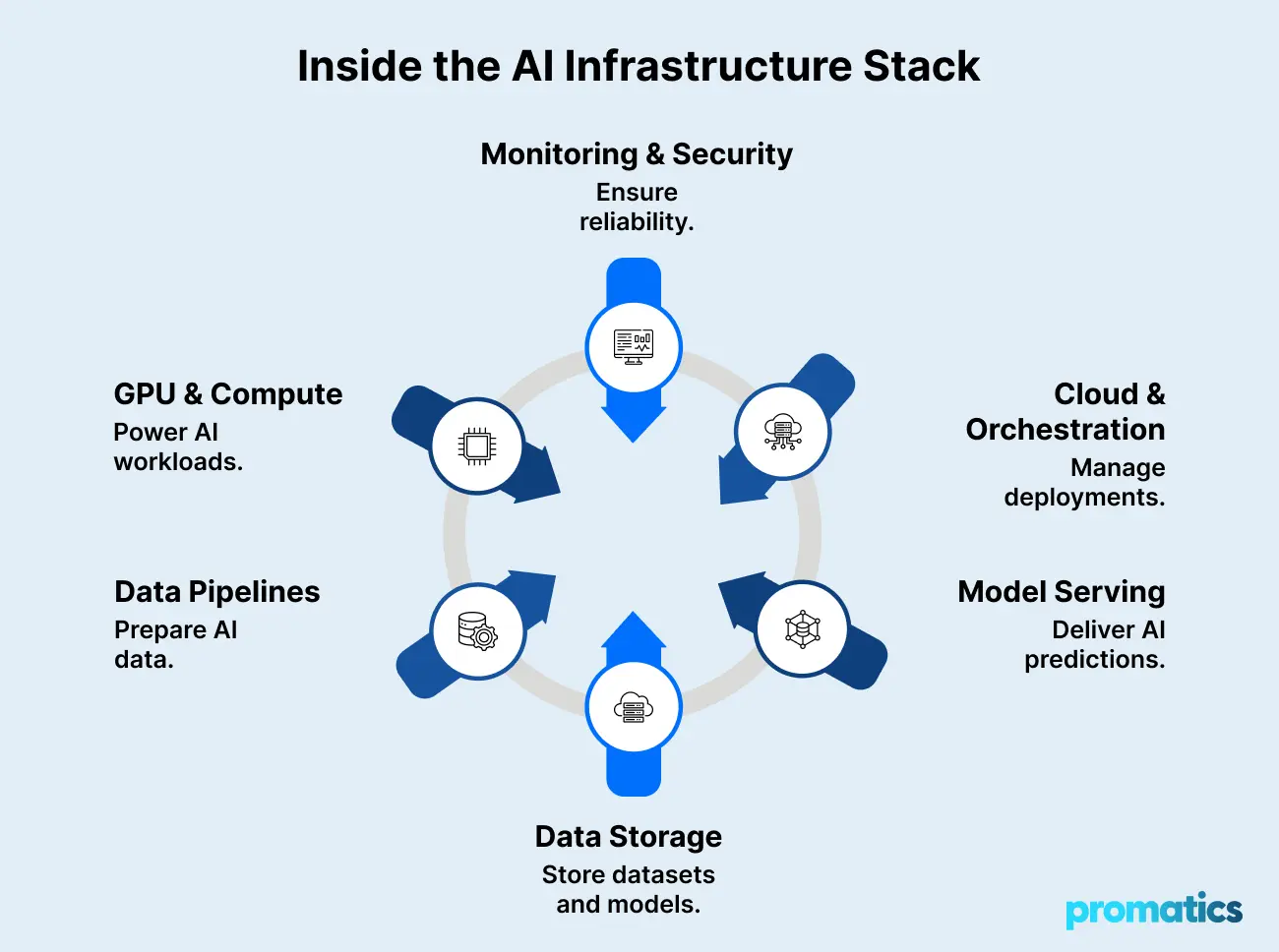
A typical AI infrastructure stack consists of six major components:
- GPU and compute infrastructure: Provides processing power for AI workloads.
- Data pipelines: Collects, processes, and prepares data for AI models.
- Data storage: Stores datasets, model artifacts, and application information.
- Model serving: Makes trained AI models accessible to applications.
- Cloud and orchestration: Manages infrastructure resources and deployment.
- Monitoring and security: Maintains performance, reliability, and data protection.
These components work together to support the complete AI lifecycle, from preparing training data to delivering predictions and responses in production.
For example, an AI-powered customer support platform needs data pipelines to retrieve customer information, computing resources to run models, and model-serving infrastructure to generate responses.
Without a properly designed infrastructure, even a capable AI model can struggle with slow responses, high operating costs, and inconsistent performance.
1. GPU Infrastructure: The Computing Power Behind AI
Graphics Processing Units (GPUs) are among the most important components of modern AI infrastructure.
Unlike traditional CPUs, which handle a wide range of general-purpose computing tasks, GPUs are designed to perform large numbers of calculations in parallel.
This makes them particularly effective for machine learning, deep learning, and generative AI workloads.
Why Are GPUs Important for AI?
AI models handle vast volumes of data during both training and inference. GPUs accelerate these operations by distributing computations across multiple processing cores.
They are commonly used for:
- Model training: Processing large datasets and adjusting model parameters.
- Deep learning: Running computationally intensive neural networks.
- Generative AI: Supporting large language models and image-generation systems.
- Real-time inference: Generating predictions and responses with low latency.
- Computer vision: Processing images, videos, and visual information.
According to MarketsandMarkets, computing infrastructure represents the leading offering segment of the AI infrastructure market, supported by demand for GPUs and other accelerated computing technologies.
Popular GPU Technologies for AI Infrastructure
| Technology | Primary application |
| NVIDIA GPUs | AI training, inference, and deep learning |
| AMD Instinct | High-performance AI computing |
| Google Cloud TPUs | Machine learning training and inference |
| Intel AI accelerators | Enterprise AI and specialized computing |
However, selecting GPUs involves more than choosing the most powerful hardware.
Businesses must evaluate GPU memory, processing requirements, networking capabilities, energy consumption, and infrastructure costs.
For example, an enterprise chatbot using a hosted language model may not require dedicated GPU servers. A company developing and hosting its own large language model, however, may need significant accelerated computing capacity.
The best option depends on the specific workload, required performance, and intended deployment environment.
2. Data Pipelines: Preparing Information for AI Applications
AI models depend on data. But collecting information from different sources is only the beginning.
Before data can be used effectively, it must be cleaned, processed, transformed, and delivered to the appropriate systems.
This is where AI data pipelines become essential.
A data pipeline automates the movement and transformation of information between data sources, storage environments, and AI applications.
How Do AI Data Pipelines Work?
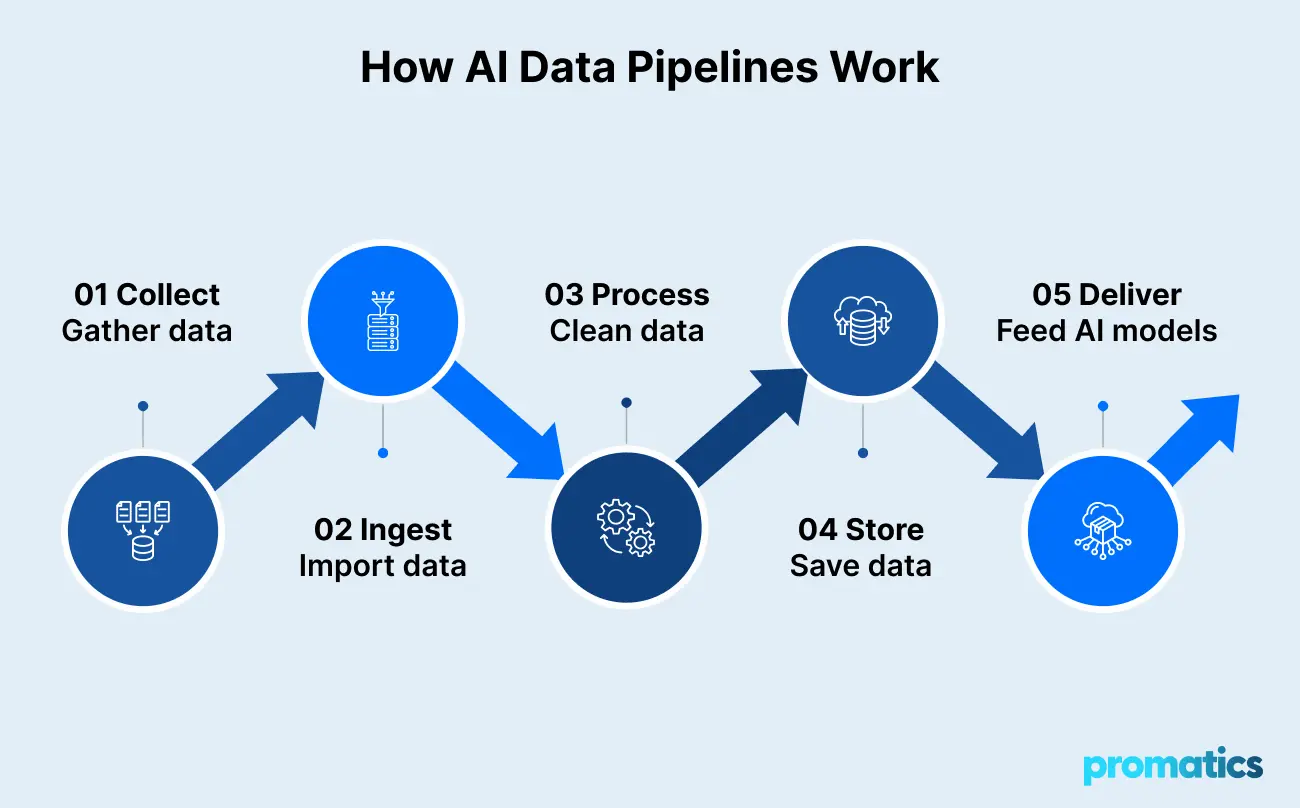
A typical AI data pipeline involves five stages.
1. Data Collection
Information is gathered from business applications, databases, APIs, IoT devices, and external platforms.
2. Data Ingestion
Collected information enters the processing environment through batch ingestion or real-time streaming.
3. Data Processing
Raw information is cleaned, validated, transformed, and organized into a usable format.
4. Data Storage
Processed information is stored in databases, data warehouses, data lakes, or cloud storage systems.
5. Data Delivery
Prepared information is delivered to AI models for training, inference, analytics, or retrieval.
Technologies Used in AI Data Pipelines
| Technology | Purpose |
| Apache Kafka | Real-time data streaming |
| Apache Spark | Large-scale data processing |
| Apache Airflow | Workflow orchestration |
| Amazon S3 | Cloud object storage |
| Amazon Kinesis | Streaming data ingestion |
| Snowflake | Cloud data warehousing |
Batch vs. Real-Time Data Pipelines
Businesses generally choose between batch processing and real-time data processing.
Batch processing handles information at scheduled intervals. It works well for historical analysis, reporting, and periodic model training.
Real-time processing continuously processes incoming information. It is useful for fraud detection, recommendation engines, and applications that require immediate decisions.
For example, a retail business analyzing monthly sales trends may use batch processing. An e-commerce platform delivering personalized product recommendations may benefit from real-time data pipelines.
The right architecture depends on how frequently information changes and how quickly the AI application needs to respond.
3. Model Serving: Moving AI Models Into Production
Developing an AI model is only one part of building an intelligent application.
Once a model has been trained and tested, businesses need a way to make it accessible to users and software applications.
This process is known as model serving.
Model serving involves deploying AI models into production environments where they can receive requests, perform computations, and return results.
For example, when a user asks an AI chatbot a question, the application sends the request to a model-serving system. The model processes the input and generates a response.
How AI Model Serving Works
The process generally follows these steps:
- A trained model is stored in a model registry.
- The model is deployed to an inference environment.
- An application sends a request through an API.
- The inference server processes the request.
- The model generates a prediction or response.
- The result is returned to the application.
Popular Model-Serving Technologies
Several frameworks help businesses deploy and manage AI models.
- NVIDIA Triton Inference Server: Supports serving AI models across different frameworks and computing environments.
- TensorFlow Serving: Provides deployment capabilities for TensorFlow models.
- KServe: Enables Kubernetes-based model deployment and management.
- Amazon SageMaker AI: Offers managed services for model development and deployment.
- vLLM: Helps run large language models more efficiently.
Why Model Serving Matters
Model-serving infrastructure directly affects application performance.
Poorly configured serving systems can lead to slow responses, inefficient resource utilization, and higher computing costs.
For production applications, businesses should evaluate inference latency, throughput, concurrency, model-loading time, and deployment reliability.
The goal is to ensure that AI applications continue delivering consistent results as usage increases.
4. Cloud Infrastructure: Making AI More Accessible and Scalable
Running AI workloads often requires substantial computing power and storage capacity. Traditionally, businesses needed to purchase and maintain physical servers to support demanding applications.
Cloud platforms now provide access to computing resources without requiring organizations to manage all the underlying hardware.
Cloud infrastructure allows businesses to provision resources based on workload requirements and adjust capacity as applications grow.
Major Cloud Platforms for AI Infrastructure
Amazon Web Services (AWS)
AWS offers cloud computing, GPU-enabled instances, scalable storage, container orchestration, and managed AI services.
Businesses can use services such as Amazon EC2, Amazon S3, Amazon EKS, and Amazon SageMaker AI to build and deploy AI-powered applications.
Microsoft Azure
Microsoft Azure provides cloud computing, data storage, machine learning, and AI deployment capabilities for enterprise applications.
Google Cloud
Google Cloud supports AI development through GPU and TPU computing, data processing services, and managed machine learning platforms.
Why Cloud-Based AI Infrastructure Is Growing
MarketsandMarkets projects that cloud deployment will lead the AI infrastructure market from 2024 to 2030.
Cloud platforms provide several advantages:
- Flexible access to computing resources.
- Reduced need for upfront hardware investment.
- Scalable data storage.
- Managed AI and machine learning services.
- Easier integration with enterprise applications.
- Support for global application deployment.
However, cloud infrastructure is not automatically the cheapest option.
Businesses must evaluate usage patterns, GPU availability, data transfer costs, security requirements, and long-term operating expenses.
For organizations with predictable, high-volume workloads, dedicated or hybrid infrastructure may sometimes be more economical.
The ideal approach depends on business requirements rather than following a single deployment model.
5. AI Infrastructure Scalability: Supporting Growing Workloads
An AI application may perform well during initial testing but encounter problems as more users begin accessing it.
Increasing traffic creates additional demands on computing resources, data systems, model-serving environments, and networking infrastructure.
Scalability ensures that AI applications can handle these growing requirements without significant performance degradation.
Vertical vs. Horizontal Scaling
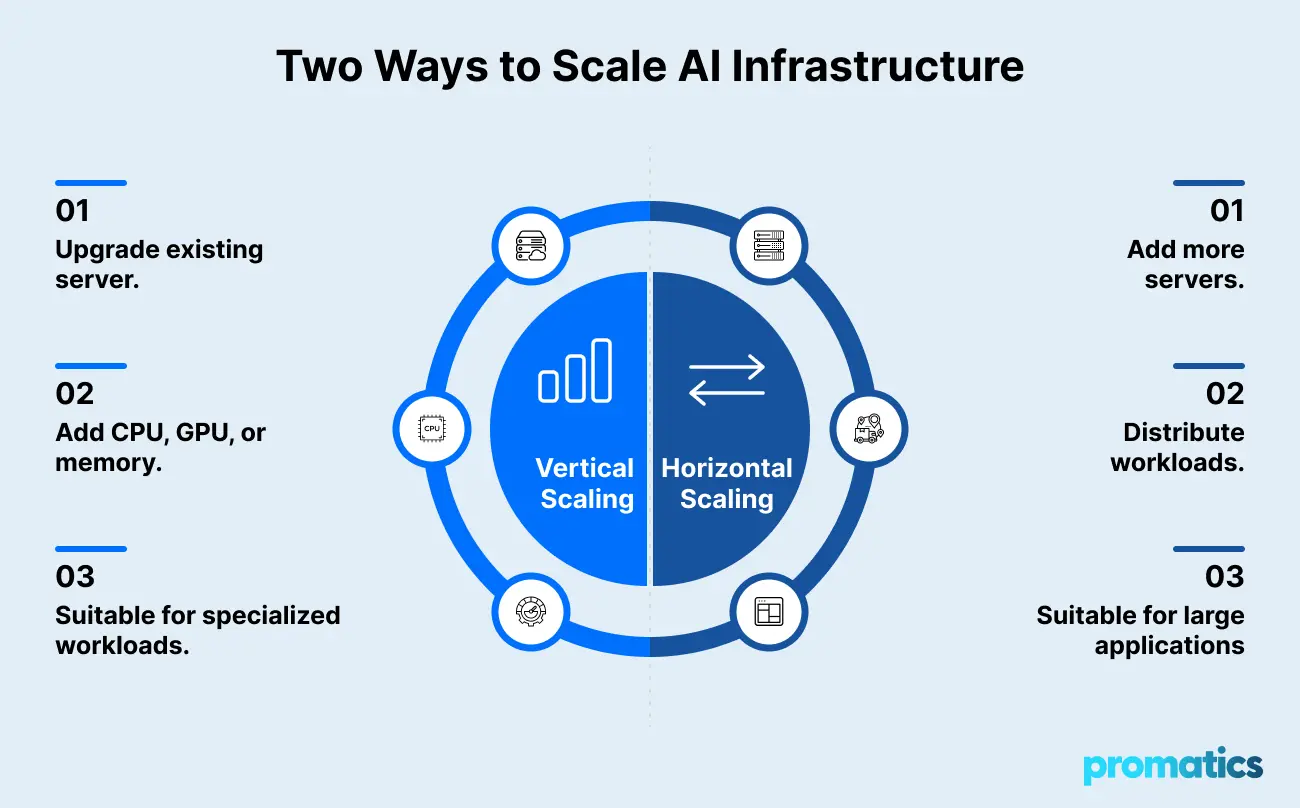
Businesses generally use two approaches to scale infrastructure.
| Factor | Vertical scaling | Horizontal scaling |
| Approach | Upgrade an existing server | Add more servers |
| Resource expansion | More CPU, GPU, or memory | Additional computing nodes |
| Complexity | Relatively simpler | Requires distributed coordination |
| Suitable for | Smaller or specialized workloads | Large-scale applications |
Vertical scaling improves the capacity of an existing machine.
Horizontal scaling distributes workloads across multiple machines, allowing applications to handle more requests and larger processing demands.
Why Networking Matters for AI Scalability
Networking is becoming increasingly important as AI workloads move toward distributed computing environments.
According to MarketsandMarkets, the network segment is expected to grow at a CAGR of 30.6% between 2024 and 2030, making it the fastest-growing category in the AI infrastructure market.
This growth highlights the importance of high-bandwidth connections between GPUs, servers, storage systems, and data centers.
When AI workloads are distributed across multiple machines, inefficient networking can create bottlenecks even when sufficient computing power is available.
Technologies That Support AI Scalability
Common technologies include:
- Kubernetes: Automates deployment and management of containerized applications.
- Docker: Packages applications into portable containers.
- Load balancers: Distribute incoming traffic across servers to prevent overload and maintain performance.
- Auto-scaling: Adjusts infrastructure resources according to demand.
- Distributed computing: Divides processing tasks among multiple computers.
- Caching: Reduces repeated computations and unnecessary requests.
Together, these technologies help organizations maintain application performance while controlling infrastructure complexity.
6. AI Infrastructure Monitoring and Security
Deploying AI infrastructure is not a one-time activity.
Once applications enter production, businesses need continuous visibility into computing performance, resource consumption, application reliability, and security.
Important Infrastructure Monitoring Metrics
Organizations should track:
- GPU and CPU utilization.
- Model inference latency.
- API response times.
- Request throughput.
- Memory and storage consumption.
- Infrastructure costs.
- Application error rates.
- Model performance and data quality.
Tools such as Prometheus, Grafana, and NVIDIA DCGM can help teams monitor infrastructure performance.
Security Considerations
AI infrastructure often processes confidential business information, customer data, and proprietary models.
Important security measures include:
- Data encryption: Keeps information secure when stored or shared.
- Access management: Restrict infrastructure access to authorized users and applications.
- Network protection: Use firewalls, private networks, and secure API gateways.
- Model security: Protect model artifacts, credentials, and deployment environments.
- Backup and recovery: Maintain recovery procedures for critical data and infrastructure configurations.
For enterprise AI applications, security should be integrated into infrastructure design from the beginning.
7. How to Build a Scalable AI Infrastructure Stack
Businesses should avoid selecting infrastructure technologies before understanding their actual AI requirements.
A structured implementation strategy helps organizations balance performance, scalability, security, and cost.
Step 1: Define Your AI Use Case
Start by identifying the business problem.
Determine whether the application requires generative AI, predictive analytics, computer vision, AI agents, or machine learning.
Different workloads require different infrastructure capabilities.
Step 2: Evaluate Computing Requirements
Identify the processing resources required for model training and inference.
Some applications can operate efficiently using APIs or CPU-based inference, while others require dedicated GPU infrastructure.
Step 3: Build Reliable Data Pipelines
Establish systems for collecting, processing, validating, and storing information.
Ensure that the data architecture supports the application’s performance and security requirements.
Step 4: Select a Deployment Environment
Choose between cloud, on-premises, and hybrid infrastructure based on workload requirements, cost, data governance, and operational capabilities.
Step 5: Implement Model Serving
Deploy models through appropriate serving frameworks and APIs.
Optimize the serving environment for latency, throughput, and reliability.
Step 6: Plan for Scalability
Introduce load balancing, orchestration, monitoring, and auto-scaling where required.
Design the architecture so that infrastructure resources can expand without major application changes.
Step 7: Monitor and Optimize
Continuously evaluate infrastructure performance, computing costs, and application reliability.
Regular optimization helps businesses identify bottlenecks and avoid unnecessary spending.
8. AI Infrastructure Trends Shaping the Future
AI infrastructure continues to evolve as businesses deploy more sophisticated applications and demand greater computing efficiency.
Several trends are shaping infrastructure planning.
Growing Demand for AI Inference
As AI applications move into production, inference infrastructure is receiving increasing attention.
MarketsandMarkets identifies inference as the fastest-growing functional segment in its market forecast.
Businesses need efficient serving environments capable of handling real-time requests while managing latency and computing costs.
AI-Optimized Data Centers
AI workloads require powerful computing systems, high-bandwidth networking, and reliable cooling infrastructure.
Data centers are increasingly adopting specialized hardware, high-density server configurations, and advanced cooling technologies to support these requirements.
Hybrid and Multi-Cloud Infrastructure
Organizations are exploring combinations of private infrastructure and public cloud services to balance flexibility, security, performance, and costs.
Smaller and More Efficient AI Models
Smaller language models and optimized inference techniques can reduce computing requirements for specific business applications.
This creates opportunities to deploy AI without relying exclusively on large, expensive computing environments.
Infrastructure for AI Agents
AI agents introduce additional requirements for workflow orchestration, memory, API integration, retrieval systems, and secure tool execution.
Businesses building agentic applications need infrastructure capable of managing multiple connected operations reliably.
AI Infrastructure News and Market Developments
AI infrastructure news increasingly covers developments in semiconductor technology, cloud computing, data centers, networking, and energy efficiency.
Companies such as NVIDIA, AMD, Microsoft, Amazon, and Broadcom are important participants in different parts of the ecosystem.
These developments also influence interest in AI infrastructure stocks. However, businesses evaluating infrastructure technologies should prioritize technical suitability, operational requirements, and total cost of ownership rather than stock market trends.
9. Common Challenges in AI Infrastructure Development
Building AI infrastructure introduces technical and operational challenges that businesses must address before scaling.
| Challenge | Potential solution |
| High computing costs | Optimize GPU usage and select appropriate compute resources |
| Poor data quality | Implement validation and data governance |
| Infrastructure complexity | Use automation and orchestration |
| Slow model responses | Optimize inference and caching |
| Scaling limitations | Adopt distributed architectures |
| Security risks | Implement access controls and encryption |
| Legacy integration | Modernize APIs and data connectivity |
One common mistake is overinvesting in infrastructure before validating the application’s actual requirements.
A more practical approach is to begin with a clearly defined use case, measure performance under realistic conditions, and expand infrastructure based on demonstrated demand.
10. How Promatics Technologies Helps Businesses Build AI-Ready Applications
Building an AI application requires more than selecting a model or connecting an API.
Businesses need a reliable software architecture that integrates data systems, AI capabilities, cloud services, and existing enterprise applications.
At Promatics Technologies, we help businesses develop AI-powered digital products with a focus on performance, scalability, and practical business requirements.
Our capabilities include:
- AI Application Development: Developing intelligent applications using generative AI, machine learning, and AI-powered features.
- AI Agent Development: Building AI agents that integrate with business systems and automate workflows.
- Cloud Application Development: Creating scalable applications using modern cloud technologies.
- Enterprise Software Development: Developing custom software that connects with existing business operations.
- Application Modernization: Updating legacy applications to support cloud environments, modern APIs, and AI integration.
Whether you are introducing AI into an existing application or planning a new AI-powered platform, choosing the right software and infrastructure architecture can make a significant difference.
Explore our AWS web development services or connect with us to discuss your AI application requirements.
Conclusion
The AI infrastructure stack plays a critical role in turning artificial intelligence from an experimental technology into a reliable business capability.
GPUs provide computing power, data pipelines prepare information, model-serving platforms deliver predictions, and cloud infrastructure supports flexible deployment. Orchestration, networking, monitoring, and security bring these components together.
As AI adoption grows, businesses must look beyond individual models and focus on the infrastructure required to operate them efficiently.
The right AI infrastructure is not necessarily the largest or most expensive. It is the one that supports the application’s requirements while balancing performance, reliability, scalability, and cost.
By planning infrastructure around real business needs, organizations can build AI-powered applications that are easier to maintain, optimize, and expand.
