Mobile App Development Architecture: Why It Matters for Scalable Business Growth

TL;DR
- Mobile app architecture defines structure, components, and data flow
- Ensures scalability, performance, and smooth user experience
- Improves maintainability and faster feature updates
- Supports seamless backend integration and data handling
- Strong architecture drives long-term app reliability and growth
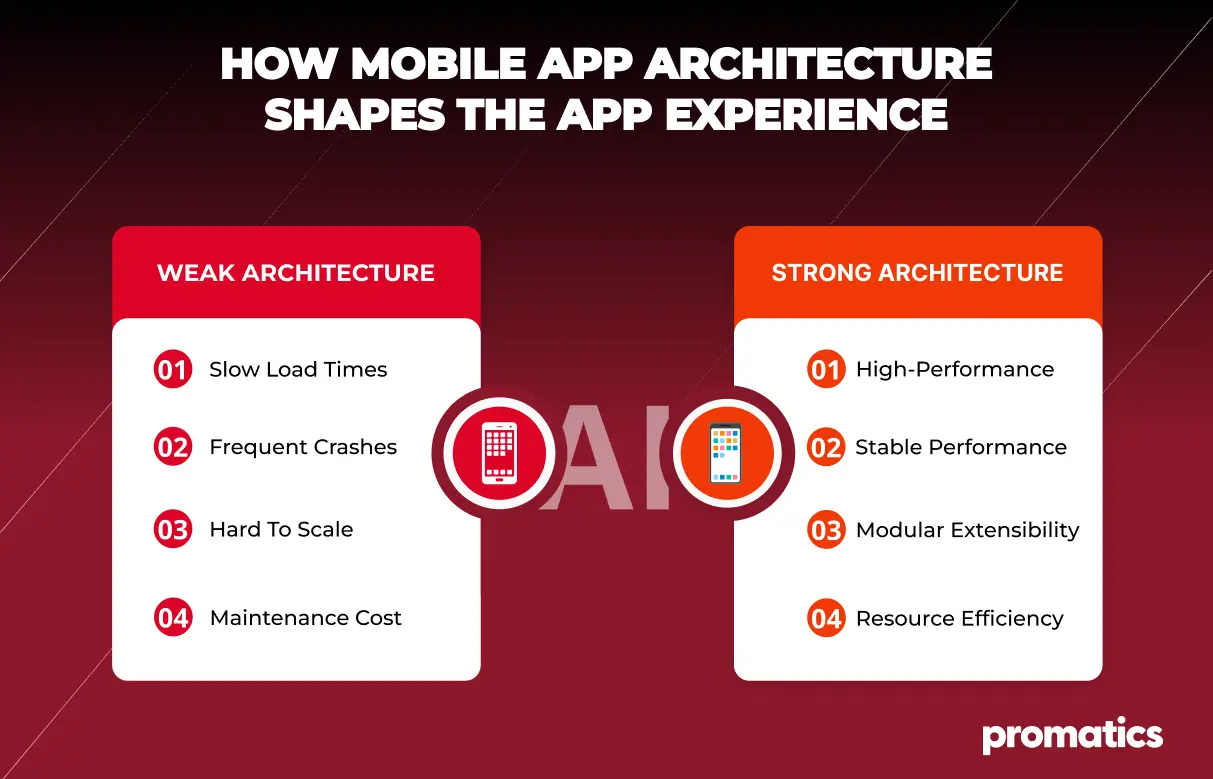
Users don’t judge mobile apps by their code or architecture, they judge them by how effortlessly they work. An app that loads instantly, responds smoothly, and feels reliable earns trust. One that lags, crashes, or breaks under pressure is quickly abandoned. What separates these two experiences is not just design or features, but the foundation beneath them: mobile app development architecture.
In the rush to ship quickly, many products prioritize visual polish and feature delivery while overlooking architectural decisions that determine how an app performs over time. Yet the apps that succeed in acquisition, retention, and long-term growth are built on architecture that supports scalability, stability, and change. Architecture isn’t about writing more code, it’s about making the right structural decisions early so performance, maintainability, and adaptability don’t become bottlenecks later.
This blog breaks down mobile app architecture for business leaders, highlighting its importance and its role in building scalable, high-performing mobile applications.ts.
What Is Mobile App Development Architecture?
Mobile app architecture is the blueprint of a mobile application. It defines how the app’s components are organized and how data flows between them from front-end interaction to back-end processing and external integrations.
Architecture provides a structure that:
- Determines how the app responds to user actions
- Dictates how data is fetched, saved, and synchronized
- Directs how components interact with each other
- Enables seamless interaction with external systems and services
Rather than simply dictating how code is written, architecture shapes how the mobile experience works and behaves under load, over time, and across device types. A well-designed architecture makes mobile app development predictable, scalable, and cost-efficient.
Why Mobile App Architecture Matters for Businesses
In mobile app development, the architecture you choose has business consequences. It impacts performance, user experience, adaptability, and how quickly you can innovate all of which affect your bottom line.
1. Scalability That Matches Business Growth
As your user base grows or new features are added, architecture determines whether your app can expand without breaking down. An app built without strong architecture may experience crashes, slowdowns, or bottlenecks as demand rises.
2. Performance and Responsiveness
Users expect apps to respond instantly. Architecture governs how efficiently data flows between the server and the user interface. Poor architecture leads to lag, freezes, and a negative experience that costs retention.
3. Security and Compliance
In fields like healthcare and fintech mobile app development security isn’t optional, it’s a requirement. Architecture defines secure communication layers, access controls, and threat mitigation strategies that keep user data safe.
4. Maintainability and Future-Proofing
Apps must evolve. Whether it’s adding a new payment method, integrating AI features, or modernizing UI, strong architecture ensures that updates don’t introduce new bugs or require costly rewrites.
In essence, mobile app architecture protects your investment. It transforms an app from a one-time project into a long-term business asset.
Key Principles of Effective Mobile App Architecture
For architecture to deliver real business value, it must be grounded in a set of core principles:
- Separation of Concerns
Each part of your app should handle only one responsibility e.g., the user interface, business logic, or data access. This reduces complexity and enables teams to work independently.
- Modularity
Breaking your app into logical modules makes maintenance easier and speeds up development cycles.
- Loose Coupling
Components should be independently replaceable without affecting other parts of the system.
- High Cohesion
Related functions should be grouped together logically, which improves readability and predictability.
- Testability
Modular design makes it easier to test parts of the app independently, reducing bugs and errors.
These principles ensure that your architecture supports performance, flexibility, and long-term evolution.
The Core Layers of Mobile App Architecture
Most modern mobile applications are organized into logical layers each serving a distinct role. This layered approach gives clarity to development teams and ensures that changes in one part of the system don’t create chaos in another.
1. Presentation Layer
This is the layer that users interact with most directly. It includes:
- UI screens
- Navigation components
- User inputs
- Visual state management
This layer focuses entirely on visual interaction not data processing or storage.
2. Business Logic Layer
Here resides the “brain” of the application where use-cases, workflows, and rules are evaluated. This layer focuses on processing user actions and defining the app’s behaviors.
3. Data Layer
This layer manages how data is stored, retrieved, and synchronized:
- API communication
- Local cache or databases
- Offline-first data handling
By isolating the data layer, the app can adapt to changing backend services without drastic changes to the rest of the system.
4. External Integration Layer
Most apps rely on external systems like payment gateways, analytics tools, push notification services, and third-party APIs. This layer manages those interfaces safely and systematically.
This separation of layers not only clarifies responsibility but also makes maintenance and future expansion far easier.
Architecture Patterns and What They Mean for Your App
Different architectural patterns influence how the system behaves, how teams work, and how scalable the application is.
Here’s a high-level overview of popular patterns:
Model-View-Controller (MVC)
- Good for simple applications
- Clearly separates UI, logic, and data
- Can become unwieldy for large, complex apps
Model-View-ViewModel (MVVM)
- Supports reactive and dynamic interfaces
- Excellent for apps with frequent UI updates
- Helps keep business logic separate from UI
Clean Architecture
- Focuses on decoupling components
- Maximizes testability and scalability
- Ideal for large teams and enterprise systems
Hexagonal & Modular Architecture
- Encourages flexibility
- Makes integration with new services simple
- Minimizes impact of changes
Each pattern comes with trade-offs. Choosing the right one depends on your product complexity, team structure, and long-term goals.
Mobile App Architecture in the Age of AI
Artificial Intelligence is transforming how modern mobile applications deliver value.
From personalized experiences to predictive interactions, AI elements are now integrated into mobile apps at multiple layers. However, AI doesn’t just add features it influences how architecture should be designed.
Why AI Matters in Architecture
AI models often require:
- Modular separation from business logic
- Scalable data pipelines
- Real-time processing
- AI-specific monitoring
For example:
- Recommendation engines may operate independently and feed decisions into the UI layer
- Image or voice recognition might be processed via cloud functions before results are passed back to the app
This trend means that traditional mobile architectures must evolve to support both real-time AI needs and future adaptability.
How Businesses Should Think About Architecture
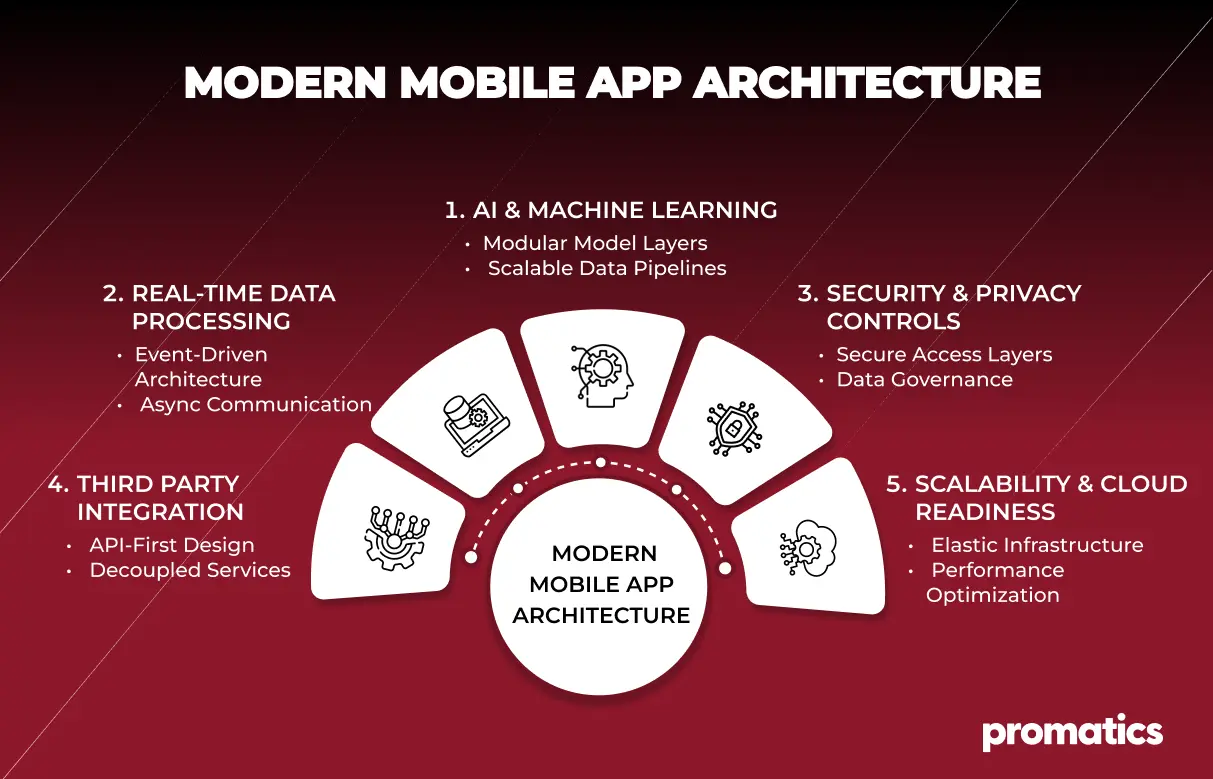
For most organizations, mobile app architecture is a strategic business decision, not a technical one.
Here are questions leaders should ask:
- Can this architecture scale as our user base grows?
- Will future feature additions require costly rewrites?
- Is our architecture resilient to integration changes?
- Can this design support emerging tech like AI or IoT?
Simply put: architecture defines the ceiling of possibility for your app. The stronger the architecture, the higher the ceiling.
Common Mobile App Architecture Mistakes to Avoid
Even experienced teams fall into traps that undermine architectural goals:
- Tight Coupling
When modules depend too heavily on each other, even minor changes can cause system breakdowns.
- Ignoring Scalability
Designing for today without thinking about tomorrow leads to bottlenecks and costly redesigns.
- Skipping Automated Testing
Architecture without testability increases risk and slows down releases.
- Relying on Temporary Fixes
Technical debt accumulates rapidly when architecture is repeatedly bypassed for speed. Avoiding these mistakes protects your investment and supports long-term product health.
Why Partner with Promatics Technologies
Choosing the right partner is as vital as choosing the right architecture.
At Promatics Technologies, we bring:
- Strategic Architecture Thinking
We don’t just code, we design systems that align with business goals.
- Modern Technology Expertise
From native to cross-platform to AI-integrated applications, we know what architecture works best for your objectives.
- Performance-First Mindset
Speed, reliability, and responsiveness are not features they are expectations we build into architecture.
- Security and Compliance
Especially for finance, healthcare, and enterprise systems, we implement architecture with security as a first-class requirement.
- Long-Term Partnership Approach
We build solutions that grow with you and not become obsolete next quarter.
We understand that application architecture is not something you “fix later.” It’s a business decision that protects your investment while enabling innovation.
Building Mobile Apps That Last
Mobile app architecture is not just a technical decision it is a business imperative that defines how an application performs, scales, and evolves over time. From performance and security to long-term scalability, architecture determines whether a mobile product can support growth or become a limitation.
In a competitive market with rising user expectations, architecture becomes the key differentiator between applications that struggle to adapt and those that remain stable, efficient, and future-ready. Products built without a solid architectural foundation often face increasing maintenance costs and slower innovation, while well-architected apps continue to deliver value as business needs change.
If the goal is to build a mobile product that lasts, one that remains responsive, secure, and adaptable architecture must be part of the strategic conversation from the start. Whether you are launching a new application or scaling an existing one, hiring the best mobile app development company is essential.
Partner with Promatics Technologies to build mobile applications designed for long-term growth and scalability. Let’s discuss your vision and explore how our architecture-first approach supports sustainable business success.