Quick Commerce App Development: Technology Behind 10-Minute Delivery Apps

TL;DR
- AI-powered logistics, hyperlocal fulfillment, and real-time inventory management make 10-minute delivery possible.
- Modern quick commerce platforms rely on microservices, cloud infrastructure, AI, and predictive analytics.
- Businesses investing in scalable quick commerce app development can improve customer retention, operational efficiency, and revenue growth.
- Success depends on technology, logistics optimization, and intelligent automation rather than speed alone.
Consumer expectations have fundamentally reshaped digital retail. Waiting three or four days for an online order is no longer considered convenient, and even same-day delivery is rapidly becoming the baseline rather than a competitive advantage. As a result, businesses across industries are investing in quick commerce app development to deliver groceries, medicines, electronics, and everyday essentials within minutes while creating seamless, on-demand customer experiences.
The market momentum reflects this shift. According to Fortune Business Insights, the global quick commerce market was valued at USD 184.55 billion in 2025 and is projected to reach USD 385.36 billion by 2034, growing at a CAGR of 8.55%. North America accounted for 33.43% of the global market, while Asia Pacific is expected to witness the fastest growth, driven by increasing urbanization, smartphone adoption, and digital payments.
Industry leaders like Blinkit, Zepto, Instacart, Gopuff, and Swiggy Instamart have transformed shopping into an on-demand experience where convenience is measured in minutes instead of days. However, what appears to be a simple tap on a mobile app is powered by a sophisticated technology ecosystem operating behind the scenes.
Artificial intelligence forecasts demand before orders are placed, real-time inventory systems synchronize stock across multiple fulfillment centers, intelligent routing engines identify the fastest delivery paths, and cloud-native architectures process thousands of concurrent transactions without compromising performance. Together, these technologies create a scalable and intelligent digital ecosystem capable of delivering products within 10 to 30 minutes.
Whether you’re building a grocery delivery platform, pharmacy app, or hyperlocal marketplace, understanding the technology behind quick commerce app development is essential for creating a high-performance, future-ready solution.
Read on this blog, to explore the architecture, AI capabilities, technology stack, scalability strategies, and essential features that power modern 10-minute delivery apps and are redefining the future of instant commerce.
What Is Quick Commerce?
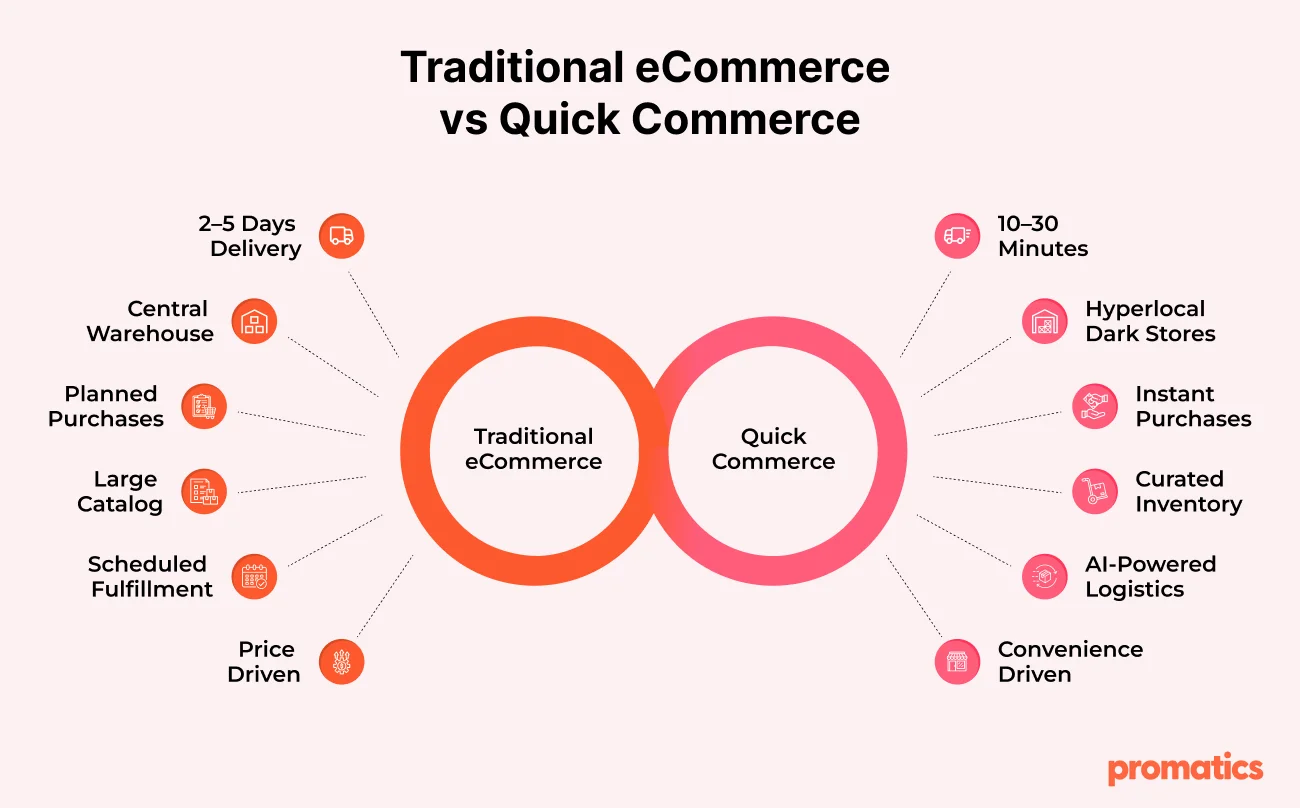
Quick commerce is an evolution of traditional eCommerce that focuses on delivering products within 10 to 30 minutes using hyperlocal fulfillment centers and intelligent logistics networks.
Unlike conventional online retail, where products are shipped from centralized warehouses, quick commerce relies on strategically located dark stores that enable rapid order processing and last-mile delivery.
Traditional eCommerce
- Delivery within 2–5 days
- Centralized warehouses
- Large product catalog
- Planned purchases
Quick Commerce
- Delivery within 10–30 minutes
- Hyperlocal dark stores
- Curated inventory
- Instant purchases
Instead of competing on price alone, quick commerce platforms compete on convenience and speed.
Market Growth Is Accelerating
Quick commerce has evolved far beyond a startup trend and is now one of the fastest-growing segments of digital retail. Driven by changing consumer expectations and advancements in AI, hyperlocal logistics, and mobile commerce, the industry is attracting significant investments from retailers, technology companies, and venture capital firms worldwide.
Market Highlights
- Global quick commerce market valued at USD 184.55 billion in 2025 and projected to reach USD 385.36 billion by 2034, expanding at a CAGR of 8.55%.
- India’s quick commerce market is expected to reach USD 12.97 billion by 2029, fueled by rapid urbanization, increasing smartphone penetration, and the widespread adoption of digital payment ecosystems.
- Blinkit, Zepto, and Swiggy Instamart continue to dominate the Indian market, while established players like JioMart and BigBasket are aggressively expanding their hyperlocal delivery capabilities.
- Mobile applications account for the majority of quick commerce transactions, making seamless user experience and high-performance mobile platforms critical for business success.
- AI-powered logistics, demand forecasting, dynamic pricing, and route optimization have become standard capabilities, enabling businesses to improve operational efficiency while reducing delivery times and costs.
- Growing investments in dark stores, cloud infrastructure, and real-time inventory management are helping businesses scale operations without compromising delivery speed or customer satisfaction.
Rapid urbanization, evolving shopping habits, and increasing demand for instant fulfillment continue to accelerate the adoption of quick commerce across groceries, healthcare, electronics, beauty, and everyday essentials. For businesses, investing in quick commerce app development is no longer just about enabling faster deliveries. It represents an opportunity to build recurring revenue streams, increase customer retention, optimize last-mile operations, and create a scalable digital commerce ecosystem designed for long-term growth.
Why Technology Matters More Than Speed
Many businesses assume quick commerce is simply about hiring more delivery partners.
In reality, speed is only the final outcome.
The real competitive advantage comes from technology.
Every successful quick commerce platform operates as an intelligent ecosystem where multiple services communicate continuously.
These systems must process:
- Customer requests
- Inventory availability
- Warehouse allocation
- Delivery partner location
- Payment confirmation
- Route optimization
- Estimated delivery time
- Order tracking
All within a few seconds.
Without automation and AI, 10-minute delivery would be impossible.
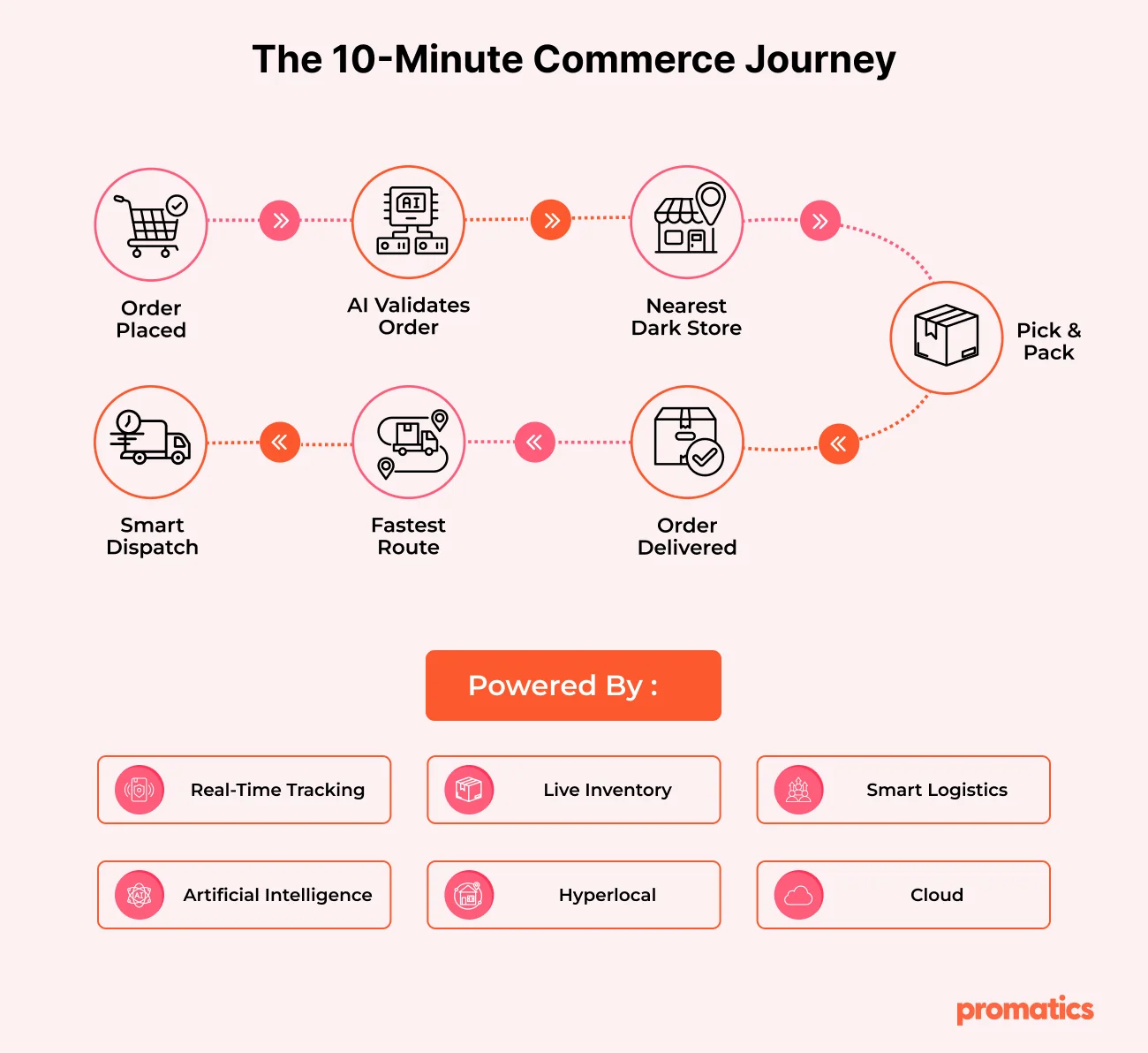
How a 10-Minute Delivery Platform Works
- A customer places an order via the mobile application.
- The order management system validates payment and product availability.
- The nearest dark store is identified.
- Real-time inventory confirms stock availability.
- Warehouse staff receive a picking request.
- AI assigns the nearest delivery partner.
- Navigation algorithms calculate the fastest route.
- The customer receives live tracking until delivery is completed.
Every stage is optimized using automation and real-time data.
Core Components of Quick Commerce App Development
A successful platform consists of four interconnected applications.
Customer Application
This is the primary touchpoint for users.
Essential features include:
- User authentication
- Smart product search
- AI-powered recommendations
- One-click checkout
- Multiple payment options
- Live order tracking
- Push notifications
- Order history
- Loyalty rewards
The user experience must remain smooth even during peak traffic hours.
Delivery Partner Application
Delivery executives require a dedicated application that enables them to accept, manage, and complete deliveries efficiently.
Key features include:
- Order notifications
- Navigation integration
- Earnings dashboard
- Availability management
- Route optimization
- Real-time status updates
- Digital proof of delivery
AI-powered dispatch systems automatically assign orders based on location, traffic conditions, and delivery capacity.
Merchant and Dark Store Dashboard
Warehouse operations determine whether 10-minute delivery is possible.
The dashboard should provide:
- Live inventory management
- Stock alerts
- Order management
- Employee allocation
- Product updates
- Performance analytics
Real-time synchronization prevents overselling and improves fulfillment accuracy.
Admin Panel
The admin dashboard provides complete operational visibility.
Functions include:
- Customer management
- Delivery management
- Promotions
- Analytics
- Revenue reports
- Coupon management
- Fraud detection
- Role-based access
This centralized system enables businesses to monitor every aspect of operations.
The Technology Stack Behind Quick Commerce
Choosing the right technology stack directly impacts scalability, reliability, and performance.
Frontend
These frameworks enable responsive and high-performance mobile experiences.
Backend
Most modern quick commerce platforms rely on:
- Node.js
- NestJS
- Spring Boot
These technologies support thousands of concurrent requests while maintaining low latency.
Databases
Different databases handle different workloads.
PostgreSQL manages transactional data.
MongoDB stores flexible product information.
Redis provides ultra-fast caching for inventory and session management.
Cloud Infrastructure
Cloud-native deployment enables automatic scaling during peak demand.
Popular choices include:
Combined with Kubernetes and Docker, these platforms ensure high availability and resilience.
AI and Machine Learning
Artificial intelligence powers almost every critical business function.
AI applications include:
- Personalized recommendations
- Demand forecasting
- Dynamic pricing
- ETA prediction
- Route optimization
- Fraud detection
- Inventory planning
Rather than reacting to demand, AI enables businesses to anticipate it.
Why Scalability Is the Biggest Challenge
Processing 500 orders per day is relatively simple.
Processing 500,000 orders across multiple cities is an entirely different challenge.
Modern quick commerce platforms solve this problem through:
- Microservices architecture
- Event-driven systems
- Distributed databases
- Load balancing
- API gateways
- Auto-scaling infrastructure
These technologies ensure that performance remains consistent even during high-demand periods.
Quick Commerce App Development: The Technology Behind 10-Minute Delivery Apps
Customers see a simple interface: browse products, add items to the cart, pay, and receive the order.
Behind the scenes, dozens of independent services work together in milliseconds.
Modern quick commerce platforms rely on a microservices architecture, where each business function operates independently while communicating through APIs and event streams.
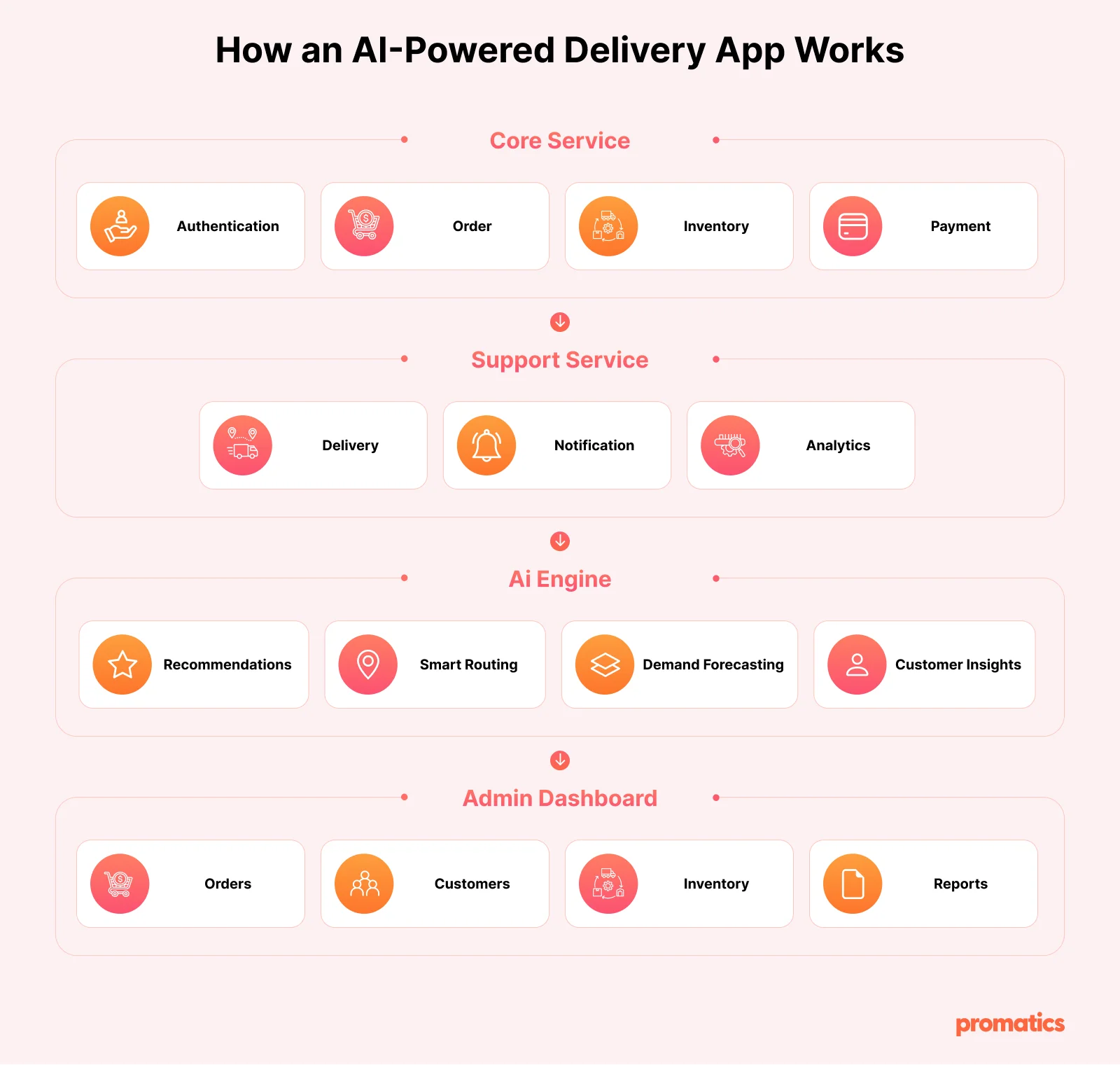
This architecture allows businesses to update inventory services without affecting payment systems, or scale delivery operations independently during peak demand.
Why Microservices Are Essential
A monolithic application may work for a startup handling a few hundred daily orders.
But when thousands of customers place orders simultaneously, every service must scale independently.
For example:
If a flash sale generates 50,000 orders in five minutes,
the platform should scale:
- Order Management
- Inventory Service
- Notification Service
without unnecessarily scaling payment or analytics services.
This reduces infrastructure costs while improving performance and reliability.
Event-Driven Architecture Improves Performance
Quick commerce platforms cannot rely on sequential processing.
Every second matters.
Instead of waiting for one service to finish before starting another, modern platforms use event-driven communication.
Example:
- Customer places an order
- Payment Successful Event
- Inventory Reserved Event
- Dark Store Assignment Event
- Delivery Partner Assigned Event
- Customer Notification Event
Each service reacts independently, reducing delays and improving system resilience.
AI Is Becoming the Core of Quick Commerce
Most businesses think AI simply recommends products.
In reality, artificial intelligence influences almost every operational decision inside a quick commerce platform.
Instead of reacting to orders, AI predicts them before they happen.
This enables businesses to reduce costs while improving delivery speed.
AI-Powered Demand Forecasting
One of the biggest challenges in quick commerce is maintaining inventory.
Too much inventory increases waste.
Too little inventory creates lost sales.
AI continuously analyzes:
- Purchase history
- Seasonal trends
- Local events
- Weather conditions
- Festivals
- Customer behavior
before recommending stock allocation for each dark store.
For example,
AI can predict increased demand for ice cream during a heat wave or higher grocery purchases before a holiday weekend.
Businesses can restock inventory before customers even place orders.
Route Optimization Makes Speed Possible
Finding the shortest route is no longer enough.
Modern routing engines evaluate multiple variables simultaneously.
Including:
- Traffic conditions
- Delivery partner availability
- Road closures
- Weather
- Vehicle type
- Multiple delivery batches
Instead of optimizing one order,
AI optimizes an entire delivery network.
This significantly reduces delivery costs while improving customer satisfaction.
Real-Time Inventory Synchronization
Inventory accuracy determines whether 10-minute delivery is achievable.
Every purchase updates inventory instantly across:
- Customer application
- Dark store dashboard
- Warehouse system
- Admin panel
- Recommendation engine
Without synchronization,
customers may order products that are already sold out.
creating cancellations and poor user experiences.
Hyperlocal Fulfillment and Dark Stores
Traditional eCommerce relies on centralized warehouses located far from customers.
Quick commerce relies on strategically located micro-warehouses known as dark stores.
Dark stores are optimized exclusively for online fulfillment.
Unlike supermarkets,
They do not serve walk-in customers.
Their layout is designed to maximize picking speed.
Advantages include:
- Faster order processing
- Better inventory management
- Reduced delivery distance
- Lower operational costs
- Higher fulfillment accuracy
This infrastructure is one of the primary reasons companies can consistently deliver within 10 to 20 minutes.
The Role of Data Analytics
Every interaction generates valuable business intelligence.
Modern quick commerce platforms analyze the following:
- Customer behavior
- Popular products
- Peak ordering times
- Delivery performance
- Cart abandonment
- Inventory turnover
- Customer lifetime value
- Marketing ROI
This data helps businesses continuously improve operations and increase profitability.
Security Cannot Be an Afterthought
Quick commerce applications process sensitive information every second.
Including:
- Customer addresses
- Payment details
- Personal information
- Order history
- Delivery locations
Enterprise-grade security should include:
- End-to-end encryption
- Multi-factor authentication
- PCI DSS compliance
- GDPR compliance
- Secure API management
- Role-based access control
- Continuous security monitoring
Security is no longer just a compliance requirement.
It has become a competitive advantage.
Building for Peak Traffic
One of the biggest technical challenges is handling unpredictable demand spikes.
Examples include:
- Festival sales
- Weekend grocery orders
- Flash discounts
- Rainy weather
- Sporting events
Traffic may increase by 500% within minutes. Cloud-native infrastructure allows platforms to automatically scale resources without downtime.
Technologies commonly used include:
- Kubernetes
- Docker
- Redis
- Kafka
- CDN
- Load Balancers
This ensures customers experience fast performance regardless of demand.
The Cost of Quick Commerce App Development
The cost of quick commerce app development varies depending on your business model, feature set, technology stack, AI capabilities, and scalability requirements. A basic MVP designed to validate an idea requires a significantly lower investment than an enterprise-grade platform capable of processing millions of orders across multiple locations.
| Platform Type | Estimated Development Cost |
| MVP (Minimum Viable Product) | $30,000–$60,000 |
| Startup Platform | $60,000–$120,000 |
| Enterprise Solution | $120,000–$300,000+ |
Key Factors That Influence Development Cost
Several technical and business requirements directly impact the overall investment:
- Customer mobile application (iOS & Android)
- Delivery partner application
- Merchant and admin dashboards
- AI-powered recommendations and demand forecasting
- Real-time inventory management
- Cloud infrastructure and DevOps
- Third-party API integrations (payments, maps, notifications, analytics)
- Security, compliance, and data protection
- Quality assurance, testing, and ongoing maintenance
While reducing upfront costs may seem appealing, prioritizing scalable architecture, cloud-native infrastructure, and intelligent automation delivers greater long-term value. A well-designed quick commerce platform can easily accommodate growing user traffic, expand to new markets, integrate advanced AI capabilities, and support future business needs without requiring a complete rebuild, ultimately lowering operational costs and maximizing return on investment.
Emerging Trends Shaping Quick Commerce
Agentic AI
Instead of assisting operations,
AI agents will independently:
- Allocate inventory
- Assign deliveries
- Optimize pricing
- Resolve customer issues
- Predict supply shortages
This will significantly reduce operational overhead.
Predictive Commerce
AI will begin recommending products before customers actively search for them.
Personalized shopping experiences will become the industry standard.
Autonomous Delivery
Although still emerging,
delivery robots and drones are expected to handle hyperlocal deliveries for selected categories,
reducing delivery costs and increasing efficiency.
Computer Vision
Warehouses will increasingly rely on computer vision systems for:
- Inventory counting
- Quality inspection
- Shelf monitoring
- Product verification
reducing manual effort while improving accuracy.
Why Businesses Are Investing in Quick Commerce
Quick commerce is no longer limited to grocery startups.
Industries adopting this model include:
- Healthcare
- Pharmacy
- Electronics
- Fashion
- Pet supplies
- Restaurants
- Beauty products
- Home essentials
The objective is no longer simply delivering products faster. It is creating a seamless customer experience that increases purchase frequency and long-term loyalty.
Final Thoughts
Quick commerce is redefining the future of digital retail by bringing together AI, automation, cloud-native infrastructure, and hyperlocal logistics into a single intelligent ecosystem. What customers experience as a seamless 10-minute delivery is powered by real-time inventory synchronization, predictive analytics, microservices architecture, and data-driven decision-making working behind the scenes.
As customer expectations continue to rise, businesses need more than a delivery application. They need a scalable, secure, and high-performance platform capable of handling rapid growth, optimizing operations, and delivering exceptional user experiences. Investing in quick commerce app development is not just about enabling faster deliveries; it’s about building a future-ready digital ecosystem that drives customer loyalty, operational efficiency, and sustainable business growth.
Whether you’re launching a grocery delivery app, pharmacy marketplace, or hyperlocal commerce platform, partnering with an experienced development team can accelerate your journey from idea to market.
At Promatics Technologies, we build AI-powered quick commerce solutions with scalable architecture, real-time inventory management, intelligent logistics, and seamless user experiences tailored to your business goals. Contact our experts today to develop a high-performance quick commerce platform that delivers speed, scalability, and long-term business value.
