AI Readiness Assessment: Identify and Prioritize AI Use Cases

TL;DR
- Assess AI readiness across data, technology, people, processes, and strategy.
- Find high-value AI use cases based on impact, feasibility, and ROI.
- Close critical gaps in data, infrastructure, skills, security, and governance.
- Prioritize AI investments with a clear roadmap from pilot to scale.
- Build for business value, not AI hype. Start where AI can deliver measurable results.
AI is quickly becoming a business priority, but adopting it without assessing readiness can result in poor data quality, integration challenges, unclear ROI, and pilots that never scale.
According to McKinsey’s State of AI research, about 37% of organizations report some level of EBIT impact from AI, while AI agent adoption continues to grow, especially among larger businesses.
This raises a critical question:
Is your business ready to adopt AI, or simply ready to experiment with it?
An AI readiness assessment helps answer this by evaluating your strategy, data, technology, talent, processes, security, governance, and organizational culture. It helps businesses identify the right AI use cases, uncover capability gaps, prioritize investments, and build a practical AI implementation roadmap.
McKinsey also found that organizational AI readiness explains 48% of the difference between organizations that successfully capture AI value and those that do not.
In this guide, we explain how to assess AI readiness, prioritize high-value AI use cases, identify gaps, and prepare your business for successful AI adoption.
The goal is not to adopt AI everywhere. It is to identify where AI can create measurable value and build the right foundation to scale it.
Quick Answer: What Is an AI Readiness Assessment?
An AI readiness assessment evaluates whether a business has the strategy, data, technology, people, processes, security, governance, and resources required to successfully adopt artificial intelligence.
It helps businesses answer four key questions:
- Where can AI create measurable business value?
- Do we have the required data and technology?
- Which AI use cases should we prioritize?
- What gaps must we address before implementation?
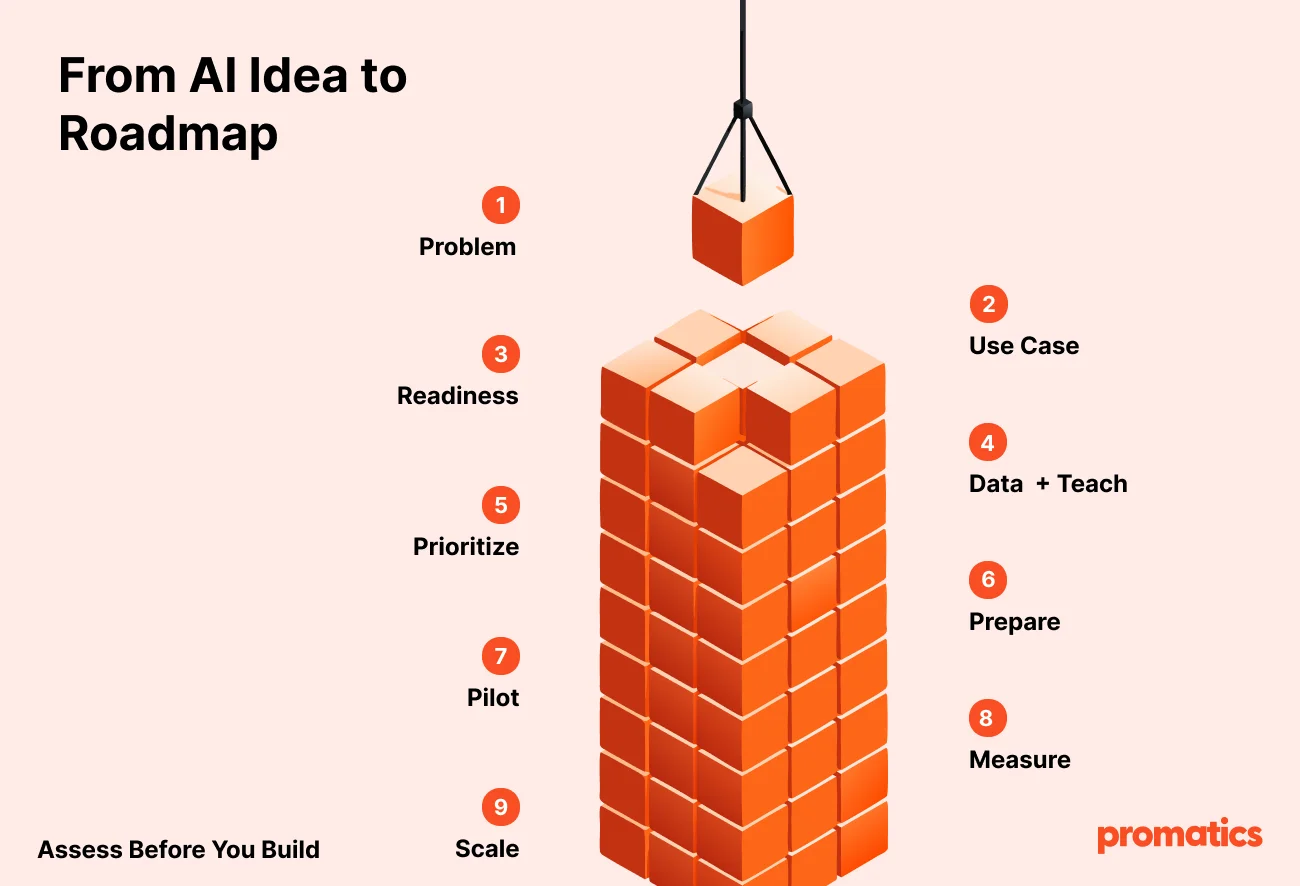
A practical AI readiness journey follows:
Assess → Identify → Prioritize → Prepare → Pilot → Measure → Scale
Why AI Readiness Matters for Businesses
AI adoption is moving from experimentation toward operational use.
McKinsey’s 2026 State of AI research shows that organizations are increasingly scaling AI agents across business functions, including IT, knowledge management, and software engineering.
However, adopting AI tools does not automatically create business value.
Organizations still need the right:
Data + Technology + People + Processes + Governance
This is why businesses should evaluate their AI readiness before making significant investments in development or deployment.
An AI readiness assessment helps identify opportunities while exposing gaps that could increase cost, risk, or implementation time.
What Is Business AI Readiness?
Business AI readiness is an organization’s ability to adopt, implement, manage, and scale AI effectively.
Consider an ecommerce company planning AI-powered demand forecasting.
The idea may appear simple, but an assessment could reveal:
- Sales data is spread across multiple systems.
- Inventory information is inconsistent.
- Historical data is incomplete.
- Existing systems lack APIs.
- Forecast accuracy is not measured.
- No team owns the data pipeline.
The problem is not necessarily the AI model.
The business may simply need to improve its data and technology foundation first.
That is the value of an AI readiness assessment: it identifies these issues before development begins.
AI Readiness vs AI Adoption
AI readiness and AI adoption are closely related but different.
| AI Readiness | AI Adoption |
| Measures preparedness | Implements AI |
| Identifies gaps | Addresses gaps |
| Finds opportunities | Deploys solutions |
| Evaluates risks | Manages AI |
| Defines priorities | Executes the roadmap |
A company can already use ChatGPT, Copilot, Gemini, or other AI tools while still having low organizational AI readiness.
For example, employees may use AI independently without formal policies, data controls, governance, or evaluation processes.
Why Businesses Need an AI Readiness Assessment
1. Identify the Right AI Opportunities
AI should solve a business problem rather than simply introduce new technology.
Instead of asking:
“Where can we use AI?”
ask:
“Which business problems could AI solve better, faster, or more economically?”
Potential opportunities include:
- Customer-service automation
- Predictive analytics
- AI-powered personalization
- Intelligent document processing
- AI assistants
- AI agents
- Fraud detection
- Workflow automation
2. Reduce AI Project Risk
AI projects can fail because of:
- Poor data
- Weak integration
- Unclear KPIs
- Lack of expertise
- Security concerns
- High operating costs
- Low employee adoption
IBM identifies data readiness, governance, security, ROI, skills, organizational change, and workflow integration as important challenges for organizations adopting AI.
A readiness assessment identifies these risks before they become expensive development problems.
3. Understand Data Readiness
Large amounts of data do not automatically mean an organization is AI-ready.
Businesses should assess:
- Data availability
- Data quality
- Data accessibility
- Data integration
- Data ownership
- Data governance
IBM’s 2025 Chief Data Officer research found that the share of CDOs reporting that they had the right data platform to process enterprise data increased from 41% in 2023 to 75% in 2025.
The message is clear:
AI readiness starts with data readiness.
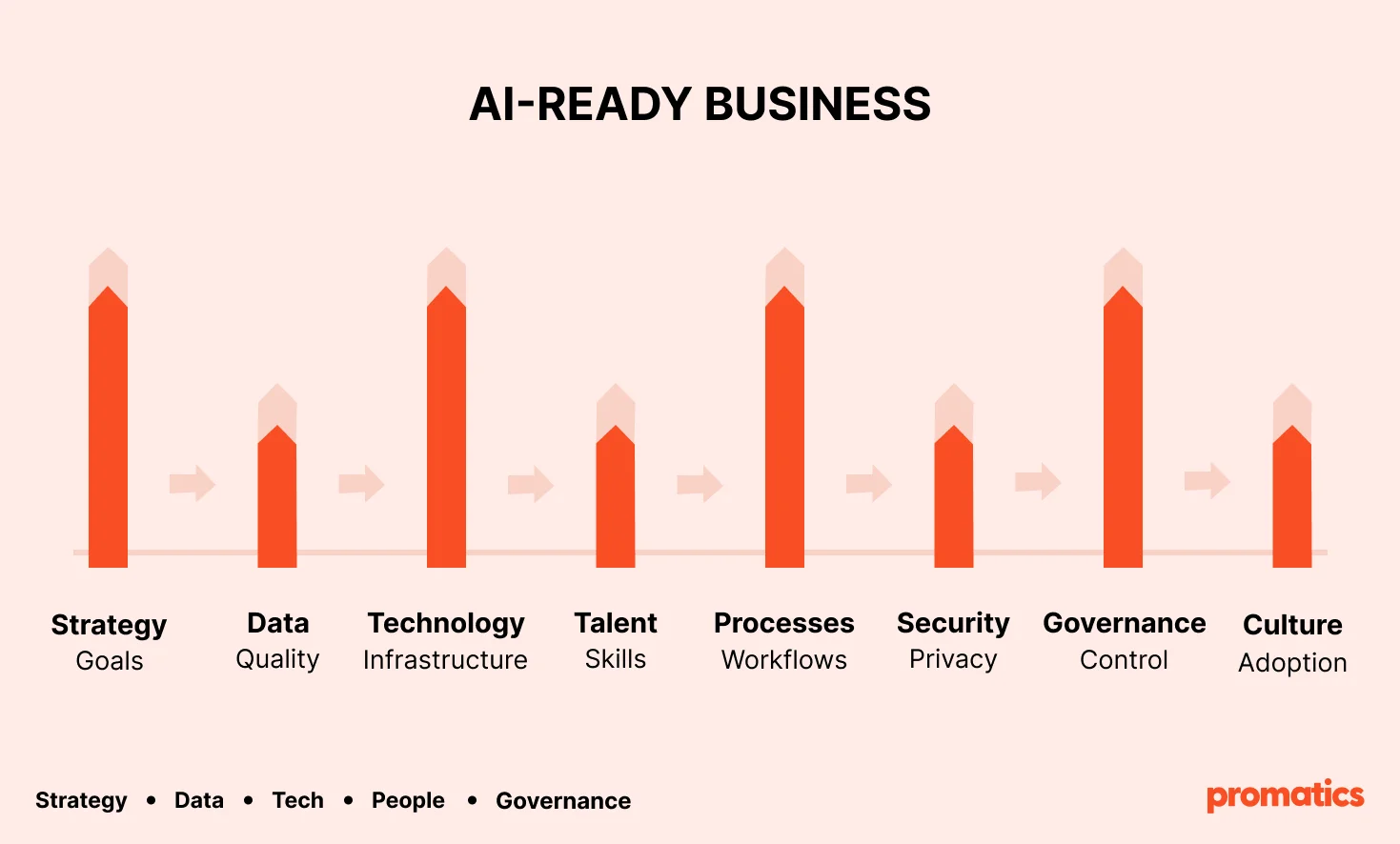
The 8 Dimensions of AI Readiness
A comprehensive AI readiness framework should evaluate eight areas.
1. Business Strategy
Assess:
- Business objectives
- AI goals
- Priority problems
- Expected outcomes
- Leadership support
AI initiatives should directly connect to business strategy.
Businesses that need help aligning technology investments with business objectives can explore Promatics strategy consulting.
2. Data Readiness
Evaluate:
- Availability
- Quality
- Accessibility
- Integration
- Governance
Ask:
Can our teams access the data required for this AI use case today?
If not, data preparation becomes part of the implementation roadmap.
3. Technology and Infrastructure
Assess:
- Cloud infrastructure
- Databases
- APIs
- Enterprise applications
- Integration architecture
- Security
- Monitoring
For example, an AI customer-service system may need access to:
CRM → Orders → Knowledge Base → Tickets
If these systems cannot communicate effectively, AI deployment becomes more complicated.
Businesses can also assess their broader software development capabilities when modernization or integration is required.
4. AI Talent
AI initiatives may require:
- AI engineers
- ML engineers
- Data engineers
- Software developers
- Data scientists
- Cloud engineers
- Security specialists
- Domain experts
Assess which skills exist internally and where external expertise is required.
5. Process Readiness
Map the workflow:
Input → Decision → Action → Outcome
Identify:
- Repetitive tasks
- Manual handoffs
- Bottlenecks
- Errors
- Data-heavy decisions
- Human approval points
Do not automate a broken process without first understanding why it is broken.
6. Security, Privacy and Compliance
Assess:
- Sensitive data
- Access controls
- Encryption
- Data retention
- Third-party AI providers
- Model security
- Audit logging
- Regulatory requirements
The EU AI Act, for example, uses a risk-based approach with requirements that vary according to the AI system and its use.
AI readiness therefore includes regulatory readiness.
7. AI Governance
Governance should define:
- AI policies
- Data usage
- Risk classification
- Human oversight
- Model evaluation
- Monitoring
- Accountability
- Incident management
Good governance becomes especially important when AI systems begin making decisions or taking actions.
8. People and Culture
Assess:
- Leadership support
- AI literacy
- Employee training
- Change management
- Cross-functional collaboration
- Adoption readiness
Employees should understand how AI will affect their workflows and responsibilities.
How to Conduct an AI Readiness Assessment
A practical assessment can follow nine steps.
Step 1: Define Business Objectives
Identify:
- Business goals
- Target outcomes
- Priority departments
- KPIs
Example:
| Business Goal | AI Opportunity |
| Reduce support costs | AI support assistant |
| Increase conversions | Lead scoring |
| Improve forecasting | Predictive analytics |
| Reduce manual work | Workflow automation |
| Improve productivity | AI assistant |
Step 2: Identify Business Problems
Ask:
- What consumes the most employee time?
- Where do delays occur?
- Where are errors common?
- Which decisions require extensive data?
- Which processes are difficult to scale?
Start with problems, not technologies.
Step 3: Identify AI Use Cases
Potential use cases include:
- Sales: Lead scoring, forecasting, recommendations
- Marketing: Personalization, segmentation, sentiment analysis
- Customer Service: AI assistants, ticket classification, voice agents
- Finance: Fraud detection, invoice processing, anomaly detection
- HR: Candidate matching, employee assistants, workforce analytics
- Operations: Predictive maintenance, forecasting, optimization
Step 4: Assess Data Availability
Use a simple score:
| Score | Data Readiness |
| 3 | Ready |
| 2 | Needs preparation |
| 1 | Limited |
| 0 | Unavailable |
This helps separate practical AI opportunities from ideas requiring major data investments.
Step 5: Score Business Impact
Rate each use case from 1–5 based on:
- Revenue potential
- Cost reduction
- Productivity
- Customer impact
- Strategic value
Step 6: Assess Technical Feasibility
Consider:
- Data complexity
- Integration
- AI model requirements
- Infrastructure
- Development effort
- Security
- Accuracy requirements
Step 7: Evaluate Risk
Assess:
- Privacy risk
- Security risk
- Regulatory risk
- Financial risk
- Operational risk
- Accuracy risk
- Reputation risk
Step 8: Estimate ROI
Consider both implementation and ongoing costs.
AI Cost = Development + Infrastructure + Models/API + Integration + Monitoring + Maintenance + Training
Then compare the total cost against measurable benefits.
Step 9: Prioritize
Rank use cases according to:
Impact + Feasibility + Data Readiness + Strategic Fit + Time to Value − Risk
How to Prioritize AI Use Cases
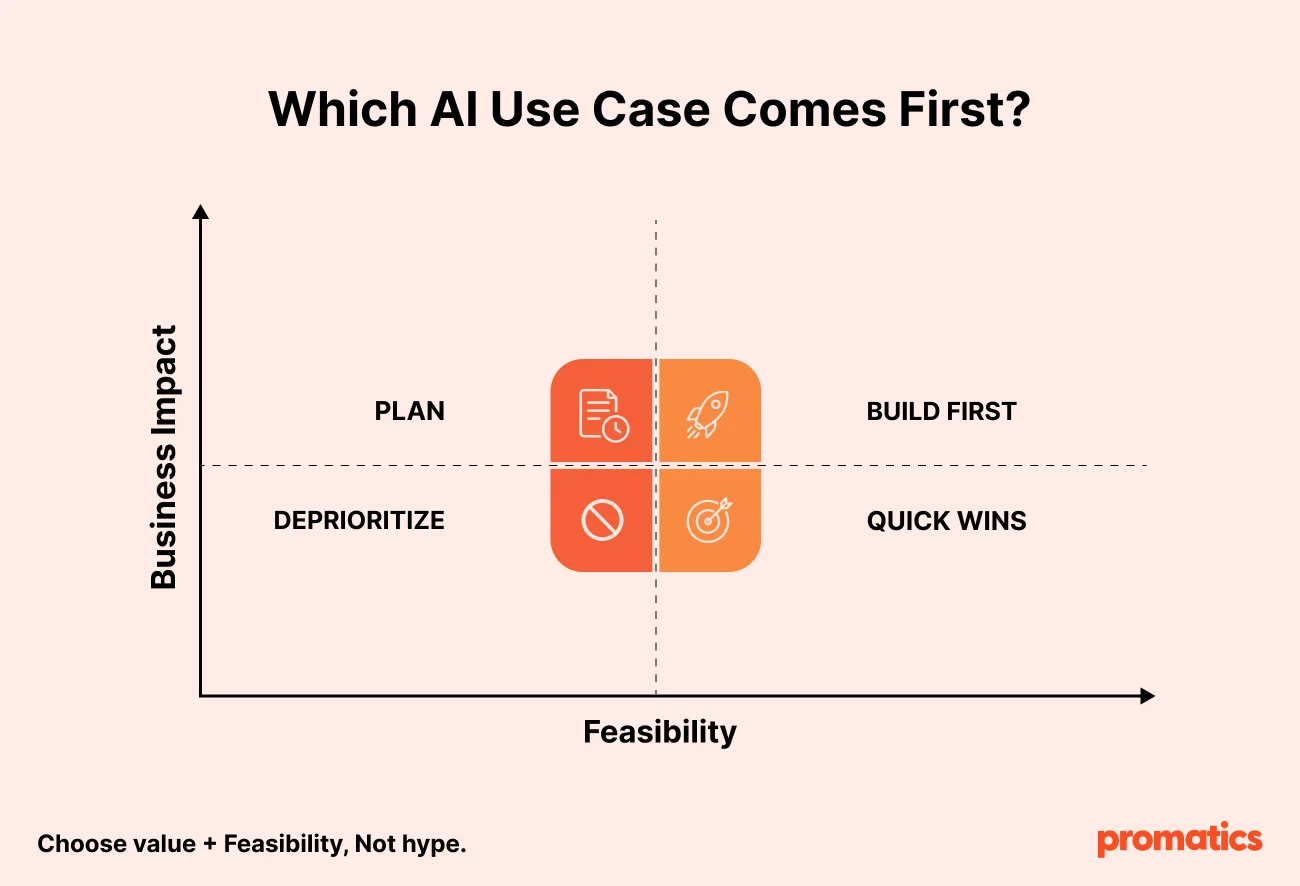
Not every AI opportunity deserves immediate investment.
A simple prioritization matrix can compare:
Business Impact × Feasibility
High Impact + High Feasibility
BUILD FIRST
Examples:
- AI customer support
- Document automation
- Lead scoring
High Impact + Low Feasibility
PLAN
Examples:
- Complex AI agents
- Advanced predictive systems
Low Impact + High Feasibility
QUICK WINS
Examples:
- Summarization
- Basic workflow assistance
Low Impact + Low Feasibility
DEPRIORITIZE
AI Readiness Maturity Model
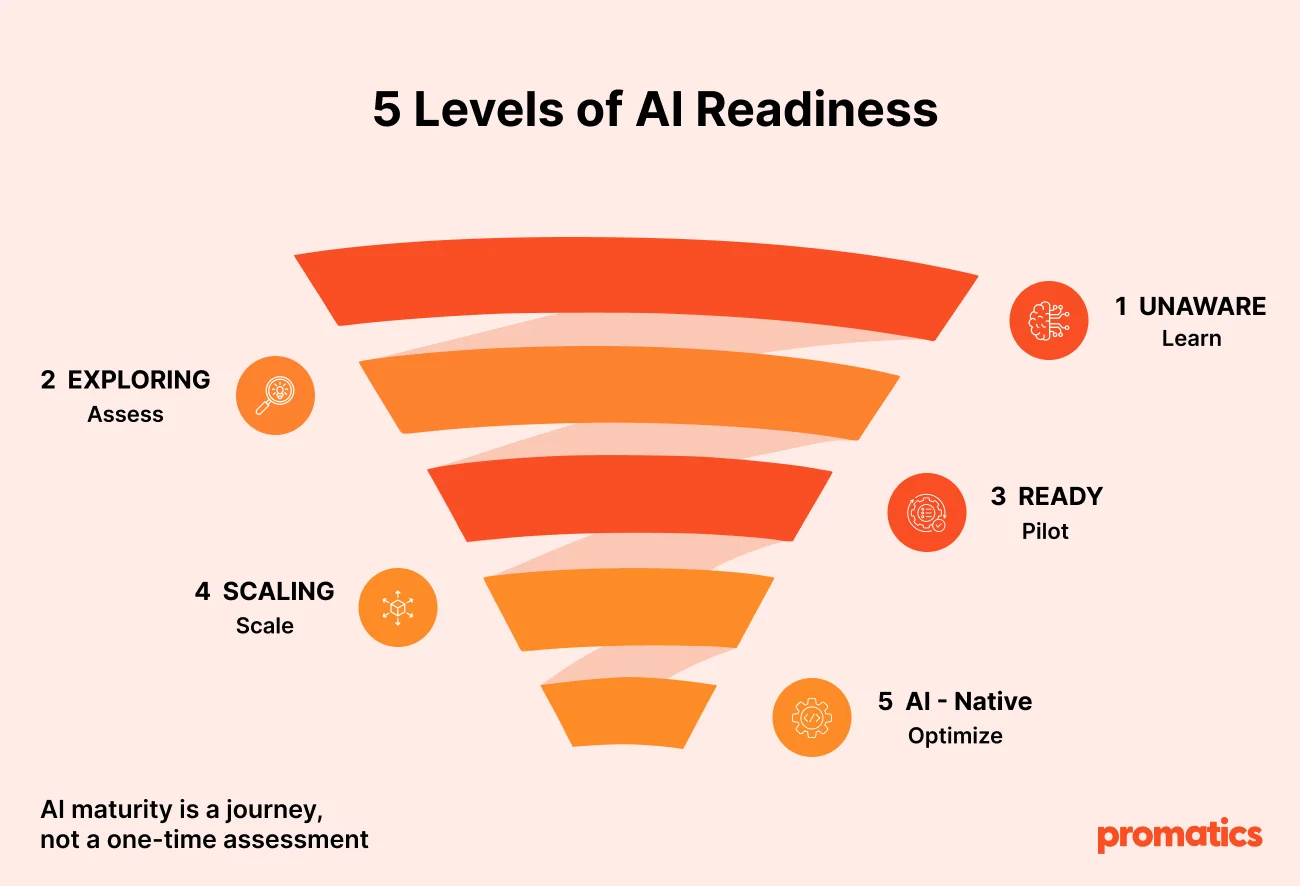
Businesses can use five levels to understand their current AI maturity.
Level 1: AI Unaware
No formal strategy or governance.
Focus: Learn
Level 2: Exploring
Experiments and early use cases.
Focus: Assess
Level 3: AI Ready
Priorities, data, KPIs, and capabilities are defined.
Focus: Pilot
Level 4: Scaling
AI is integrated into workflows and production.
Focus: Scale
Level 5: AI-Native
AI is embedded across products and operations.
Focus: Optimize
AI Readiness Checklist
Before starting an AI project, ask:
Strategy
- Goals defined
- Leadership aligned
- KPIs established
Data
- Data available
- Data quality acceptable
- Data accessible
Technology
- Infrastructure ready
- APIs available
- Security controls established
People
- AI skills available
- Ownership defined
- Training planned
Governance
- AI policies defined
- Risks assessed
- Human oversight established
Finance
- Budget approved
- ROI estimated
- Operating costs understood
Common AI Readiness Gaps
Poor Data Quality
Unreliable data can undermine AI performance.
Solution: Improve data quality, standardization, ownership, and governance.
Legacy Systems
Older applications may lack modern integration capabilities.
Solution: Modernize critical systems or introduce appropriate integration layers.
Lack of AI Expertise
Software teams may not have specialized AI capabilities.
Solution: Upskill teams or work with an experienced AI development partner.
Unclear ROI
Innovation alone is not a business case.
Solution: Define measurable KPIs before development.
Shadow AI
Employees may use AI tools without organizational controls.
Solution: Establish approved tools, policies, training, and data controls.
Over-Automation
Some decisions require human judgment.
Solution: Define clear human-in-the-loop controls.
AI Readiness by Business Size
Startups
Focus on:
- AI-native products
- Fast experimentation
- Scalable architecture
- Data strategy
- Cost control
Small and Medium Businesses
Prioritize:
- Customer support
- Document automation
- Sales assistance
- Marketing automation
- Internal knowledge systems
Enterprises
Evaluate:
- Legacy systems
- Data architecture
- Security
- Governance
- Compliance
- Workforce transformation
- AI operating costs
The larger the organization, the more AI readiness becomes an organizational transformation exercise.
AI Readiness by Industry
Healthcare
Patient engagement, clinical workflow support, documentation, predictive analytics and administrative automation.
Financial Services
Fraud detection, risk analysis, customer service, document intelligence and forecasting.
Ecommerce
Recommendations, personalization, demand forecasting, customer support and inventory optimization.
Manufacturing
Predictive maintenance, quality inspection, production optimization and supply-chain intelligence.
Logistics
Route optimization, ETA prediction, fleet monitoring and demand forecasting.
SaaS
AI copilots, intelligent search, workflow automation, customer support and AI agents.
AI Readiness for Generative AI and AI Agents
The AI readiness conversation is evolving beyond traditional machine learning.
Generative AI can create and summarize content, answer questions, generate code, and interact with enterprise knowledge.
AI agents go further by using tools and performing multi-step tasks.
AWS describes AI agents as systems that can reason through tasks, use tools, and take actions toward a goal.
For agentic AI, businesses should additionally assess:
- Identity and permissions
- Tool access
- Workflow boundaries
- Human approval
- Monitoring
- Auditability
- Failure handling
- Security
- Cost controls
The question is no longer simply:
“Can we use AI?”
It is:
“Can we safely allow AI to take action?”
From AI Readiness Assessment to Implementation
A readiness assessment should result in an actionable roadmap.
Phase 1: Discover
Business discovery → Process mapping → Data audit → Technology assessment
Phase 2: Prioritize
Use-case scoring → ROI analysis → Risk assessment → Pilot selection
Phase 3: Validate
MVP → Integration → Testing → User feedback → KPI measurement
Phase 4: Scale
Production deployment → Monitoring → Optimization → Expansion
For organizations that need to turn AI opportunities into production-ready digital products, Promatics Technologies provides AI, software development, web and mobile development, and digital product engineering capabilities.
Explore relevant Promatics case studies to see how technology initiatives can translate into practical business solutions.
Build, Buy or Partner?
Once AI opportunities are identified, businesses need to decide how to execute them.
Build
Best when AI is strategically important and strong internal capabilities exist.
Buy
Best when a mature product already solves the problem with minimal customization.
Partner
Best when the business needs:
- Specialized AI expertise
- Custom development
- Complex integrations
- Faster implementation
- Strategic guidance
A hybrid approach often works well:
Internal business ownership + External AI expertise
When Should You Work With an AI Development Partner?
An AI development partner can help when a business has identified an opportunity but lacks the technical capabilities to move from concept to production.
Support may include:
- AI strategy
- AI readiness assessment
- AI use-case discovery
- Generative AI development
- Machine learning
- AI agent development
- Predictive analytics
- RAG implementation
- AI integration
- Custom software development
- Cloud deployment
- AI testing and monitoring
For organizations evaluating their next AI initiative, Promatics Technologies can support the journey from strategy and readiness assessment through development and deployment.
7 Questions to Ask Before Starting an AI Project
1. What business problem are we solving?
Define the problem before selecting the technology.
2. Why does it require AI?
Traditional software or automation may sometimes be better.
3. Do we have the required data?
If not, include data preparation in the roadmap.
4. How will we measure success?
Define KPIs before development.
5. What happens if AI makes a mistake?
Define human oversight and escalation.
6. Can AI integrate with existing systems?
A prototype must eventually work within the real business environment.
7. Can we operate and scale it?
Consider infrastructure, model costs, security, monitoring and maintenance.
Common AI Readiness Mistakes
- Starting with technology: Begin with business problems.
- Choosing hype over value: Prioritize measurable impact.
- Ignoring data: Assess data before model development.
- Treating AI as an IT project: Include business, operations, security and HR.
- Ignoring integration: AI must work with existing systems.
- Underestimating ongoing costs: Budget for operation, not just development.
- Skipping governance: Define ownership and controls early.
- Scaling too quickly: Prove value with a controlled pilot first.
A Practical 90-Day AI Readiness Roadmap
Days 1–30: Discover
Business goals → Process mapping → Data audit → Technology assessment → Use-case discovery
Output: AI readiness and opportunity report
Days 31–60: Prioritize
Use-case scoring → ROI analysis → Risk assessment → Architecture planning
Output: Prioritized AI roadmap
Days 61–90: Validate
MVP → Integration → Testing → Feedback → KPI measurement
Output: Validated AI pilot
This approach allows businesses to test value before committing to large-scale AI implementation.
What Should an AI Readiness Assessment Deliver?
A professional assessment should produce:
- Current-State Assessment
- AI Maturity Score
- AI Use-Case Inventory
- Use-Case Prioritization Matrix
- Data Readiness Report
- Technology Assessment
- Risk and Governance Assessment
- ROI Framework
- AI Implementation Roadmap
The final output should be actionable, not simply a report.
Final Takeaway
AI readiness is not about achieving perfect technology, perfect data, or unlimited AI expertise before starting.
It is about understanding:
Where are we today?
Where can AI create value?
What gaps must we address?
Which use case should we build first?
A strong AI readiness assessment connects:
Strategy + Data + Technology + People + Processes + Security + Governance + ROI
into a practical roadmap.
The winning approach is:
Assess → Identify → Prioritize → Prepare → Pilot → Measure → Scale
For businesses evaluating AI, the smartest first step is not necessarily building an AI solution.
It is identifying the right problem, the right use case, and the right path to measurable value.
If your organization is evaluating AI opportunities, Promatics Technologies can help turn those opportunities into a practical technology roadmap and production-ready solution.
