Blockchain Beyond Crypto: Real-World Use Cases for Modern Businesses
TL;DR
- Real-world blockchain applications beyond cryptocurrency.
- Supply chain, healthcare, finance, and identity verification use cases.
- Smart contracts, decentralization, and transparency benefits.
- Enterprise blockchain adoption and Web3 ecosystem growth.
- Business innovation opportunities powered by blockchain technology.
Introduction: Opening Lens: Blockchain’s Shift From Hype to Utility
In the past, almost all blockchain talks were mainly related to price charts, volatility, and speculative investment. The headlines were full of noise, the markets were driven by emotions, and it was hard to see how this technology could bring real value to businesses.
However, the present-day scenario is that the topic sounds quite different now. Executives in companies situated in such cities as London, New York, and Singapore, discuss blockchain seriously, not as a thing of a trend, but as an enabler of trust, transparency, and automation.
The speculative crypto fever has gone down. On the other hand, the enterprise blockchain uptake is becoming more and more rapid. Traders are not the ones paving the way for the new wave of technology adoption anymore – it’s businesses driven by operational needs.
This turnaround has been facilitated by the changes in the ways businesses use blockchain:
- Zero-knowledge proofs enabling privacy-first verification.
- Tokenized real-world assets entering regulated and compliant markets.
- AI–Blockchain convergence creating verifiable, tamper-proof intelligence.
At Promatics, the transformation can be observed through enterprise projects where blockchain is not seen as innovation theater but as a proper secure digital system foundation. The technology of blockchain beyond crypto is no longer excessive, it is becoming a true underlying digital trust framework.
Why Blockchain Still Matters in 2025 (Even Without Crypto)
Imagine the situation where you have to check whether a document, a dataset or a digital identity actually exists – and all the while, the majority of contents are AI-generated. This trust issue is what companies face nowadays all over the world.
At this point, blockchain is the perfect technology to solve this problem.
A few examples of core business problems that can be resolved through blockchain
- Data integrity in an AI-generated world
- Identity verification amid deepfakes and synthetic identities
- Supply chain transparency for ESG-conscious customers
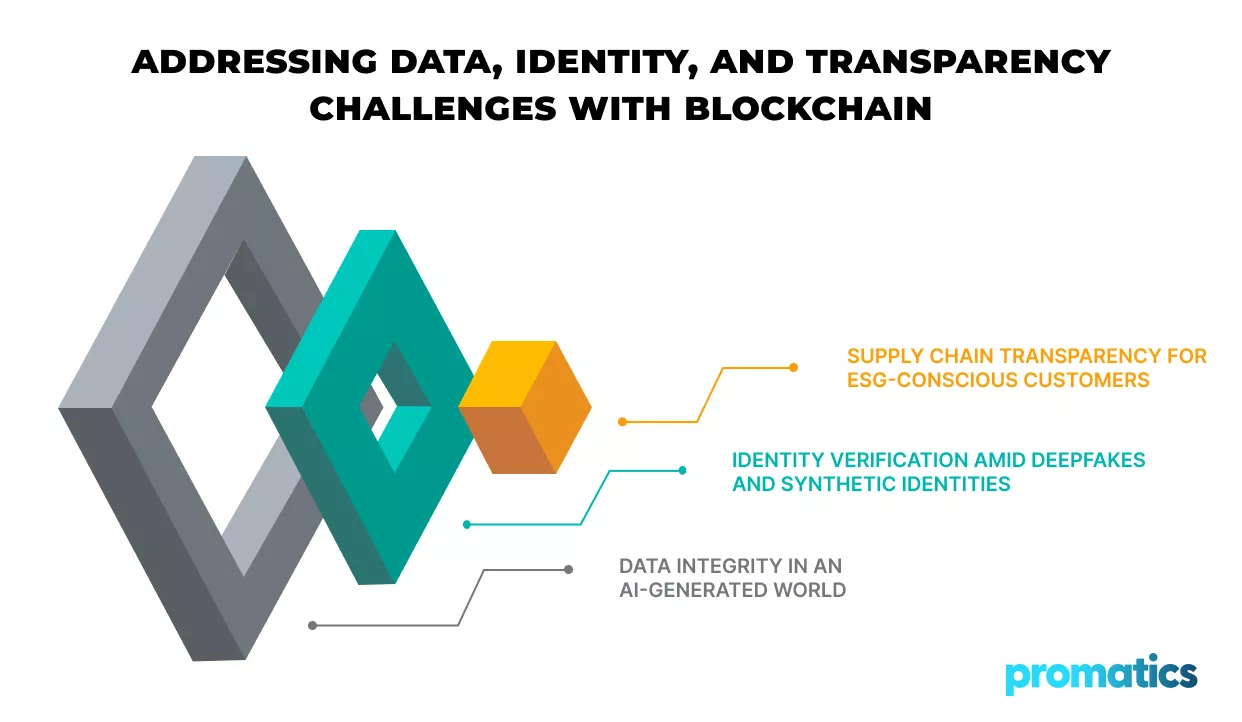
The use of blockchain in business, especially in trust-centric, audit and compliance-heavy sectors, has long been a necessity rather than a mere option.
The main reasons behind the surge of adoption nowadays
- UK and US regulations pushing transparency and audit trails
- Enterprises adopting private blockchain networks
- Rapid growth of decentralized identity systems for compliance
According to the World Economic Forum, blockchain-based systems are increasingly viewed as foundational trust infrastructure rather than financial tools alone.
Today’s Popular Blockchain Tech Stacks (What Companies Actually Use)
a. Enterprise-Focused Blockchain Platforms
These platforms are preferred over others by most enterprise blockchain deployments:
- Hyperledger Fabric
Widely used by US enterprises for permissioned data sharing - Corda
Popular in UK financial services for secure, peer-to-peer data exchange - Quorum / Enterprise Ethereum
Trusted for regulated environments requiring Ethereum compatibility
Lots of these implementations are carried out via custom enterprise blockchain development services.
b. Web3 & Developer-Friendly Ecosystems
For scalable and high-performance systems, enterprises increasingly adopt:
- Polygon – enterprise-friendly scalability
- Avalanche – modular architecture for complex apps
- Solana – real-time validation use cases
These ecosystems support faster deployment while maintaining decentralization benefits.
c. Tools Enterprises Love in 2025
| Category | Tools |
| Oracles | Chainlink |
| Storage | IPFS, Filecoin |
| Wallets | MetaMask Institutional |
| Languages | Solidity, Rust |
These tools make blockchain automation practical, not experimental.
Real-World Areas Where Blockchain Is Quietly Winning
a. Supply Chain Blockchain: Tracking Truth From Source to Buyer
Major food retailers in the U. S. use blockchain to track the origins of their produce in seconds – resulting in the recall time being cut down from days to minutes.
Luxury brands in the UK employ blockchain to prove the authenticity of their products and, thereby, fight against counterfeiting.
Key Use Cases
- Anti-counterfeit verification
- Food safety and pharma traceability
- ESG-driven transparency
Find out how blockchain is integrated into supply chain management in the real-world.
IBM highlights similar enterprise use cases in the supply chain of food and healthcare
b. Smart Contracts in Business Automation
The use of smart contracts results in getting rid of manual bottlenecks.
The contracts are no longer replaced by emails, approvals, and reconciliations but by logic-based execution.
Common Applications
- Automated escrow releases
- Subscription billing with rule-based triggers
- Compliance checks without bottlenecks
US-based delivery companies are already taking advantage of blockchain-based automation to process payments automatically when the delivery conditions are met.
This aligns closely with workflow automation solutions.
c. Decentralized Identity (DID) for Compliance & Trust
Decentralized IDs are gaining importance in tightly regulated sectors.
Projects led by the UK government are currently actively evaluating the promise of DID frameworks for delivering secure citizen services.
Business Applications
- Faster customer onboarding
- Employee verification for global teams
- Secure e-governance systems
Check out more regarding identity-centric digital transformation. And the MIT Media Lab demonstrates how decentralized identity is a major factor in building digital.
d. Secure Data Sharing Across Organizations
In the US healthcare industry, blockchain serves as:
- Secure medical record sharing
- Controlled access across hospitals
- Tamper-proof audit trails
Artificial Intelligence platforms also increasingly employ blockchain to show that the dataset has not been tampered with, which is an essential requirement both for compliance and for gaining the trust of the model.
This method goes hand in hand with healthcare software development.
e. Tokenization for Enterprises: Real Assets, Real Value
Currently, tokenization is not merely a theory, but a concept that is getting gradually embedded into practices.
Live Enterprise Examples
- Property tokenization in US real estate platforms
- Invoice financing via blockchain in UK fintech
- Equipment leasing using tokenized ownership
Tokenization for enterprises facilitates the aspects of liquidity, transparency, and fractional ownership – all this is achieved without having to expose one’s self to public crypto markets.
A Micro Story: Quiet Impact, Real Results
A while ago, an enterprise client with operations in both the UK and the US faced difficulties when it came to verifying documents of their partners across teams that are geographically spread.
Blockchain technology, which empowers data verification, was used to create a layer of verification without having to build another centralized system. Real-time access to the same authenticated data brought great value to every stakeholder.
The Outcome
- Document validation time dropped by 63%
- Compliance improved
- No additional tools were required
That is the blockchain beyond crypto in a nutshell.
Industry Trends Making Blockchain More Relevant Than Ever
Several 2025 trends are accelerating adoption:
- AI + Blockchain for proving data origin
- Government adoption of blockchain-based e-invoicing
- ESG audits demanding transparent supply chains
- Cross-border payments moving to stable blockchain rails
- Hybrid models combining private chains with public verification
These trends align closely with AI and blockchain convergence strategies.
Misconceptions Still Holding Companies Back
There are numerous outdated assumptions on the basis of which the businesses are deciding to wait with the implementation.
Common Myths
- “Blockchain equals cryptocurrency” (it doesn’t)
- “Blockchain is too expensive” (modular systems reduce costs)
- “Blockchain is slow” (modern L2s are extremely fast)
- “Only tech giants can use it” (SMEs deploy private chains daily)
Getting to know these truths is a decisive step towards an informed decision and readiness for the adoption.
How Businesses Should Evaluate Blockchain Adoption
Here are some questions that executives should ask themselves before the implementation of blockchain technology:
- Is trust a core issue?
- Are multiple parties involved?
- Is real-time verification critical?
- Does long-term data integrity matter?
- Can automation reduce manual effort?
If most answers are “yes,” blockchain for business is likely a strong fit.
Where Blockchain Fits in the Future Tech Roadmap
In the future, blockchain can be a core technology:
- AI model training lineage stored on blockchain
- Human identity secured via decentralized credentials
- Fully transparent global supply chains
- Smart cities using decentralized governance
- Autonomous commerce: machines paying machines
These systems will operate quietly, but reliably.
Final Words: Blockchain Will Become Infrastructural
Businesses are toying with different technologies one day and the very next day, they are already ready to upgrade them and integrate them into their regular business processes. So, it is reasonable to think that one day the discussion of blockchain might not come up at all.
It’s not that it failed but because the technology worked.
Like cloud computing or APIs, blockchain beyond crypto will quietly embed itself into everyday business operations. It will secure data integrity, enable automation, and create transparent systems without drawing attention to the technology behind them.
As organizations continue to modernize their digital ecosystems, blockchain will entirely move to the background, supporting trust-driven processes at scale. Promatics utilizes this forward-looking mindset to design enterprise blockchain solutions: functional, compliant, and durable.
