Enterprise Web Development: Building Scalable, Secure, and Future-Ready Solutions

TL;DR
- Enterprise web application architecture and scalable development strategies.
- Cloud infrastructure, APIs, automation, and cybersecurity practices.
- AI-powered systems and modern enterprise development trends.
- Workflow optimization and operational efficiency improvements.
- Building secure and future-ready enterprise applications.
Enterprise businesses depend on robust web applications to unify operations, automate processes, and support large-scale digital ecosystems. Creation of such applications calls for strategic engineering, profound security, and architectures that are ready for the future. This guide explains the essentials of enterprise-grade development, including scalability, cloud integration, DevOps, modernization, and upcoming trends, helping enterprises understand why trusted partners like Promatics play a critical role in delivering such high-performance systems.
What Makes an Enterprise-Level Web Application
An enterprise-level application should have the capacity to cater to high traffic, processing of complex workflows, multiple user roles, and functions that are critical to the organization’s survival. Such apps require strong security, easy integrations, a reliable uptime, and performance of a class that is acceptable by other enterprises. They are based on modular architectures and are constructed in a way that they can be updated without any disruption, thus, reliability, scalability, and long-term maintenance are taken for granted as necessities.
A lot of these requirements are fulfilled by custom-built solutions at Promatics: refer to our Custom Web Application Development services for tailored enterprise solutions.
Scalability and Cloud Integration Essentials
Scalability is what keeps the application growing without lowering the performance, and cloud integration is what brings about the flexible use of the resources and their global accessibility.
Horizontal & Vertical Scaling
- Horizontal scaling: This is where you add more servers/nodes to be able to handle a larger load.
- Vertical scaling: This is where you upgrade the resources (CPU, memory) of one server.
How Promatics handles cloud-native growth
- Auto-scaling infrastructure for traffic surges, our Cloud Infrastructure & DevOps services enable dynamic scaling and resource flexibility.
- Load balancing for optimized performance is the process of assigning the most recent requests to the least busy servers or resources, thus making the system efficient and fast at handling requests, and also avoiding bottlenecks.
- Distributed architecture for availability is a design where a system ensures that it has more than one instance of the service or data resources used in different locations for the purposes of redundancy and failover capabilities.
Cloud Platforms for Enterprise Growth
- Prepare your systems to be compatible with the main platforms such as: AWS, Azure, Google Cloud.
- Implement cloud-native architectures & serverless components to get scalable and efficient deployments. For more on these principles, see the AWS Well-Architected Framework.
- Keep tough security & compliance measures which are very necessary for enterprise apps.
Our web-development services are strongly focused on cloud-based web applications, which give enterprises the opportunity to use remote servers, flexible resource management, and scalable infrastructures.
Role of DevOps in Enterprise Delivery
DevOps is the main factor that delivers faster, better collaboration, less risk during deployments, and continuous improvements.
CI/CD Pipelines
- Automated builds & deployments to release the processes very fast and with ease.
- Very fast release cycles, thus, they allow frequent updates and shorter time-to-market.
- Development that’s version-controlled leading to the same builds, easy rollbacks, and good traceability.
Infrastructure as Code
- Environments that are standard and can be repeated, thus, problems like “works on my machine” are completely avoided.
- Releases without any downtime, a feature very necessary in enterprise systems that require high uptime.
- Manually work is less, thus, human mistakes will be less too.
Together with dedicated DevOps and cloud teams, enterprises receive a comprehensive infrastructure and deployment plan, which is the key to achieving improved stability, speed, and reliability.
Case Study – Enterprise Modernization Success
- Business Challenge: Old architecture that was barely holding up under high traffic and was slow.
- Solution: Modular redesign, cloud migration, and automated CI/CD pipeline.
- Tech Stack: React, Node.js, AWS, Kubernetes.
- Result: Load time got shortened by 60%, cost reduced by 40%, and infrastructure became highly scalable.
This reflects the way the company supports large-scale transformations in enterprises, as explained in its Enterprise Web Development Solutions section.
Future Trends in Enterprise Web Systems
- Machine Learning-powered automation and micro-decisions
- API-first, headless, and composable architectures
- Cloud-native enterprise ecosystems
- Zero-trust security & sophisticated compliance
- Low-code accelerators for enterprise workflows
- Real-time analytics and event-driven systems
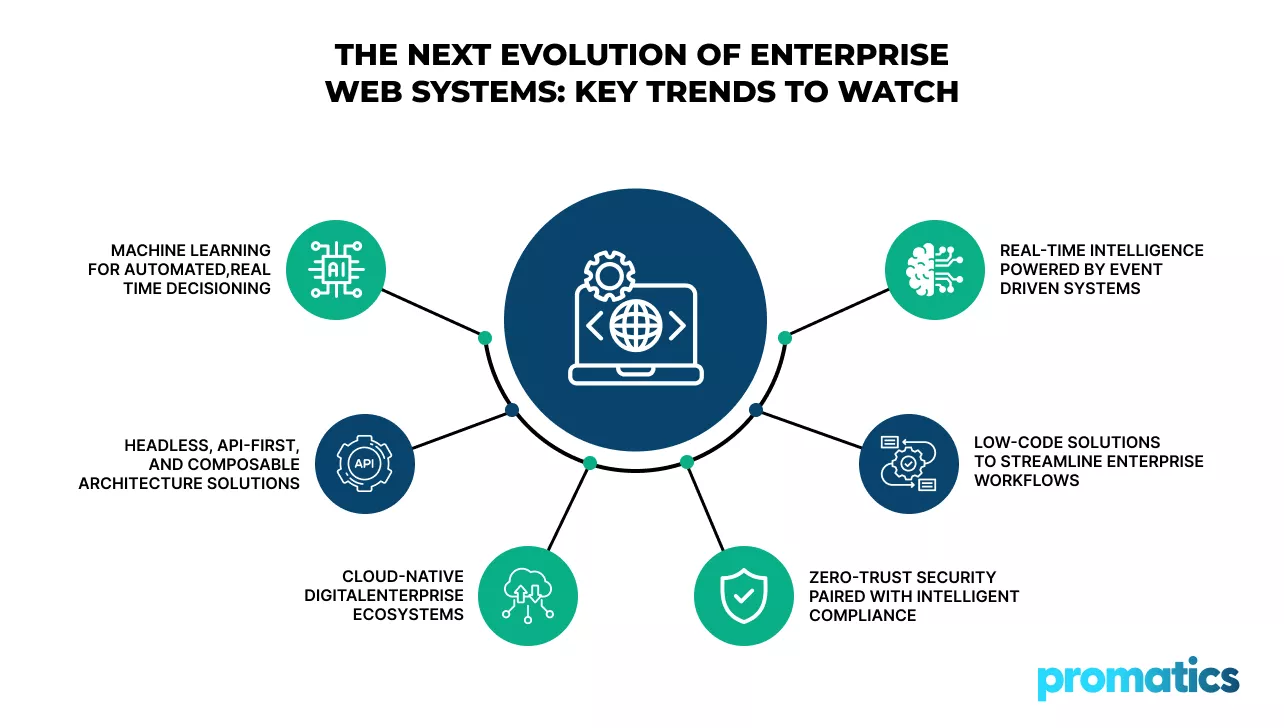
These are some of the trends that point towards the bigger shift of large-scale web development in the direction of agility, flexibility, security, and data-driven decision making. If you want to know more about the architecture and the latest web patterns, you can refer to the brief at Mozilla Developer Network (MDN).
Checklist for Enterprise Web Development
- An architecture plan that’s well-defined
- Strong DevOps & automation maturity
- Engineering that is security-first
- Readiness for cloud & containerization
- Infrastructure that can support scaling
- Documentation, SLAs, and support governance
- Data compliance (GDPR, HIPAA, ISO, SOC)
How to Select the Best Enterprise Web Development Partner
Majorly, a prospective partner should demonstrate extensive large-scale engineering experience, cloud deployments, DevOps maturity, integration expertise, and enterprise security. A dependable partner not only synchronizes technology with business objectives but also provides the support that is needed in the long run for upgrades, maintenance, and digital acceleration.
5 Qualities to Look For:
- Enterprise engineering experience that is proven
- Strong architectural & consulting capabilities
- Development standards that are scalable
- Costing & delivery timelines that are transparent
- Support that is dedicated & post-deployment management
Book a free consultation today.
Conclusion
Enterprise web development requires a balance of scalability, security, cloud readiness, and continuous innovation. The right engineering strategy and the right development partner, such as Promatics, who has the proven track record of enterprise-grade system building, is what guarantees your applications to be your business’ seamless and peak performance-demanding evolution. Solutions that are future-ready in enterprises give the power to the companies to be able to operate in a smarter, faster way and more competitively in the digital world that is becoming more and more dominant.
