How to Hire Dedicated Mobile App Developers: A Complete Guide for Businesses

Your next mobile app could have a great idea behind it, but the wrong developer can turn that idea into expensive technical debt.
With nearly 150 billion apps downloaded globally in 2025, competition for mobile users is intense. Building an app that stands out requires more than coding skills. You need the right architecture, UX, integrations, security, and scalability from the start.
That’s why businesses searching for an app developer near me should look beyond location and focus on technical capability.
A dedicated mobile app development team can give you the engineering continuity needed to build, launch, and scale your product without constantly changing developers or rebuilding technical context.
From product discovery and UI/UX to mobile development, AI, backend engineering, QA, and cloud, the right technology partner can take ownership of the complete development journey.
This blog explains what to look for when hiring dedicated mobile app developers, how to evaluate technical expertise, which engagement model fits your project, and how to choose a team that can turn your app idea into a scalable product.
How Do You Hire the Right Dedicated Mobile App Developer?
Quick Answer: To hire the right dedicated mobile app developer, start by defining your product requirements, target users, platforms, integrations, technical requirements, budget, and timeline.
Then follow a structured process:
Define → Shortlist → Evaluate → Interview → Test → Verify → Contract → Build → Scale
Evaluate developers across five areas:
- Mobile expertise: iOS, Android, Flutter, React Native
- Engineering depth: APIs, backend, databases, cloud, architecture
- Product thinking: UX, business logic, scalability, performance
- Delivery discipline: Agile, QA, CI/CD, communication
- Long-term capability: security, maintenance, monitoring, optimization, and future feature development
For a small application, one developer may be enough.
For a product involving complex backend systems, payments, real-time features, AI, enterprise integrations, or multiple platforms, a dedicated mobile app development team may be the better choice.
What Is a Dedicated Mobile App Developer?
A dedicated mobile app developer is a developer who works primarily on your product for the duration of the engagement.
Instead of treating your application as a short-term assignment, the developer becomes familiar with:
- Your product requirements
- User journeys
- Business logic
- Codebase
- APIs
- Architecture
- Development workflow
- Release process
- Product roadmap
This model sits between hiring an employee internally and outsourcing a fixed-scope project.
You get focused development capacity without necessarily taking on the full burden of recruitment, salaries, equipment, onboarding, and employee management.
More importantly, you retain continuity.
When the product roadmap changes, the developer already understands the system.
When a new integration is required, they already understand the architecture.
When a performance issue appears, they already know where to investigate.
That continuity is one of the biggest advantages of dedicated development.
Dedicated Developer vs Freelancer vs In-House Team vs Development Company
Before searching for an app developer near me, decide which hiring model actually fits your product.
| Hiring Model | Best For | Main Advantage | Main Challenge |
| Freelancer | Small projects and specific tasks | Flexible and quick to engage | Limited bandwidth |
| In-house team | Long-term internal products | Maximum control | Recruitment and operating costs |
| Dedicated developer | Long-term focused development | Consistent technical capacity | May need additional specialists |
| Dedicated team | Complex products | Multiple skills under one engagement | Higher investment |
| Development company | End-to-end products | Strategy, design, engineering, QA and support | Requires careful vendor evaluation |
Choose a Freelancer If
You need:
- A small feature
- A bug fix
- A prototype
- A short-term task
- A clearly defined technical assignment
Choose a Dedicated Developer If
You need:
- Continuous development
- One focused technical resource
- Long-term product knowledge
- Additional capacity for an existing team
- Regular feature development
Choose a Dedicated Team If
Your product requires:
- Mobile development
- Backend engineering
- UI/UX
- QA
- DevOps
- AI
- Cloud infrastructure
Choose a Full-Service Development Company If
You need help across the entire product lifecycle, from product discovery and design to development, testing, deployment, and post-launch optimization.
The dedicated-team model is particularly useful when a product is expected to evolve continuously rather than being delivered once and handed over. The DigiSoft reference similarly distinguishes dedicated teams from freelancers, in-house hiring, and fixed-scope agencies based on continuity, control, and scalability.
When Should You Hire Dedicated Mobile App Developers?
Not every application needs a dedicated team.
But the model becomes particularly valuable when your product has a long roadmap or significant technical complexity.
1. Your Product Will Keep Evolving
Most serious applications do not stop at version 1.0.
After launch, you may need to:
- Add features
- Improve UX
- Fix bugs
- Optimize performance
- Integrate new APIs
- Add AI capabilities
- Expand to another platform
- Improve security
- Scale infrastructure
A developer who already understands your product can work through these changes more efficiently.
2. You Need Consistent Development Capacity
A dedicated developer gives you predictable engineering bandwidth.
Instead of hiring someone every time a feature appears, you have a resource who can work continuously against your roadmap.
This makes sprint planning, release planning, and prioritization easier.
3. Your App Has Complex Integrations
Modern mobile applications rarely operate in isolation.
Your architecture may look like:
Mobile App → API Layer → Backend → Database → Cloud → Third-Party Services
Those services could include:
- Payment gateways
- CRM platforms
- ERP systems
- Maps
- Analytics
- Authentication providers
- Communication APIs
- AI services
- Enterprise databases
The more connected the application becomes, the more important architectural continuity becomes.
4. You Need to Scale Your Engineering Team
You may start with:
1 Mobile Developer
and later need:
Mobile Developer → Backend Developer → QA Engineer → UI/UX Designer → DevOps Engineer → AI Engineer
A dedicated engagement makes it easier to add specialists as the product grows.
5. You Already Have an Internal Team
Dedicated developers can work as an extension of your existing engineering organization.
For example:
- Internal team → product strategy and business requirements
- Dedicated team → mobile and backend development
- QA → testing
- DevOps → deployment and infrastructure
This approach can increase engineering capacity without requiring you to build every role internally.
When Should You Not Hire Dedicated Developers?
Dedicated development is not automatically the right answer.
A freelancer or short-term engagement may be enough if:
- You are validating a simple idea
- You need a quick prototype
- The scope is completely fixed
- You need one specific feature
- Your internal team already owns the architecture
- The development requirement is temporary
The goal is not to hire the biggest team.
The goal is to hire the right technical capacity for the stage of your product.
What Skills Should You Look for in a Dedicated Mobile App Developer?
This is where an app developer near me needs to move beyond location and into technical evaluation.
A strong mobile developer should understand not only the mobile interface but also how the application interacts with backend systems, APIs, cloud infrastructure, security layers, and external services.
- Native iOS Development
For iOS applications, look for experience with:
- Swift
- SwiftUI
- UIKit
- Xcode
- iOS SDK
- REST APIs
- Push notifications
- Authentication
- Keychain
- App Store deployment
Native iOS development is particularly relevant when your product depends on deep Apple ecosystem integration, platform-specific capabilities, or highly optimized native experiences.
- Native Android Development
For Android, evaluate experience with:
- Kotlin
- Android SDK
- Jetpack
- Jetpack Compose
- Android Studio
- Firebase
- REST APIs
- Push notifications
- Google Play deployment
- Android security
Android development also requires consideration of device fragmentation, different screen sizes, OS versions, permissions, and hardware capabilities.
- Cross-Platform Development
If you want to target iOS and Android from a shared codebase, your developer may recommend:
- Flutter
- React Native
- .NET MAUI
- Kotlin Multiplatform
The right choice depends on the product.
Consider:
- Performance requirements
- Platform-specific features
- Development speed
- Existing team expertise
- Maintenance requirements
- Long-term scalability
Do not choose a framework simply because it is popular.
Ask:
Why is this technology right for our product?
That question can reveal whether you are speaking with an engineer who understands architecture or someone simply selling the technology they already know.
Backend and API Expertise Matters Too
Your mobile application is only one layer of the product.
Behind the interface, you may have:
Mobile Client → API Gateway → Application Services → Database → Cloud Infrastructure
The backend may manage:
- Authentication
- User management
- Business logic
- Payments
- Notifications
- Data processing
- Analytics
- Third-party integrations
- AI services
Your development partner should therefore understand:
- REST APIs
- GraphQL
- Authentication
- OAuth
- Databases
- Microservices
- Serverless architecture
- API security
- Cloud services
Promatics’ technology capabilities include backend technologies such as Node.js, Python, Go, Django, Laravel, Express.js, and Nest.js, along with databases such as MySQL, PostgreSQL, and MongoDB.
AI Skills Are Becoming Essential for Modern Mobile Apps
AI is changing what businesses expect from mobile applications.
Modern applications can:
- Understand user intent
- Generate content
- Personalize experiences
- Analyze information
- Automate workflows
- Recommend products
- Search semantically
- Interact through voice
- Execute multi-step tasks
Common AI capabilities include:
- Generative AI
Generate content, summaries, reports, recommendations, and responses.
- AI Chatbots
Provide conversational assistance directly within the app.
- AI Agents
Execute multi-step workflows rather than simply returning a text response.
- Predictive Analytics
Identify patterns and generate forecasts using user or business data.
- Computer Vision
Analyze images, documents, products, and other visual inputs.
- Intelligent Search
Allow users to find information based on meaning and context rather than exact keyword matches.
- Personalized Recommendations
Use user behavior and contextual data to deliver relevant content, products, or actions.
For AI-first products, your ideal team may need both mobile engineering and AI engineering capabilities.
What Does an AI-Powered Mobile App Architecture Look Like?
Adding an AI API to an app is relatively simple.
Building an AI feature that works reliably in production is much harder.
A typical architecture may look like:
User → Mobile App → API → Backend → AI Model → Data/RAG Layer → Response → Mobile UI
Depending on the use case, your team may need to consider:
- Model selection
- Prompt engineering
- RAG
- Vector databases
- Context management
- Hallucination mitigation
- Data privacy
- Authentication
- Response latency
- Token consumption
- Inference costs
- AI evaluation
- Monitoring
If AI is central to your product, do not evaluate the mobile developer and AI engineer as completely separate pieces.
The best results often come when mobile, backend, data, and AI architecture are designed together.
How to Find the Right App Developer Near Me
If an app developer near me is the keyword you are searching, use it to build your shortlist.
Do not use it as your only hiring criterion.
Search through:
- Professional networks
- Referrals
- Freelance platforms
- Technology directories
- Development company websites
Then follow a structured process:
Search → Shortlist → Validate → Interview → Technical Evaluation → Trial → Hire
Step 1: Write a Clear Requirements Brief
Most development problems begin before development starts.
Your requirements brief should define:
Target Users
Who will use the application?
Business Problem
What problem does the application solve?
Core Features
What must the first version include?
Platforms
- iOS
- Android
- Both
- Cross-platform
Integrations
Will the app connect with:
- Payments?
- Maps?
- CRM?
- ERP?
- Analytics?
- AI?
- Enterprise systems?
Non-Functional Requirements
Also consider:
- Security
- Performance
- Accessibility
- Offline support
- Localization
- Scalability
A good requirements brief gives developers something concrete to estimate and helps you compare proposals more accurately.
Promatics also offers product discovery workshops designed to clarify product requirements, user flows, technical implications, and development considerations before execution.
Step 2: Choose the Right Hiring Channel
You can find developers through several channels.
- Freelance Platforms
Useful for short, clearly defined projects.
- Direct Hiring
Suitable when you want permanent internal technical roles and already have the infrastructure to manage recruitment.
- Dedicated Development Companies
Useful when you want pre-assembled technical resources, project management, infrastructure, QA, and the ability to scale the team.
For a serious commercial application, the hiring channel should reduce technical risk, not simply reduce the initial price.
Step 3: Review Portfolios the Right Way
Do not stop at screenshots.
If an application is publicly available, download it.
Test:
- Startup performance
- Navigation
- Responsiveness
- Authentication
- Error handling
- Offline behavior
- Stability
- User experience
Read negative reviews too.
One-star reviews can reveal recurring issues such as crashes, poor performance, confusing workflows, or missing functionality.
If possible, ask the development partner to explain:
What was the technical challenge?
How did you solve it?
What trade-offs did you make?
What happened after launch?
That tells you much more than a polished portfolio.
Step 4: Interview for Systems Thinking, Not Syntax
One of the weakest ways to evaluate developers is to test only programming syntax.
Instead, use real engineering scenarios.
Ask:How would you design offline synchronization if a user loses connectivity during a transaction?
Or:
How would you handle token refresh when a user’s authentication session expires?
Or:
How would you optimize a mobile screen displaying thousands of records?
Or:
How would you design an AI assistant that needs to answer questions from a large internal knowledge base?
A strong developer should be able to explain:
Problem → Assumptions → Architecture → Trade-offs → Implementation → Testing → Monitoring
They should also ask clarifying questions before jumping into a solution.
Step 5: Check References by Asking About Difficult Situations
Do not ask former clients only:
“Was the developer good?”
Ask more useful questions:
- How did they communicate when something went wrong?
- Did they meet sprint commitments?
- How did they handle changing requirements?
- Did they challenge a poor technical or product decision when necessary?
- Was the code maintainable after the engagement?
- Could another developer take over easily?
The answers can tell you whether the developer is simply productive or genuinely reliable.
Step 6: Start With a Paid Trial Sprint
A short paid sprint can be one of the best ways to evaluate a developer.
Give the candidate a real feature from your backlog.
Evaluate:
- Code quality
- Architecture
- Communication
- Documentation
- Testing
- Problem-solving
- Delivery discipline
- Ability to handle ambiguity
A trial does not just answer:
“Can they code?”
It answers:
“Can they work with us?”
Step 7: Get the Contract Right
Before development starts, define:
- Scope
- Deliverables
- Milestones
- Payment terms
- Intellectual property
- Source-code ownership
- NDA
- Repository access
- Documentation
- Testing responsibilities
- Maintenance
- Support
- Knowledge transfer
- Termination terms
Make sure source-code ownership is explicitly defined.
You should also maintain appropriate access to the repository throughout development rather than receiving everything only at the end.
Step 8: Set Up Collaboration Before Development Begins
A dedicated team needs visibility.
Common tools include:
- Jira
- Linear
- Asana
- Slack
- Microsoft Teams
- GitHub
- GitLab
- Figma
- Sentry
- Firebase Crashlytics
The tools themselves are not the important part.
The workflow is.
You should know:
What is being built → Who owns it → When it is due → How it will be tested → What happens next
Promatics describes an Agile approach with dedicated teams, product management, technical leadership, UX support, continuous communication, and sprint-based delivery.
What Should a Great Dedicated Mobile App Developer Deliver?
Hiring a developer is not just about getting features shipped.
A strong developer should help create software that remains reliable as the product grows.
1. Scalable Architecture
The architecture should make future development easier.
Depending on the application, this can involve:
- Clean Architecture
- MVVM
- Modular architecture
- Dependency injection
- Reusable components
- Separation of concerns
The goal is not to make architecture unnecessarily complicated.
The goal is to make the codebase easier to maintain and extend.
2. Security at Every Layer
Security should be considered from the beginning.
Your team should understand:
- Secure authentication
- Authorization
- Token management
- HTTPS
- Encryption
- Secure local storage
- API security
- Biometric authentication
- Role-based access
- Session management
- Secure logging
- Mobile security risks
For sensitive applications, security should be treated as an architectural requirement rather than a final QA checklist.
3. Performance Engineering
Your team should monitor:
- App startup time
- API latency
- Memory consumption
- Network requests
- Database performance
- Image loading
- Battery usage
- Crash rates
The important point is not chasing arbitrary numbers.
It is measuring real application performance and continuously improving the areas that affect user experience.
4. Accessibility
Accessibility should be considered during design and development.
Depending on the application, this can include:
- VoiceOver support
- TalkBack support
- Accessible labels
- Text scaling
- Color contrast
- Touch target sizes
- Reduced-motion preferences
An accessible application is generally a more usable application.
5. Automated Testing
A production application should not depend entirely on manual testing.
Your testing strategy may include:
- Unit testing
- Integration testing
- API testing
- UI testing
- Regression testing
- Performance testing
- Security testing
- Load testing
Testing should be integrated into the development lifecycle rather than postponed until the final week.
Promatics highlights manual testing, automation, regression, performance, load and stress testing, security testing, and code review within its broader technology capabilities.
UI/UX Is Part of the Hiring Decision Too
Technical quality gets the application working.
UX determines whether people actually want to use it.
Your development partner should understand how design affects:
- Navigation
- Conversion
- Engagement
- Accessibility
- Task completion
- Retention
Look for teams that can connect product requirements with wireframes, prototypes, interaction design, and usability testing.
App Store and Google Play Readiness
Development does not end when the code compiles.
Your team should understand:
- App signing
- Build configuration
- Store metadata
- Screenshots
- Privacy disclosures
- Permissions
- Release management
- Version updates
- Store review requirements
App Store and Google Play requirements can influence technical implementation, privacy disclosures, permissions, and monetization decisions.
So involve your development team in launch planning early.
App Store Optimization Should Not Be an Afterthought
Getting an app approved is not the same as getting it discovered.
Your launch plan should consider:
- App title
- Description
- Keywords
- Screenshots
- Preview videos
- Localization
- Ratings and reviews
- In-app rating prompts
The mobile product and its store presence should work together as one acquisition experience.
Data Privacy and Compliance
If your application collects personal information, privacy should influence architecture from the beginning.
Depending on your target markets and industry, consider:
- Data minimization
- Consent management
- Account deletion
- Data retention
- Secure storage
- Access controls
- Data export
- Privacy disclosures
- Regulatory requirements
The exact compliance requirements depend on your users, geography, business model, and data types.
Your development partner should help identify these requirements early rather than discovering them immediately before launch.
How Much Does It Cost to Hire Dedicated Mobile App Developers?
There is no universal price.
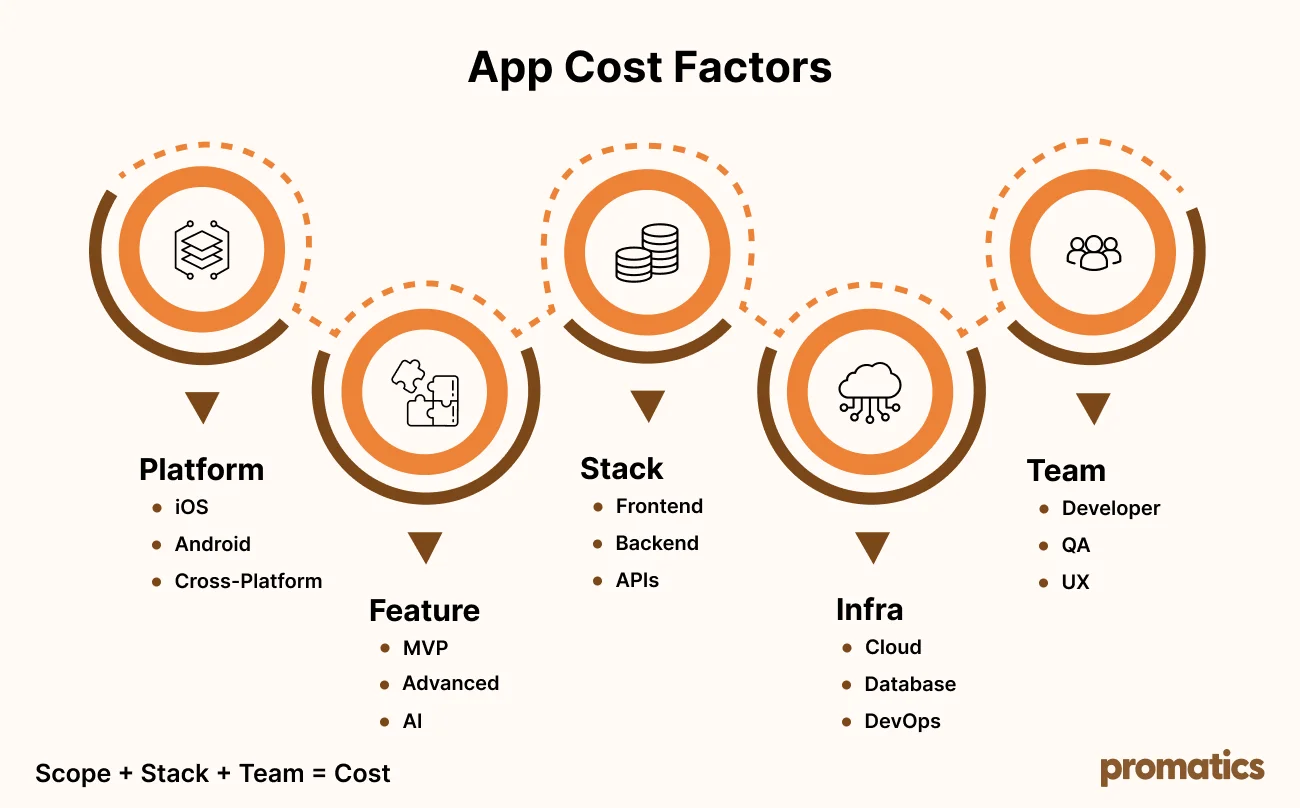
The total cost depends on:
- Developer seniority
- Technology stack
- Location
- Platform
- Engagement duration
- Project complexity
- Team size
- Backend requirements
- AI requirements
- Security requirements
- Support requirements
There is also a difference between developer cost and total product cost.
A cheaper developer can become expensive if poor engineering leads to:
- Rework
- Technical debt
- Security vulnerabilities
- Performance problems
- Delayed launches
- Difficult maintenance
Instead of asking only:
“What is your hourly rate?”
Ask:
“What will it cost to build, launch, maintain, and scale this product successfully?”
That is a much more useful commercial question.
Hidden Costs to Consider Before Hiring
Your initial development quote may not include everything.
Consider potential costs for:
- Third-Party Services
Payment gateways, maps, analytics, communication APIs, AI APIs, and cloud services may have usage-based costs.
- App Store Accounts
Developer accounts and platform-related fees should be included in your launch budget.
- Infrastructure
Cloud hosting, storage, databases, monitoring, backups, and bandwidth can create recurring costs.
- Security
Sensitive applications may require security assessments or penetration testing.
- Maintenance
Your app will need updates as operating systems, devices, APIs, and platform policies change.
- Product Iteration
User feedback often creates new feature requirements after launch.
A realistic budget should therefore account for the full product lifecycle, not just initial development.
Junior vs Mid-Level vs Senior Mobile Developers
Not every project requires the most senior developer available.
But you should understand the difference.
- Junior Developer
Typically works under supervision and is best suited for clearly defined implementation tasks.
- Mid-Level Developer
Can independently handle features, debugging, integrations, and testing.
- Senior Developer
Can own architecture, make technology decisions, identify technical risks, conduct code reviews, mentor other developers, and take responsibility for long-term maintainability.
For complex commercial applications, having at least one experienced technical resource responsible for architecture can significantly reduce risk.
One Developer or a Dedicated Development Team?
The answer depends on the complexity of your product.
Choose One Dedicated Developer If:
- You already have a technical lead
- Your architecture is established
- The product has a focused scope
- You need additional execution capacity
- Your technology stack is straightforward
Choose a Dedicated Team If:
- You are building from scratch
- You need iOS and Android
- Backend development is required
- AI is part of the product
- You need UI/UX
- You need QA
- You need DevOps
- You expect continuous development
A dedicated team can provide multiple disciplines without forcing you to coordinate several independent vendors.
Why Choose Promatics Technologies for Dedicated Mobile App Development?
If your searching for an app developer near me has brought you to the point of comparing development partners, the next question should be:
Who has the technical depth to build and evolve this product?
Promatics Technologies brings together web and mobile application development, UI/UX and product strategy, AI solutions, cloud infrastructure and DevOps, and other digital engineering capabilities.
That means businesses can access multiple capabilities through one technology partner rather than assembling disconnected specialists.
- Mobile App Development
Build scalable mobile applications around your business goals, users, platforms, and product roadmap.
- iOS App Development
Develop applications for Apple’s ecosystem with native iOS capabilities.
- AI Development
Add intelligent automation, predictive analytics, generative AI, and AI-powered workflows to mobile and digital products.
- Product Discovery
Turn an initial idea into a clearer product scope with requirements, user flows, technical considerations, and development planning.
- UI/UX Design
Combine user research, wireframes, prototyping, product design, and usability considerations to create intuitive digital experiences.
- Cloud and DevOps
Build and modernize infrastructure through cloud development, migration, automation, and scalable deployment environments.
QA and Testing
Test functionality, APIs, performance, security, and critical user journeys before and after launch.
Dedicated Resources
If you already have an internal team and need additional technical capacity, Promatics also supports dedicated-resource engagements.
Promatics describes its delivery approach around dedicated teams, Agile development, product management, technical leadership, UX support, communication, and predictable delivery.
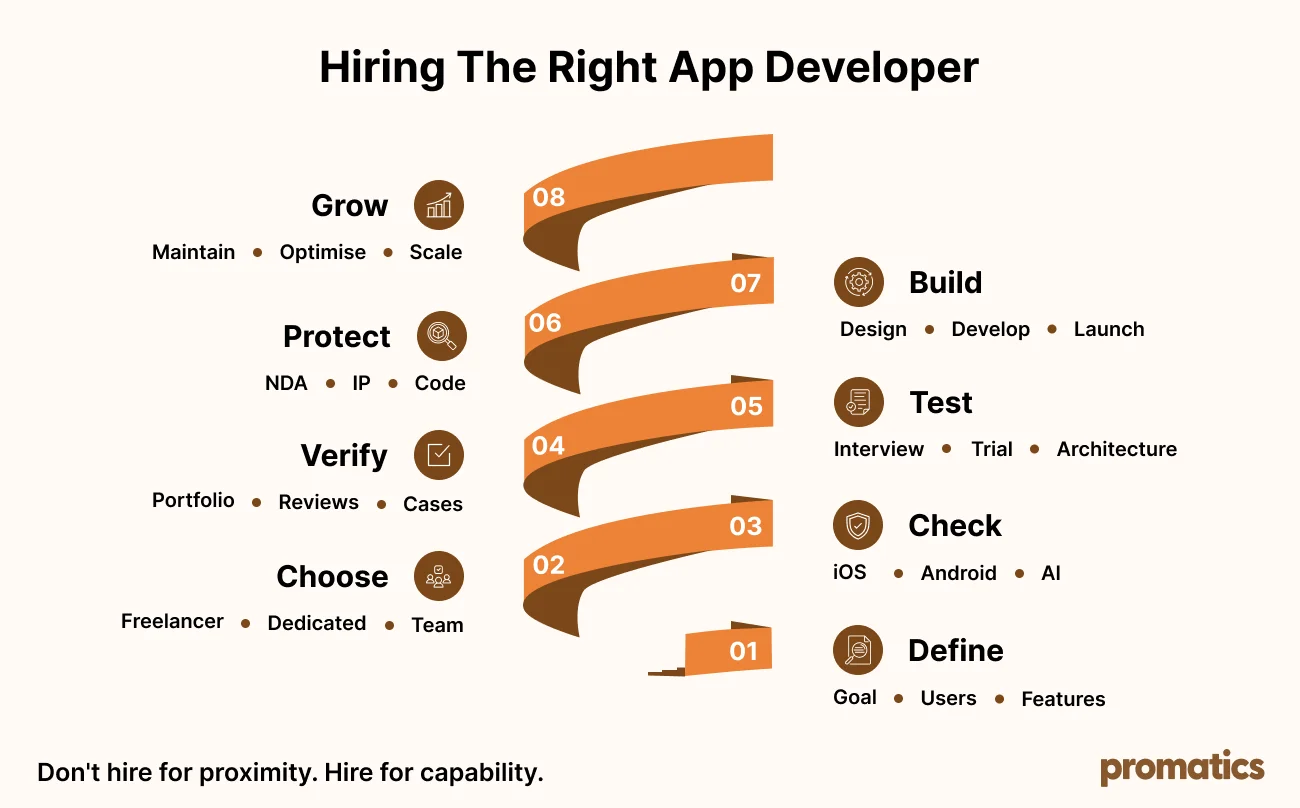
A Practical 8-Step Checklist for Hiring Mobile App Developers
01. DEFINE
- Business problem
- Target users
- Core features
- Platforms
- Budget
- Timeline
02. CHOOSE
- Freelancer
- Dedicated developer
- Dedicated team
- Development company
03. SHORTLIST
- Portfolio
- Case studies
- Industry experience
- Technical expertise
04. EVALUATE
- Architecture
- Security
- Technology stack
- Communication
- Development process
05. TEST
- Technical interview
- Architecture discussion
- Paid trial sprint
06. PROTECT
- NDA
- IP ownership
- Source-code access
- Documentation
07. BUILD
- UX
- Development
- API integration
- QA
- Deployment
08. SCALE
- Monitoring
- Maintenance
- Optimization
- New features
- Infrastructure scaling
Final Takeaway
Conclusion
Choosing the right mobile app developer is about more than proximity or price. The right partner should understand your business goals, users, technology requirements, and long-term roadmap while delivering a product that is secure, scalable, and built to evolve.
Build With the Right Technology Partner
As your app grows, you may need expertise across mobile development, backend engineering, AI, UI/UX, QA, cloud, and DevOps. Managing multiple specialists can make development more complex and create gaps in communication and accountability.
A dedicated technology partner brings these capabilities together under one coordinated process, helping you move from product idea and strategy to development, launch, and scale.
Promatics Technologies combines dedicated mobile app development with expertise across AI, UI/UX, backend engineering, cloud, DevOps, and software engineering to help businesses build digital products that are ready for long-term growth.
Have an app idea or an existing product to scale? Talk to Promatics Technologies and take the next step toward building your mobile product.
