Mobile App Development Roadmap: A Step-by-Step Guide for 2025

TL;DR
- Step-by-step mobile app development lifecycle from idea to launch.
- Planning, UI/UX design, development, testing, and deployment stages.
- Agile workflows and scalable app development practices.
- AI integration and cross-platform development trends.
- Best practices for building scalable and future-ready applications.
A mobile app development roadmap is a strategic plan that contains every step, timeline, and task that relevant teams need to follow to launch the mobile app successfully.
The roadmap acts like a GPS for the entire development and product release process. It helps different teams and employees coordinate and communicate with each other to improve workflow, prioritize critical tasks, and build a complete app in time.
According to a Gartner survey, a majority of product managers believe that they need an effective roadmap to decrease the product failure rate and align the app development process with the company’s business objectives.
In this blog, we will talk about different types of mobile app development roadmaps and show you the steps you must follow to create one for your next app.
Why is the Mobile App Development Roadmap Important?
The app developers, analysts, product managers, and all other relevant personnel use roadmapping during the entire app-building process.
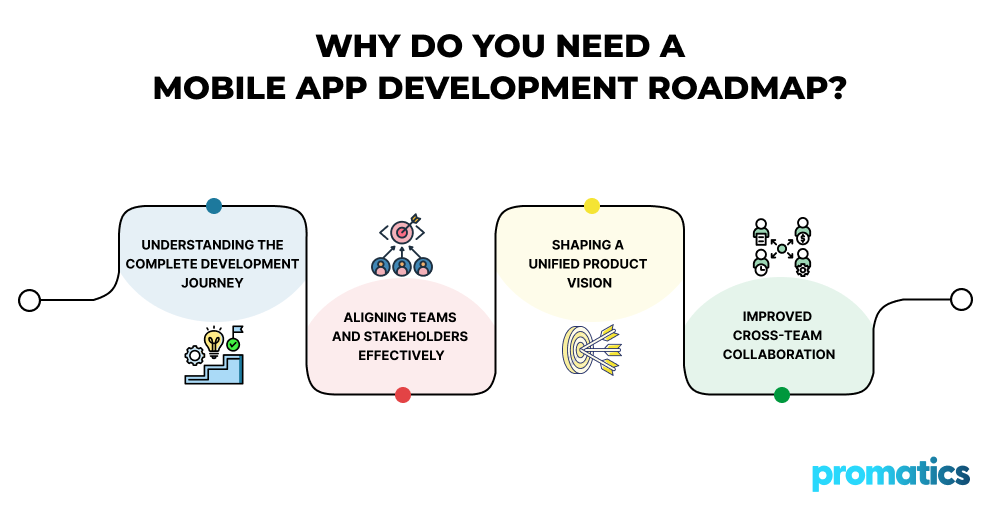
Let’s see why the mobile app development roadmap has such an appeal to different stakeholders and why it’s important:
- The Big Picture of the Mobile App Development: Programmers often use the app development roadmaps to make sure their development efforts align well with the company’s business goals. The roadmap makes it easier to understand which tasks to prioritize and prevent scope creep.
- Better Cooperation with Relevant Stakeholders: With a proper roadmap, product managers can convey their vision and goals to the company’s investors. This makes it easier for the external stakeholders to decide how the app or product should evolve in the future.
- Product Vision and Strategy: Roadmaps can help the teams understand what they need to do and how they should do it. It will transform the complex development process into a format that the sales manager, marketing department, and other non-technical folk can easily understand.
- Smoother Communication Between Teams: The roadmaps can help all the relevant teams to update their work status and track all changes in the project. This will help them identify which tasks they need to prioritize to avoid delays.
How to Build an Effective Mobile App Development Roadmap?
Here are the six easy-to-follow steps to creating an effective mobile app development roadmap that your developers, managers, investors, and all other relevant stakeholders will love:
1. Define the Product Vision
Before you begin creating an app development roadmap, you need to thoroughly understand why you are making your product. In short, you need to understand and define the product vision.
Here are a few questions you must answer first to articulate the product vision properly:
- How can your mobile app benefit the end-users?
- What is the perfect time to launch your product and why?
- What are the business goals that you want to achieve by creating this roadmap?
- What pain points do you want your product to solve, and how can the app do it?
When you are at this stage, you don’t have to come up with all the intricate app features and their development timelines. Just define the product vision well to help you set proper product goals and major tasks in the next step.
2. Set Measurable Goals and Initiatives
Next, you need to set some measurable goals that align well with the product you have envisioned in the previous step. These goals should be clear objectives that you need to fulfill within a set amount of time to help you measure the progress of the app development.
These goals must be clear enough to give the software engineers and other teams a clear purpose and direction.
Finally, you need to map out relevant initiatives to fulfill these goals and realize certain app features. By aligning these initiatives with clear goals, you can create a roadmap that can monitor team performance and app development progress efficiently.
3. Define the Target Audience for the Mobile App in the Roadmap
In this step, you need to define the target audience of your mobile application development roadmap. Although all relevant personnel will be included in the roadmap, details that are crucial for a software engineer might not be as important to sales managers.
So, your roadmap should have different target audiences, helping you deliver the details and tasks the respective teams need to know and work on.
For example, the roadmap for the business executives should only include the product goals, timeline, and relevant initiatives. The sales team’s roadmap should have details of the release dates and information about the value of the app to the end-users.
4. Prioritize the Important App Features
In this step, you need to find out which app features bring the most value to the app’s end-users. This way, you can prioritize the important app features early on and create a solid development plan to integrate those features into your app.
But that’s not all. Prioritizing the important app features also helps you identify the less essential app features, which you can roll out slowly after the initial deployment of the app.
5. Make a Proper Timeframe to Achieve the Goals
Usually, app development or any product roadmap doesn’t have hard deadlines. Why? Because it simply doesn’t benefit those involved in the project. Setting deadlines for the tasks that aren’t even in progress will only cause more stress.
In many cases, you can’t even be sure if the relevant stakeholders will be able to keep up with the deadlines you set before they even understand the full scope of the work.
For example, the UX design team will never be able to give you an exact deadline to finish the app prototype, because they don’t know how the app’s buttons or features are supposed to perform.
So, instead of a hard deadline, managers often made plans that they need to do within a certain broad timeframe, for example, within a quarter.
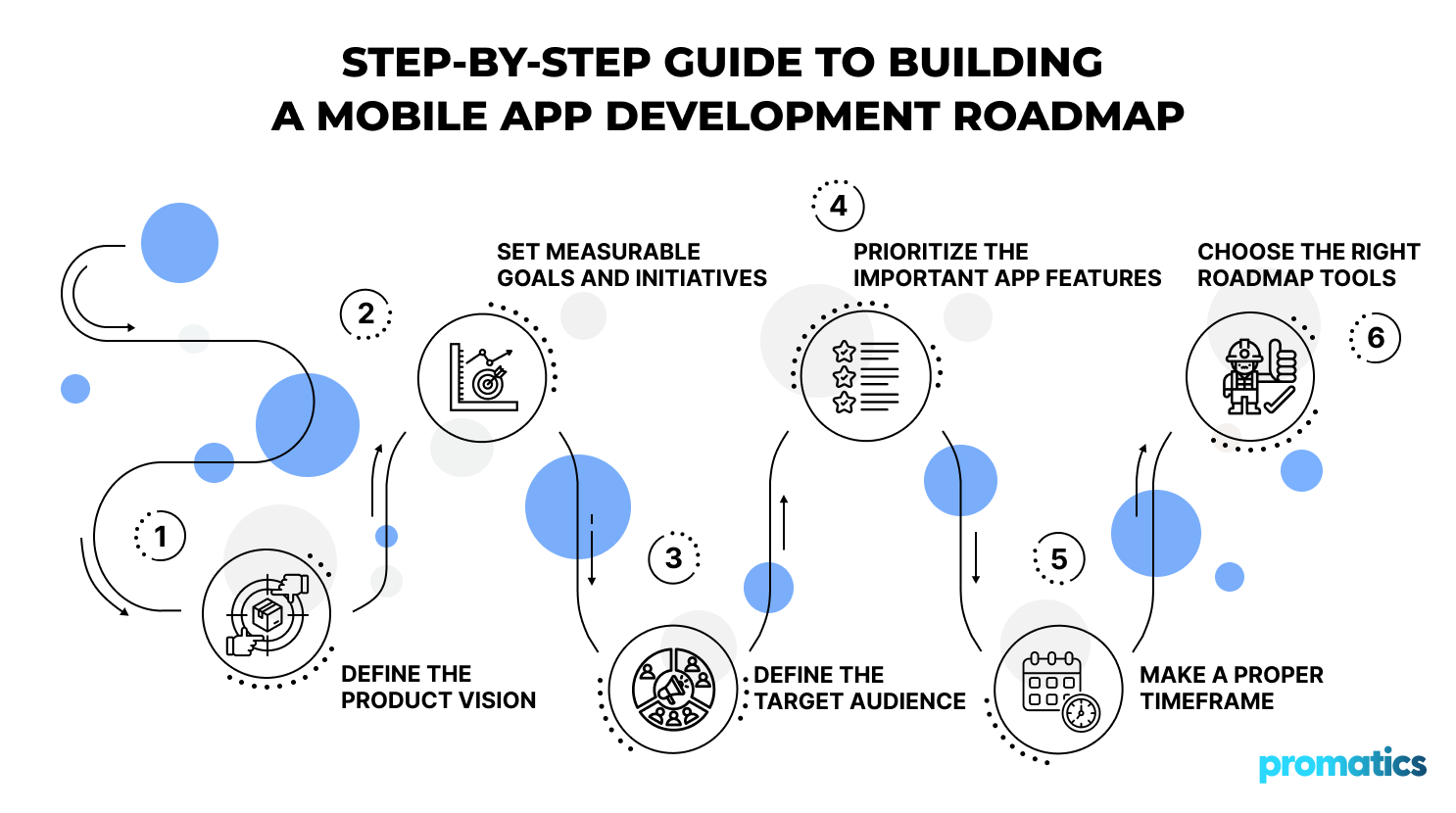
6. Choose the Right Roadmap Tools
Finally, you need to check and evaluate various mobile app development roadmap tools that align well with your business needs. Back in the day, Excel was one of the most used applications for developing product roadmaps.
But these days, the market is practically brimming with many cloud-based roadmapping tools that are better and more convenient to use than Excel.
Jira, Trello, ProductPlan, and Asana are a few examples of popular tools for developing visually pleasing and efficient product roadmaps.
Once you choose the tool, you can select one of the existing templates within the tool to create a roadmap that your team will love.
Also Read – Top 10 Mobile App Development Tools (2025 Edition)
Key Elements of the Mobile App Development Roadmap
As a vital part of the mobile app development process, the roadmap has to be easy-to-understand, clean, accurate, and actionable.
In a way, you can treat it as an extended project plan. That’s why every app development roadmap must have the following key elements:
1. Measurable Goals
Setting proper goals will help you and your team understand what you or they should expect after finishing a certain task. Whether your objectives are related to a specific product or your business, they should be within your team’s capability.
2. Proper Timelines
Every app development roadmap has several timelines or timeframes stacked into it. These timelines are aligned with specific objectives and tasks that must be fulfilled within those specific timeframes.
This will help your team identify which tasks they need to complete on high priority, allowing them to work collectively to achieve specific milestones.
3. Features
Your roadmap must include which app features you want to build or release within the timelines we have mentioned above. In the roadmap, you can group these features based on their release urgency or significance.
To make things easier, you can even create a category of major features and then break them down into several essential sub-features.
6 Types of Mobile App Development Roadmap
1. Release Plan Roadmap
The release plan roadmap generally outlines when and how you are planning to finish or deliver your prioritized tasks. These tasks may include delivering new improvements, doing bug fixes, product upgrades, and adding new features during the next release cycle.
You can use this roadmap to provide a high-level overview of the planned releases of the products to the teams, managers, senior executives, and investors.
The release plan roadmaps are perfect for app development projects that have fixed, non-time-bound milestones with a defined scope for the mobile apps with regular release schedules.
This way, all relevant departments of your company will know when a new product or feature will be launched. It allows the departments to coordinate more efficiently to achieve the release goal.
2. Sprint Plan Roadmap
Your app development projects can run with more efficiency and less friction if the relevant teams know exactly what they need to deliver. That’s where the sprint plan roadmaps can help you.
With this roadmap, you can make the workload more manageable by breaking down the deliverables into smaller tasks that your team can deliver over multiple sprints or short, time-boxed iterations. You can even assign each of these smaller tasks to a responsible person.
In short, this roadmap uses the timeframe you are given to complete the task and create multiple small, time-bound plans to ensure success.
3. Kanban Roadmap
This roadmap takes a visual-first approach to managing the workflow, making sure that the relevant teams can track, optimize, and prioritize tasks in real-time. Unlike the sprint plan roadmap, Kanban roadmaps deal with continuous workflow.
That means each task in the Kanban roadmap will go through several pre-defined stages, such as “To-Do”, “Work in Progress”, “App Testing”, and “Completed.”
This way, you can control the number of active tasks to improve workflow efficiency and prevent bottlenecks. A Kanban roadmap is perfect for those who work on apps that need constant bug fixes and updates.
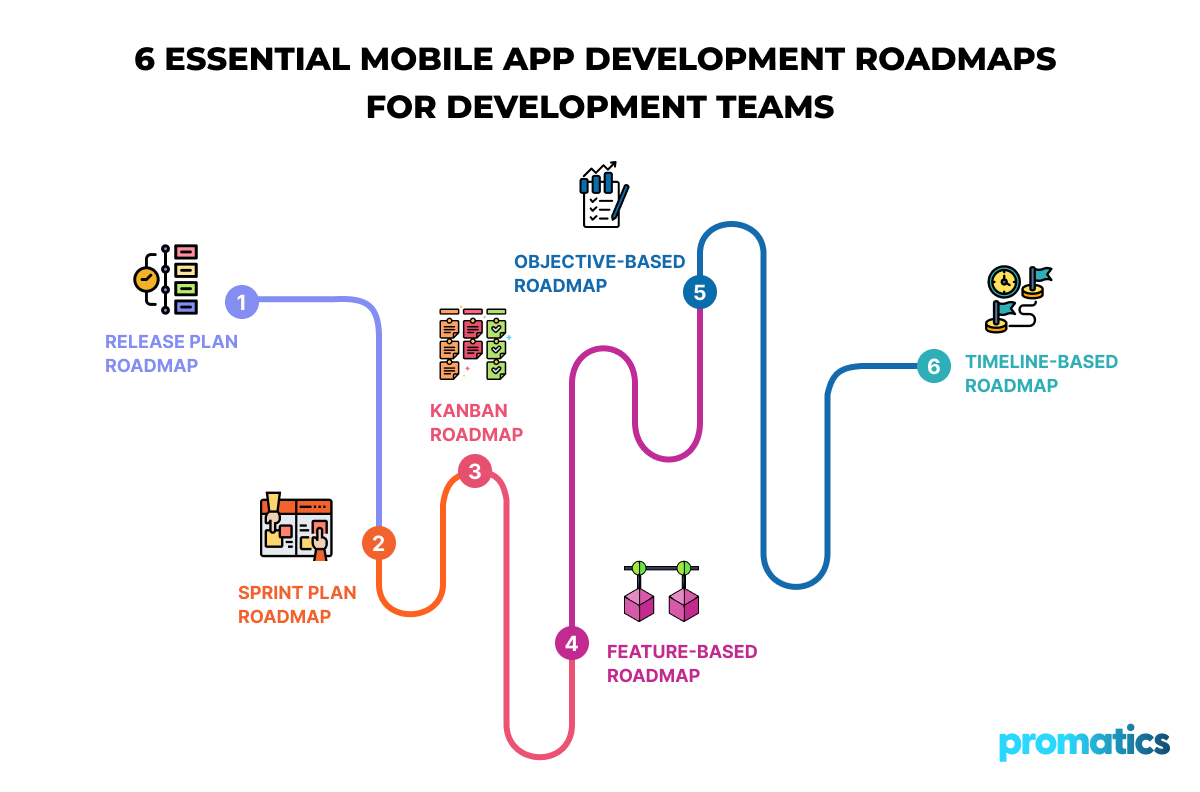
4. Feature-based Roadmap
This type of mobile app development roadmap emphasizes prioritizing a specific goal and releasing new app features over time. It’s useful for developing mobile apps that need regular updates, incremental features, and feature enhancements based on the feedback of the end-users.
Feature-based roadmap can help you keep different teams in sync on developing the prioritized features and determine when to release them.
This roadmap works best for companies and product managers who work on developing SaaS, gaming, or consumer apps (Which also need regular updates).
5. Objective-based Roadmap
This app development roadmap revolves around your company’s business goals and specific outcomes instead of technical app updates and upgrades. It helps companies adapt to the latest market trends and changes, and helps companies make informed decisions.
Objective-based roadmap will help you find answers to the following questions:
- What are the problems that you’re trying to solve with your app?
- What do you want to achieve by solving those problems?
In other words, it will help businesses align their long-term growth strategies with their mobile app development efforts.
For example, if you want your ecommerce app to reduce cart abandonment rate by X% within Y months, this is the roadmap you need.
6. Timeline-based Roadmap
This one is a deadline-driven, comprehensive roadmap for mobile app development. It incorporates important milestones, timeframes, sprints, and the release schedules to create an all-encompassing roadmap for any project that needs to follow a tight deadline.
Timeline-based roadmap is a perfect guide for companies that need to develop new apps, launch specific app features, or modify their products for events within a fixed timeline.
This mobile app development framework is ideal for large corporations, start-ups with specific product launch deadlines, and government projects.
6 Key Considerations for Creating an Effective Roadmap for Building Mobile Apps
To create a foolproof mobile app development roadmap that can help you build a sustainable and successful mobile app, you need to consider the following factors:
- Make sure that the roadmap can align the mobile app development process with your company’s short-term and long-term business objectives.
- Calculate the overall infrastructure, development, marketing, sales, and employment costs to create a reasonable budget.
- The relevant teams should have enough experience and expertise to finish the project and launch a complete mobile app as soon as possible.
- Your company should have the right tools to create the roadmap and complete the tasks mentioned in the roadmap.
- Make sure to consider the future app updates, bug fixes, new feature launches, and other post-launch development requirements when creating a roadmap.
- You must make your apps as secure as possible to avoid data breaches.
Conclusion
With an efficient mobile app development roadmap, you can improve communication between relevant stakeholders and coordination between different departments within the company.
The roadmap will help you prioritize important tasks, make the app development process smoother, and ensure regular release of app updates without a hitch.
Make sure you understand all the key elements of a roadmap and the steps you need to follow to make the roadmap as perfect as possible.
Want to create a reliable mobile app using a strong product roadmap? Reach out to our experts at Promatics India today to discover how we can help you develop a feature-packed app to boost your business.
