Top 10 SaaS trends influencing the Saas landscape in 2025
TL;DR
- Explores the latest SaaS trends shaping the future of software development.
- Covers AI, automation, low-code, and vertical SaaS innovations.
- Highlights cloud-native architecture and scalability strategies.
- Discusses security, customer experience, and data-driven solutions.
- Helps businesses stay competitive in the evolving SaaS market.
What is SaaS?
Software as a Service (SaaS) is a way to deliver software over the cloud. In this model, a provider hosts the applications, and clients access them over the internet. Customers don’t have to buy and install software on each device. Instead, they pay for services as they use them, which saves money, makes them easier to access, and makes them more scalable.
SaaS has changed the software world by moving away from ownership and towards a service-based model. This change in thinking lets businesses save money on initial costs, make maintenance easier, and get the newest features without having to do manual upgrades. SaaS is flexible enough that businesses can easily grow their operations to meet changing needs without having to spend a lot of money on new infrastructure.
SaaS products also often come with built-in analytics and reporting tools that give you important information about how users interact with the system and how well it works. With this data-driven approach, businesses can make smart choices, speed up processes, and give customers a better experience. The subscription model also encourages continuous improvement because providers want to keep customers by giving them value all the time.
SaaS is still growing in 2025, using advanced technologies like artificial intelligence (AI) and machine learning (ML) to offer more personalised and useful services. Most industries’ digital transformation processes are still led by SaaS because of its focus on user experience and agile development.
How Does a Software as a Service Company Work?
A SaaS organisation builds, hosts, and manages software programs on cloud infrastructure. Customers use web browsers to access these programs without the requirement of local installations. The SaaS company manages updates, security, and infrastructure while enabling clients to concentrate on their core business activities.
- Development and Deployment: SaaS vendors develop applications that are custom-made for particular business requirements. The applications are hosted on cloud servers, making them highly available and scalable.
- Subscription Management: People subscribe to the service using usage or tiered pricing plans. The recurring revenue stream gives predictable income to providers and affordable solutions to users.
- Maintenance and Updates: The providers ensure the software is maintained, such as with bug fixes, security updates, and feature additions. This provides the users with continuous access to the latest version without any manual effort.
- Customer Support: SaaS businesses provide support services to guide users through onboarding, troubleshooting, and optimising the value of the software.
- Data Compliance and Security: Data security and regulatory compliance with regulations such as GDPR and HIPAA are of the highest importance. SaaS vendors have stringent security in place and frequent audits to ensure trust.
In essence, SaaS companies act as custodians of software solutions, delivering continuous value through innovation, reliability, and customer-centric services.
Top Emerging SaaS Trends to Watch in 2025
AI-Powered SaaS
Artificial Intelligence (AI) is changing SaaS by adding machine learning and automation to basic products. This integration adds features like smart automation, predictive analytics, and a personalised user experience. For instance, Freshworks is utilising agentic AI to help its business grow, which shows how AI can help with productivity and customer service.
By 2025, AI-based SaaS products will be even better at helping people make decisions in real-time and fix problems before they happen. Natural language processing (NLP) makes it easier for users to interact with the system, and artificial intelligence-powered analytics give you deeper insights into how customers behave and where the market is headed. This gives businesses the ability to customise their services better, increasing customer satisfaction and retention.
Further, AI improves business efficiency by automating repetitive tasks, eliminating human errors, and releasing human resources for strategic purposes. With ongoing advancements in AI technology, its embeddedness in SaaS platforms will become more intuitive, providing users with smarter, more responsive, and highly dynamic software solutions.
Vertical SaaS
Vertical SaaS is a term used to describe solutions that are custom-built for specific industries, providing specialised features that tackle sector-specific issues. By targeting niche markets such as healthcare, legal, or manufacturing, vertical SaaS vendors offer more effective and contextual solutions than generic software.
By 2025, vertical SaaS is gaining momentum as companies look for software that closely maps onto their business processes and regulatory needs. These specialised solutions provide domain-specific capabilities, such as electronic health records (EHR) systems for medical care or compliance management software for finance. This approach benefits from higher efficiency, lower customisation costs, and shorter time-to-value.
In addition, vertical SaaS companies usually have extensive industry expertise, which allows them to predict market trends and regulatory shifts. This makes them strategic partners instead of straightforward software suppliers, and they attract long-term customer relationships and sustained growth.
Micro SaaS
Micro SaaS is small-scale software created by individual entrepreneurs or small groups of developers, catering to particular functionalities or specialised markets. They tend to supplement more comprehensive platforms with specialised features but without the burden of large-scale infrastructure.
The growth of micro SaaS in 2025 is driven by the availability of development tools and increasing demand for tailored software solutions. Micro SaaS applications deal with concrete pain points, giving users streamlined, effective instruments that increase productivity. The low costs of operation and the fast development cycles that come with micro SaaS make it an appealing framework for entrepreneurs and small-scale businesses.
In addition, micro SaaS products tend to integrate well with existing systems, providing users with added functionality without the hassle of implementing radically new systems. This integration helps ensure that micro SaaS solutions continue to be relevant and worthwhile in a more integrated software environment.
Usage-Based Pricing Models
The movement from legacy subscription models to usage-based pricing makes customers pay according to their consumption. This pricing model identifies the cost with the value they gain and provides flexibility, as well as the ability to scale. Metronome’s report shows high adoption of usage-based pricing among SaaS businesses, citing it as increasingly popular.
Usage-based pricing will become the new standard in 2025, especially in sectors where consumption intensities are highly different. This approach serves both the provider and the customer by correlating costs and usage, ensuring transparency, and minimising entry barriers. For companies, it provides the ability to ramp services up and down according to needs without optimising resource allocation.
Instead, providers make insights into customer behaviour possible through usage data, allowing them to optimise offers and enhance customer experiences. This data-driven strategy promotes innovation and keeps pricing strategies competitive and customer-focused.
Low-Code/No-Code Integration in SaaS
Low-code and no-code platforms allow users to create applications with little or no coding expertise. This software development democratisation speeds up innovation and minimises reliance on professional developers. Tools such as Appsmith help users develop applications effectively, creating a culture of agility in SaaS development.
Additionally, low-code/no-code platforms close the technical and non-technical teams’ gap, improving collaboration and minimising development bottlenecks. As tools improve, complex workflows and integrations become manageable, making them suitable for enterprise applications.
Integration and Interoperability
As companies utilise SaaS applications, integrated operation and compatibility are of utmost importance. Proper integration ensures data consistency and efficient workflows across platforms. Solutions supporting SaaS integration enable organisations to break data silos and improve operational effectiveness.
In 2025, interoperability is accelerating the use of integration platforms and APIs that allow various systems to exchange information effectively. This interconnectedness allows for unified data views, improved collaboration, and more informed decision-making.
Furthermore, standardised integration and standardised frameworks are emerging, simplifying the process of connecting various applications. This standardisation reduces the standardisations associated with custom integrations, making seamless interoperability more accessible to businesses of all sizes.
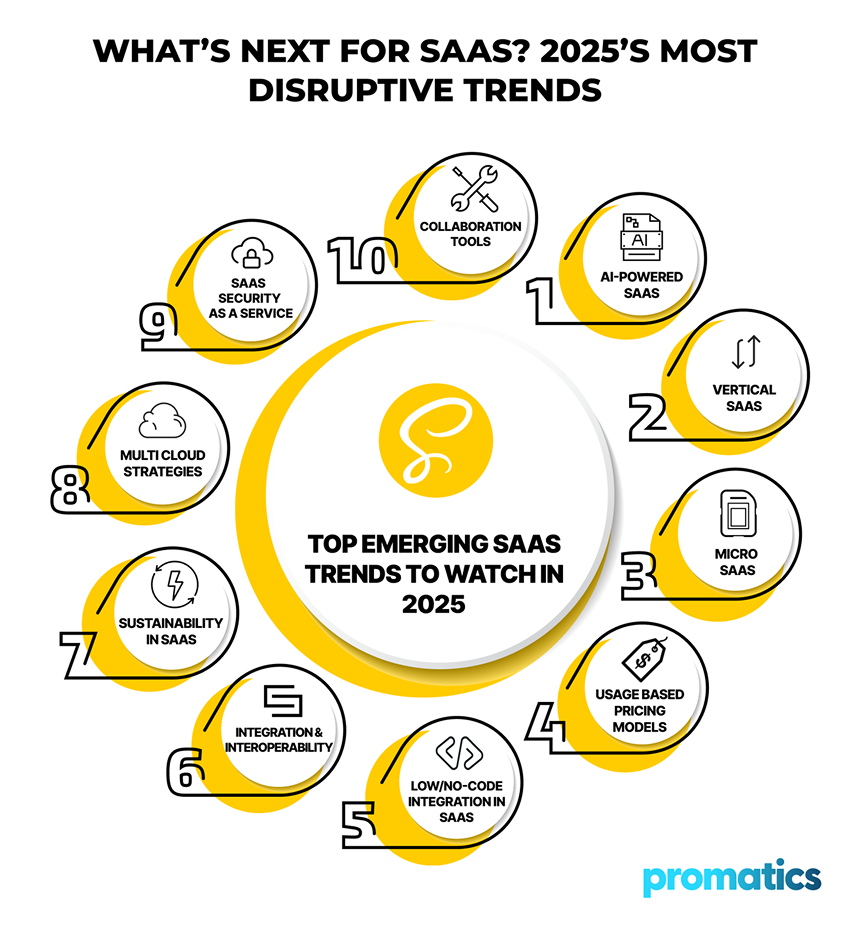
Sustainability in SaaS
Environmental issues are encouraging SaaS firms to turn to sustainable methods. Activities involve using renewable energy sources for data centres, maximising energy efficiency, and advocating for green operations. Salesforce, for instance, runs its business on 100% renewable energy, reflecting a commitment to green practices.
In addition to this, product design is also being shaped by sustainability, with designers emphasising efficiency and resource optimisation. Not only are these optimisations environmentally beneficial, but they also save money and lead to better system performance.
Multi-Cloud Strategies
Embracing multi-cloud strategies enables organisations to use the organisation’s cloud providers, promoting flexibility and vendor lock-in avoidance. It promotes redundancy, optimises performance, and allows businesses to optimise and choose best-of-breed for certain requirements.
In 2025, multi-cloud strategies are increasingly important to ensuring business continuity and resilience. By spreading workloads across a number of cloud platforms, organisations reduce the potential for organisational surges or service disruptions. Diversification also enables businesses to take advantage of the distinctive strength of capitalised individual providers, including specialist services or geography-specialised ability.
Moreover, multi-cloud architectures support compliance with data sovereignty regulations by enabling data storage in specific geographic locations. This flexibility is crucial for multinational organisations navigating corporate organisational landscapes.
SaaS Security as a Service (SECaaS)
SECaaS is the practice of outsourcing cybersecurity services to cloud providers, providing scalable and economical security solutions. Solutions range from threat detection to data protection and compliance management. According to the Cloud Security Alliance, SaaS security is a top concern for 86% of organisations with security budgets.
In 2025, the sophistication of cyber threats requires sophisticated security solutions. SECaaS providers provide specialised, know-how technology that most organisations use themselves. They provide real-time monitoring, incident response, and vulnerability testing.
SECaaS scalability enables organisations to change their security position in relation to changing threats. Furthermore, industry compliance and regulation are eased through automated reporting and auditing assistance, which lessens internal teams’ workload.
Collaboration Tools
The rise of remote and hybrid work models has amplified the importance of collaboration tools within SaaS. Platforms facilitating real-time communication, project management, and data sharing are essential for maintaining productivity and team cohesion. Tools like Baserow enable seamless data collaboration, supporting modern workplace dynamics.
In 2025, collaboration tools are evolving to offer more integrated and immersive experiences. Features such as virtual whiteboards, AI-driven meeting summaries, and real-time language translation enhance communication across diverse teams. These advancements foster inclusivity and ensure that all team members can contribute effectively, regardless of location.
Furthermore, the integration of collaboration tools with other business applications streamlines workflows and reduces context switching. This interconnectedness enhances efficiency and supports a more agile and responsive organisational culture.
Real-World Example of SaaS Companies
- Baserow: Offering collaborative tools for real-time database management, Baserow empowers non-technical users to build custom workflows and manage data without writing code. It’s a strong example of no-code innovation democratising and software development for businesses of democratising sizes. Its integrations with popular SaaS apps make it a flexible choice for teams needing real-time collaboration and centralised data control.
- Metronome: A key centralised promoting usage-based pricing, Metronome allows SaaS businesses to track customer usage and translate it into dynamic billing structures. This empowers companies to adopt more transparent and adaptable pricing models. By enabling real-time metering and billing analytics, Metronome helps businesses align revenue with value delivered, paving the way for more customer-centric monetisation strategies.
- Notion: Known for monetisation, productivity and knowledge management, Notion combines notes, docs, databases, and wikis into one unified platform. With the introduction of AI features like content summarisation, task automation, and AI writing assistance, Notion exemplifies how collaboration tools are becoming smarter and more indispensable in remote and hybrid work environments.
- Appsmith: A standout in the low-code movement, Appsmith enables developers and business users to quickly build internal tools with drag-and-drop functionality and easy API integrations. Its open-source foundation allows for deep customisation and active community-driven customisation, making it a robust platform for agile SaaS development in 2025.
- Salesforce: Beyond its CRM dominance, Salesforce is a leader in the sustainability space, setting a precedent for environmentally conscious SaaS practices. Through its Sustainability Cloud, Salesforce helps businesses track and reduce their carbon footprint, highlighting how SaaS companies can drive ESG (Environmental, Social, Governance) outcomes.
Importance of Adaptability in the SaaS Space
In a landscape shaped by constant technological shifts and user expectations, adaptability is no longer optional—it’s essential. The SaaS industry thrives on rapid innovation, and companies must remain agile to maintain their relevance and competitive edge. What worked yesterday may no longer suffice today. New trends like AI integration, low-code/no-code solutions, and usage-based pricing models are redefining how users interact with and pay for software. Only those companies willing to pivot, iterate, and evolve with these shifts can hope to retain market leadership.
Adaptability in SaaS manifests in various forms—product innovation, business model flexibility, or customer engagement strategies. For instance, SaaS businesses that adopt agile development frameworks can quickly deploy updates, incorporate feedback loops, and scale based on user demand. Moreover, embracing microservices architecture and interoperability enables products to be modular, integrative, and future-ready.
Another key element of flexibility is understanding the international trend towards distributed recognition of remote teams. SaaS businesses should provide collaboration capabilities, information-sharing features, and mobile-centric interfaces to maintain productivity.
In the end, the most successful SaaS vendors in 2025 are not merely those possessing advanced features but also those imbued with a culture of persistent learning, a passion for customer success, and the resilience to grasp emerging chances and dilemmas in equal measure.
Promatics Technologies: A Recognised Leader in Building Innovative Solutions
Promatics Technologies has firmly established itself as a trailblazer in the SaaS development domain, setting benchmarks for innovation, scalability, and client satisfaction. Known for its forward-thinking approach, Promatics has helped countless startups and enterprises transform ideas into market-ready SaaS products that are both robust and future-proof.
Their strength lies in combining cutting-edge technologies—such as cloud-native infrastructure, AI/ML integration, and mobile responsiveness—with a customer-centric development methodology. Every SaaS product built by Promatics reflects a deep understanding of business logic, user behaviour, and market needs. This results in tailor-made platforms that not only solve industry-specific problems but also enhance user engagement and operational efficiency.
The Promatics team stands for agile and DevOps principles, with the objective of quick development cycles, pain-free deployment, and constant feedback integration. Be it a B2B SaaS enterprise resource planning platform or a micro SaaS tool for solving a specific pain point, Promatics delivers with precision, performance, and scalability in mind.
Another bedrock of their success is their pledge to data security, UX mastery, and scalability—three pillars essential for any SaaS product to flourish in today’s unpredictable digital landscape. With a strong portfolio and a proven history, Promatics Technologies continues to break new ground on what SaaS can do in 2025 and beyond.
Final Thoughts
As we navigate the evolving contours of the SaaS universe in 2025, one thing becomes abundantly clear: success belongs to the bold, the agile, and the user-focused. The trends shaping this era—AI-powered solutions, vertical specialisation, usage-based pricing, low-specialisation, and environmental accountability—are not fleeting innovations but fundamental shifts in how software is built, delivered, and consumed.
For SaaS companies, embracing these changes isn’t just about staying competitive; it’s about redefining what value means in the age of intelligent software. Businesses that lean into adaptability, prioritise customer-centricity and invest in prioritise le, secure, and sustainable technologies will lead the charge into a future where software isn’t just a service—it’s a strategy.
As seen through pioneers like Promatics Technologies, the real differentiator lies in understanding the pulse of the market and turning that insight into innovation. Whether you’re launching a micro SaaS project or scaling a global B2B SaaS enterprise, the key lies in aligning with these transformative trends.
In 2025, SaaS is not just shaping industries—it’s shaping the way we live, work, and connect. And the companies that understand this will not only survive the next wave—they’ll ride it.
