Why Progressive Web Apps (PWAs) Are the Future of Web Development

TL;DR
- Key benefits of Progressive Web Apps (PWAs) for businesses.
- Offline access, push notifications, and faster loading experiences.
- SEO advantages and cross-device compatibility features.
- Cost-effective alternative to native mobile applications.
- Growing adoption of PWAs for scalable digital experiences.
Today, users demand quick, dependable, and app-like experiences without the need to download heavy mobile apps. This is precisely where Progressive Web Apps (PWAs) come in to revolutionize the situation. PWAs combine the best features of both websites and native apps with great speed, offline capabilities, and high-quality performance.
In this guide, Promatics explains what PWAs are, their benefits, comparisons, use cases, and why businesses must adopt them now.
What Are Progressive Web Apps (PWAs)?
Progressive Web Apps (PWAs) are basically web apps which behave like native mobile apps, but are run in a browser. These apps provide almost the same user interface features, but the former is not a must. PWAs are compatible with all types of mobiles, desktops, tablets, as well as browsers. With the help of service workers, web app manifests, and advanced caching mechanisms, they assure high speed, reliability, and also the possibility of working offline.
To explore modern web development approaches, check out Custom Web Solutions.
Advantages of Progressive Web Apps (PWAs)
From PWA users point of view, there is no device where these programs won’t deliver perfect performance, be accessible, or remain operational. In fact, PWAs are a mixture of perfect web and mobile applications, presenting qualities such as rapidity, security, offline presence, etc., all of which culminate to user-friendliness and customer satisfaction. Such qualities alone make PWA act as the leading digital solution for the global market.
1. High Speed & Instant Loading
PWAs are super fast as they cache with the service worker the vital resources to be used. Thus, loading is minimal even during the first visit. Moreover, with the proper use of caching methods and scripts, PWAs have been known to upgrade Core Web Vitals and the general SEO score. They also facilitate user engagement thanks to their instant-loading capability that is believed to prolong users’ sessions and provide smooth browsing.
For more insights on optimizing web performance, you can explore the’ Blog section.
2. Offline Access & Low Network Support
Progressive Web Apps are capable of delivering various services even when internet connectivity is absent. This is by virtue of the offline-first policy enabling users to gain access to desired content even when they are on 2G, 3G or networks that keep changing. Thus, these attributes make PWAs so dependable especially in the cases of areas with bad signals. And thus, any business whose strategy is to go into rural or marginalized markets by means of PWA is nicely positioned to win the race.
3. Responsive & Cross-Platform Compatibility
PWAs adapt to any device, whether mobile, desktop, or tablet. Businesses no longer need separate apps for iOS and Android. A single PWA works everywhere, reducing development time and effort. Organizations can also explore the’ Web Development Services to build responsive and secure digital platforms.
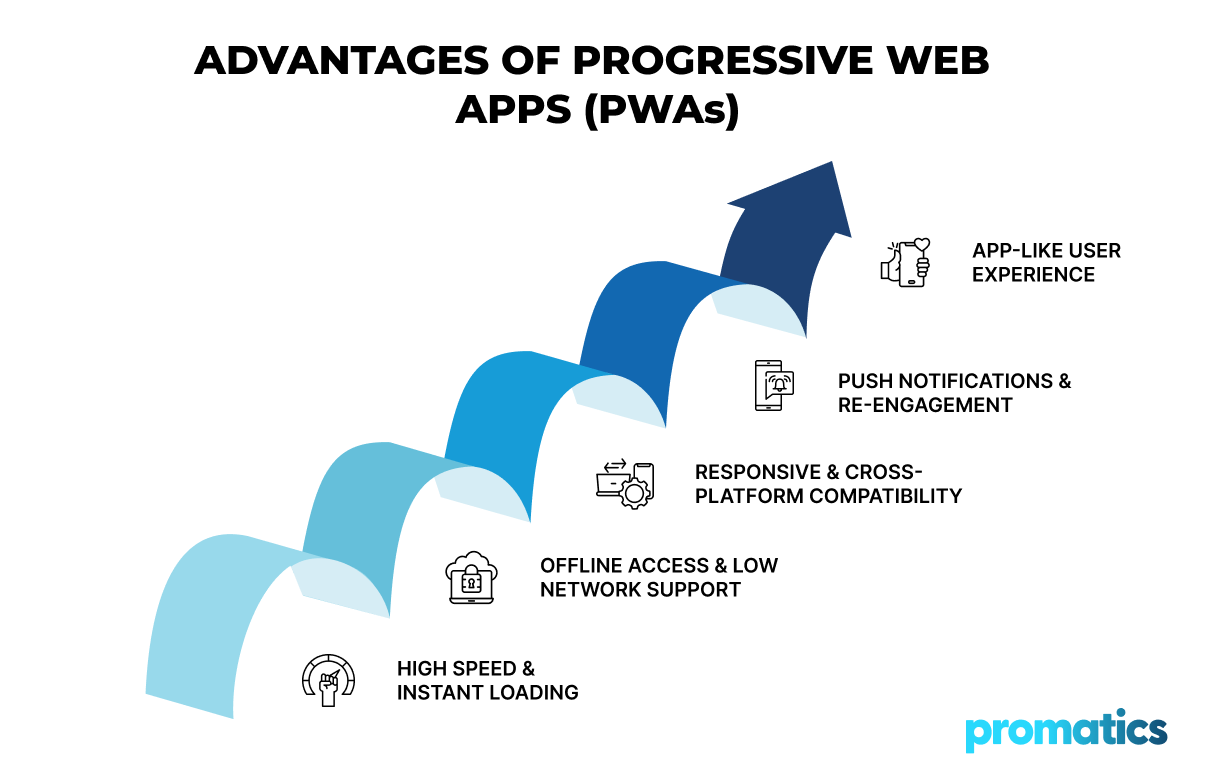
4. Push Notifications & Re-engagement
Just like native apps, PWAs support push notifications as an instrument for businesses to re-engage users. Such notifications lead to an increase in user engagement, retention, and conversion rates. In this respect, the impact of push notifications in customer return to the app can hardly be overestimated in the sectors like eCommerce, news, travel, and SaaS.
5. App-Like User Experience
Progressive Web Apps offer the same level of smoothness in terms of animation, gestures, and transition as that of a native app. Users got the option to put a PWA on their home screen without the need to download it from the app store.
Companies looking to enhance app-like design quality can benefit from expert UI/UX design services that focus on creating seamless, intuitive digital experiences. These solutions help improve usability, visual appeal, and overall engagement
Business Benefits of Progressive Web Apps
PWAs are strong drivers of higher conversion rates, reduction in development costs, and provision of long-term scalability. They work on improving customer retention, reducing bounce rates, and offering frictionless user journeys that directly lead to business growth. In addition, due to the combination of factors such as speed, convenience, and accessibility, businesses that decide to adopt PWAs will be able to enjoy a great competitive advantage.
To explore real business transformations, view more’ Case Studies.
Case Studies / Real-World Examples
- After PWA implementation Twitter experienced a 65% increase in pages per session and strong user engagement besides other metrics.
- One of the functionalities of Starbucks PWA is to work offline. Due to better accessibility, the daily active users were doubled.
- On the 2G network, Uber’s PWA can be loaded in less than 3 seconds and hence a ride can be booked anywhere.
- After transformation into a PWA Alibaba recorded the conversion rate going up by 76%, a clear indication of its eCommerce impact.
These case studies demonstrate how top-tier global brands harness the power of PWAs to drive engagement, accelerate speed, and increase conversions.
PWA vs Traditional Web Apps
PWAs offer faster performance, offline capability, app-like UI, and push notifications, features not available in traditional web apps. They load quickly, work reliably, and reduce dependency on servers. With a modern architecture, PWAs deliver a richer user experience compared to traditional web apps.
Feature Comparisons
| Feature | PWA | Traditional Web App |
| Offline Access | Yes | No |
| Push Notifications | Yes | No |
| Installation | No installation needed | Browser-only |
| Performance | Faster | Standard |
| Engagement | High | Moderate |
PWA vs Native Mobile Apps
Progressive Web Apps are less expensive and quicker to create, update, and maintain as compared to native mobile apps. Whereas native apps allow the deeper integration of the hardware, PWAs provide broader reach, immediate usability, and no installation friction. For the most part, PWAs can provide performance close to that of native apps with much lesser investments.
Key Differences
- Development cost & time
- App store dependency vs no dependency
- Battery consumption
- Reach & accessibility
- User acquisition friction (downloads vs instant use)
PWAs eliminate the limitations of downloads and storage thus, they are more user-friendly.
Tools & Technologies Used in PWA Development
PWA development involves the usage of advanced web frameworks, caching methods, and cloud technologies to maintain good performance on all devices and networks.
Popular Tech Stack
- Frontend: React, Angular, Vue
- Backend: Node.js, Django, Laravel
- Core Technology: Service Workers, Web App Manifest
- Optimization Tools: Workbox, Lighthouse
- Hosting: Firebase, AWS, Vercel
With this technology stack companies can easily and rapidly develop scalable and high-performing PWAs. You can learn about professional development practices at Software Development Services.
Checklist for Choosing a PWA Development Partner
- Substantial experience in PWA development
- Excellent UX/UI design skills
- Comprehensive understanding of service workers & caching
- Implementation of SEO-friendly PWA
- Cross-browser and cross-device test expertise
- Occurrence of pricing & project timelines
- After-launch support & upgrades that can be trusted
Collaborating with a skilled PWA development team assures your project is safe, extendable, and tuned.
Why PWAs Are the Future of Web Development
Progressive web apps (PWAs) are the ones that can resolve the issues of the digital world today – the problems of slow applications, high costs of development, and low user engagement. Their speed, openness to users, and compatibility with different platforms make them the first choice of companies willing to grow their businesses efficiently. As the need for quick and reliable web experiences rises, so do the importance and relevancy of PWAs as the future of web development.
Need a fast, secure, and powerful PWA for your business?
Hire expert PWA developers from Promatics and build your next-generation web experience.
Book a free consultation today.
Conclusion
Progressive Web Applications (PWAs) are a fusion of the best elements of the net and problem apps. Thanks to these, companies have a competitive advantage with regard to speed, reliability, and user engagement. With digital standards continuously going up, the decision to implement PWAs is still an option only in the eyes of less-informed people, in fact, it is a strategic move. Businesses that partner with Promatics and invest in PWA development early are positioned to lead in performance, accessibility, and sustainable customer growth.
