AI-Powered Shopify Apps: Custom vs Public Apps, Which Is Right for Your Business?

TL;DR
- Shopify app development in 2026 is increasingly focused on intelligent workflows rather than basic store extensions.
- A custom solution provides greater control when a merchant needs business-specific functionality and integrations.
- A public solution offers greater market reach when the underlying problem is common among Shopify merchants.
- AI can make ecommerce applications more useful by helping businesses interpret data and act on insights faster.
- The best approach is to align app architecture, AI capabilities, merchant needs, and business goals before development begins.
Shopify has become much more than a platform for creating an online store.
Today, merchants use Shopify apps to automate operations, improve customer experiences, manage marketing, optimize SEO, connect business systems, and make better decisions.
But there is a bigger opportunity emerging.
Artificial intelligence is turning Shopify apps from simple tools into intelligent business systems.
Consider the current numbers.
According to Shopify’s 2026 small-business statistics, 25% of small businesses already use AI for daily operations, while another 51% are exploring or experimenting with AI tools. Among small businesses already using AI, marketing is the most common application, with 91% using AI for marketing tasks and 76% using it to improve worker productivity.
This creates a significant opportunity for AI-powered Shopify app development.
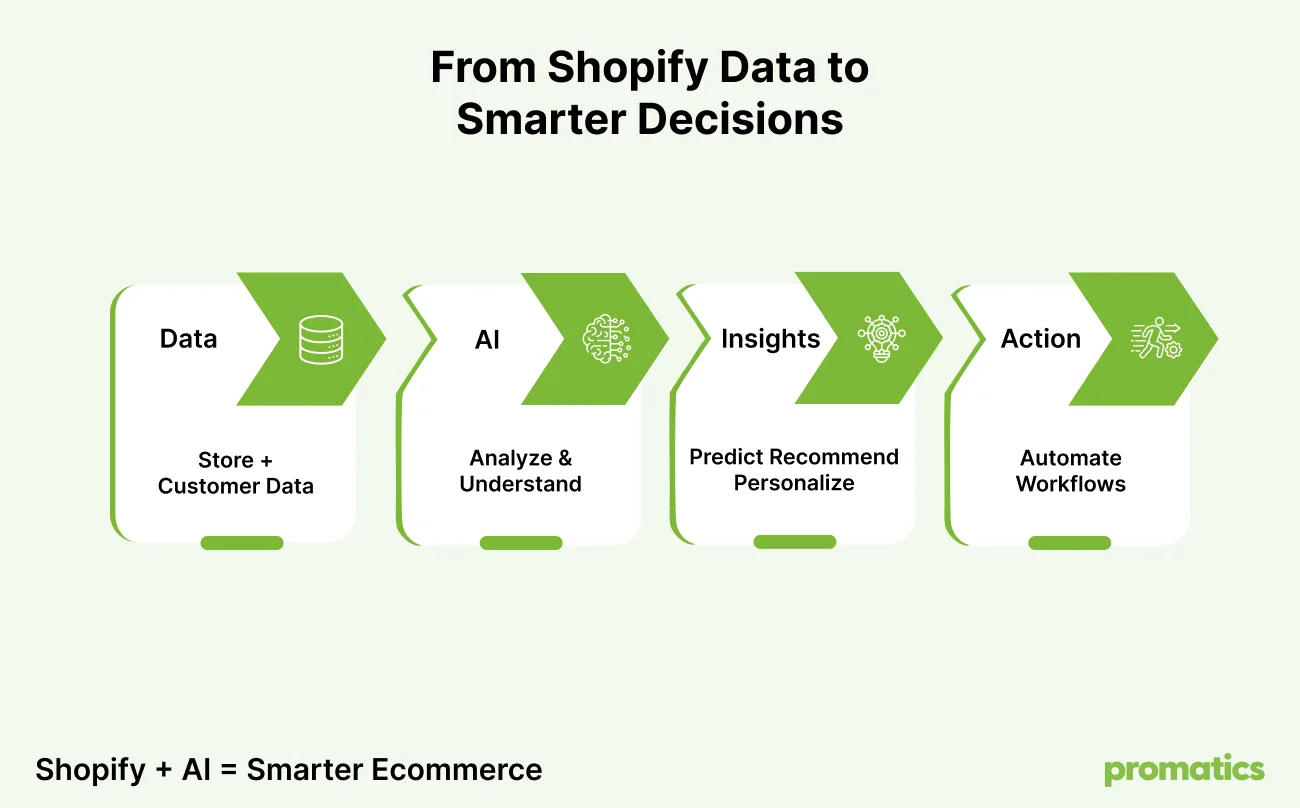
Instead of simply showing store data, an intelligent app can analyze that data, identify patterns, recommend actions, and automate repetitive processes.
But before building one, businesses need to answer an important question:
Should you build a custom Shopify app for your own business or create a public app for thousands of Shopify merchants?
Why Shopify App Development Is Becoming a Business Opportunity
Small businesses are increasingly moving online, and Shopify is an important part of that transition.
Shopify’s latest statistics show that 85% of small businesses selling to online shoppers use at least one ecommerce platform. The same data states that the average small business sells across 1.9 digital platforms, while 44% sell online only and 41% sell both online and in person.
That creates demand for software that helps merchants operate more efficiently.
- The problem is that every business has different requirements.
- A fashion retailer may need AI-powered product recommendations.
- A B2B merchant may need custom pricing and ERP integration.
- A growing D2C brand may need an intelligent Shopify app CRM.
- An international retailer may need multilingual content and automated SEO.
- A large enterprise may need Shopify connected to its existing technology ecosystem.
This is where Shopify application development becomes particularly valuable.
Instead of forcing the business to adapt to a generic application, companies can build technology around their actual workflow.
What Is Shopify Application Development?
Shopify application development involves creating software that extends Shopify’s functionality or connects Shopify with external systems.
A Shopify app can work with store data, automate workflows, provide merchant-facing tools, connect third-party platforms, or introduce completely new functionality.
Common Shopify app development use cases include:
- Customer relationship management
- Inventory management
- Product recommendations
- Marketing automation
- SEO optimization
- Analytics and reporting
- Shipping and logistics
- Payment integrations
- ERP integration
- AI-powered automation
- Customer support
- Personalized shopping experiences
For businesses that require deeper customization, custom Shopify app development can provide functionality that off-the-shelf applications cannot.
Promatics Technologies also approaches Shopify development from a broader digital-commerce perspective, covering areas such as custom Shopify apps, API integrations, migration, headless commerce, performance optimization, and AI-powered ecommerce solutions.
AI Is Changing Shopify Apps
Traditional applications generally follow a predictable workflow:
Input → Process → Output
AI-powered applications can go further:
Input → Understand → Analyze → Recommend → Automate
That difference can completely change the value of a Shopify app.
For example, a traditional analytics app might show that sales have declined.
An AI-powered Shopify application could analyze product performance, customer behavior, traffic sources, seasonal trends, and other available data to identify possible reasons and recommend the next action.
This is why AI-powered Shopify apps are becoming increasingly interesting for merchants.
Shopify’s statistics reinforce this direction. Of small businesses already using AI, 87% say AI adoption is critical to competing in their market, while almost half report that AI improves productivity and 48% say it helps provide a better client experience.
Custom Shopify Apps vs Public Shopify Apps
The choice between custom and public applications is one of the most important decisions in Shopify app development.
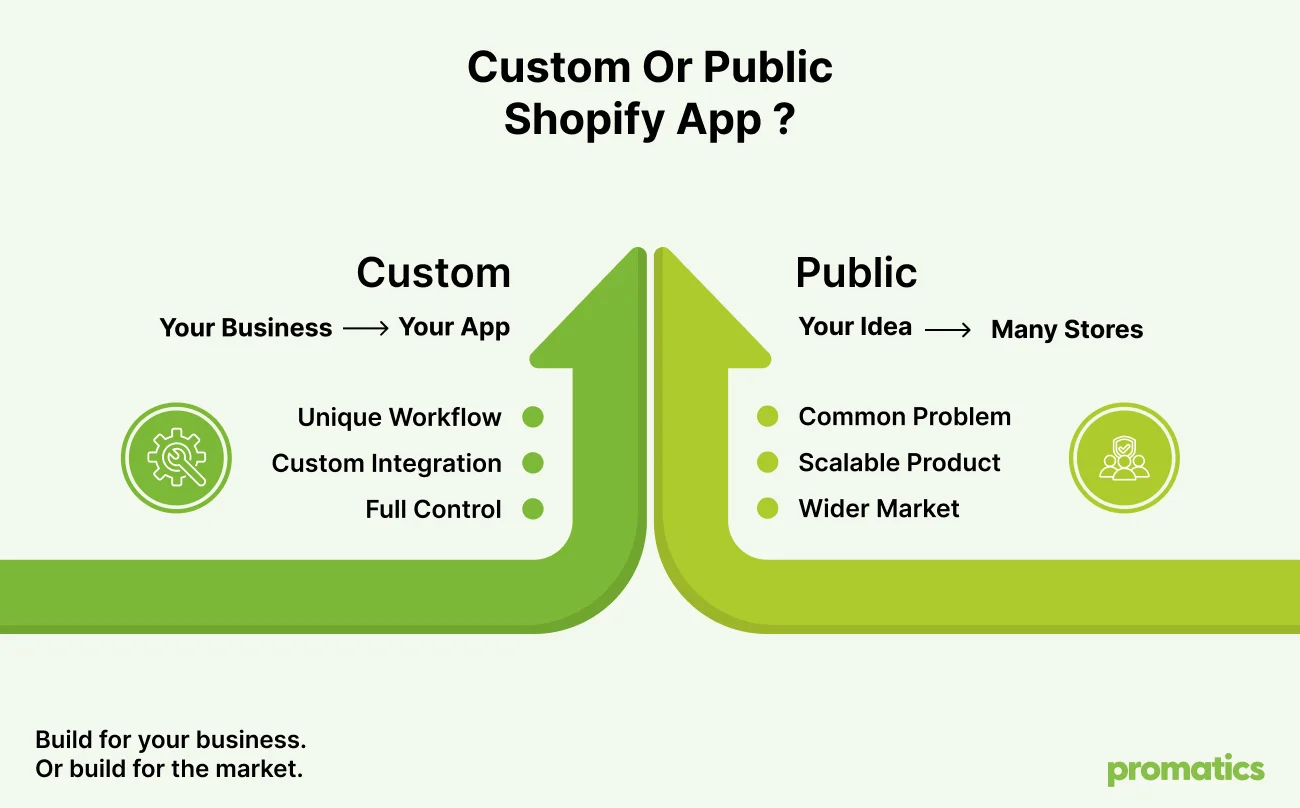
What Is a Custom Shopify App?
A custom Shopify app is designed around the requirements of a specific business.
Imagine a retailer that already uses:
- A proprietary ERP
- A CRM
- Warehouse software
- Internal analytics
- Custom pricing rules
- An AI recommendation engine
Instead of replacing these systems, a custom Shopify app can connect Shopify to the existing technology stack.
Benefits of Custom Shopify Apps
1. Highly specialized functionality
The application is built around your business processes.
2. Custom integrations
The app can connect Shopify with internal or third-party systems.
3. Better automation
Repetitive workflows can be automated according to specific business rules.
4. Greater AI flexibility
Businesses can integrate AI models, predictive systems, recommendation engines, or intelligent automation based on their requirements.
5. Competitive differentiation
Proprietary functionality can become a competitive advantage.
For businesses with complex digital ecosystems,hiring professional Shopify API integration services can be particularly important because APIs allow Shopify to communicate with CRMs, ERPs, analytics systems, mobile apps, and other platforms.
What Is a Public Shopify App?
A public Shopify app is designed for multiple merchants.
Instead of solving one company’s unique problem, the application addresses a common challenge across the Shopify ecosystem.
Examples include:
- SEO apps
- Review apps
- Email marketing apps
- Inventory tools
- Loyalty applications
- AI content tools
- Customer support apps
- Analytics platforms
- CRM applications
A public application can potentially become a scalable SaaS business.
However, it also requires broader product thinking.
The app needs to support different merchants, store configurations, workflows, integrations, and business requirements.
Custom vs Public Shopify Apps: Quick Comparison
| Factor | Custom Shopify App | Public Shopify App |
| Target users | One business | Multiple merchants |
| Main objective | Solve a specific business problem | Solve a common market problem |
| Customization | Very high | Configurable |
| Integrations | Business-specific | Common integrations |
| AI functionality | Highly specialized | Designed for multiple use cases |
| Distribution | Controlled | Wider merchant distribution |
| Revenue model | Business/project focused | Subscription, usage, or freemium |
| Best for | Enterprises and unique workflows | SaaS businesses and app startups |
Which one should you choose?
The answer is simple:
- Build custom when the problem is unique.
- Build public when the problem is widespread.
AI-Powered Shopify App Use Cases
AI can make almost every major Shopify application category more intelligent.
1. AI-Powered Shopify App CRM
A conventional Shopify app CRM can store customer information and purchase history.
An AI-powered CRM can analyze that information and identify opportunities.
For example, it could:
- Identify high-value customers
- Predict potential churn
- Segment customers automatically
- Recommend cross-selling opportunities
- Generate personalized messages
- Summarize customer interactions
- Identify customers likely to make repeat purchases
This changes the CRM from a database into a decision-support system.
2. AI SEO Apps for Shopify
Many merchants search for the best SEO apps for Shopify because product visibility directly affects ecommerce growth.
But the next generation of SEO applications can go beyond basic metadata editing.
An AI-powered SEO app could analyze:
- Product titles
- Meta descriptions
- Product descriptions
- Search intent
- Keyword opportunities
- Internal linking
- Structured data
- Duplicate content
- Content quality
It could then generate recommendations or draft improvements for merchant approval.
This creates an opportunity for businesses looking beyond traditional SEO tools toward AI-powered ecommerce development.
3. Intelligent Product Recommendations
AI can analyze customer behavior and product relationships to deliver more relevant recommendations.
For example:
Customer views running shoes → AI analyzes behavior → identifies complementary products → recommends socks, accessories, or related products.
This can make product discovery more personalized while reducing the amount of manual merchandising required.
4. AI Inventory Forecasting
Inventory problems can become expensive quickly.
Too much inventory ties up capital.
Too little inventory creates stockouts and lost sales.
An AI-powered Shopify app can analyze historical sales, product performance, seasonality, and other available data to help merchants forecast demand and make better inventory decisions.
This becomes particularly useful as ecommerce businesses scale.
5. AI Customer Support
An AI-powered customer support app can:
- Answer common questions
- Summarize conversations
- Classify support requests
- Recommend responses
- Route complex cases
- Analyze recurring complaints
Instead of replacing human support teams, AI can handle repetitive work while allowing employees to focus on higher-value interactions.
How to Build a Shopify App
One of the most searched questions among developers and entrepreneurs is:
How to build a Shopify app?
The process starts with a business problem, not a programming language.
Step 1: Identify the Problem
Ask:
What problem are merchants repeatedly experiencing?
For a custom app, this might be an internal workflow.
For a public app, it should be a problem shared by a larger group of merchants.
Shopify’s own app-development guidance recommends validating an app idea and understanding the target audience before investing heavily in development.
Step 2: Decide the App Model
Determine whether you need:
- A custom Shopify app
- A public Shopify app
- A Shopify integration
- An embedded application
- A headless commerce solution
This decision affects architecture, development, onboarding, scalability, and distribution.
Step 3: Plan Shopify API Integration
APIs are central to modern Shopify development.
A well-designed application can connect Shopify with:
- CRM systems
- ERP platforms
- Payment systems
- Inventory management
- Analytics platforms
- Marketing tools
- Mobile applications
- AI services
For businesses building complex commerce ecosystems, API-first development can also make future integrations easier.
Promatics Technologies has covered how API-first architecture helps digital products support multiple interfaces, third-party integrations, AI systems, and scalable technology ecosystems.
Shopify Apps and Headless Commerce
Not every business needs a traditional Shopify storefront. Growing brands may eventually require greater control over the customer experience. This is where headless commerce development becomes relevant.
Headless commerce separates the frontend experience from backend commerce functionality and uses APIs to connect the two.
This allows businesses to create experiences across:
- Websites
- Mobile apps
- Marketplaces
- Social platforms
- Digital kiosks
- Other customer touchpoints
For example, a company could use Shopify as its commerce backend while building a completely customized frontend.
Promatics Technologies’ recent research on headless commerce vs traditional ecommerce highlights the flexibility, scalability, API integrations, and omnichannel advantages of this approach.
Why Small Businesses Need Smarter Shopify Apps
The Shopify statistics reveal an interesting challenge.
Small businesses are adopting technology quickly, but they often have fewer resources than large enterprises.
Shopify reports that only 18% of small firms have paid employees, yet those businesses employ 45.9% of all US workers. It also reports that 56% of small businesses were hiring or attempting to hire employees in April 2025, with 85% of hiring businesses struggling to attract qualified applicants.
This makes automation particularly valuable.
If a merchant cannot hire another employee to manually analyze orders, update products, respond to customers, optimize SEO, or manage repetitive workflows, intelligent software can help bridge that gap.
That is one reason AI-powered Shopify application development has such strong potential.
Shopify App Development and Ecommerce Growth
The opportunity extends beyond Shopify itself.
Shopify’s data shows that the top reasons small businesses sell online include expanding customer reach, increasing sales, and responding to customer preferences. At the same time, merchants identify digital security, marketing costs, website development and maintenance, and fulfillment among the biggest challenges of selling online.
This creates several opportunities for developers and technology companies.
A Shopify application can potentially reduce:
- Manual work
- Operational costs
- Marketing workload
- Customer support pressure
- Inventory complexity
- Technical maintenance
- Data-analysis time
The most successful apps therefore should not simply add features.
They should remove friction.
What Shopify Apps Is This Website Using?
Another popular question among ecommerce owners is:
“What Shopify apps is this website using?”
Unfortunately, there is no guaranteed way to identify every Shopify app installed on a store.
Some applications leave visible storefront signals, such as scripts, widgets, app blocks, or specific code patterns.
However, backend integrations, custom applications, private systems, and certain services may not be publicly detectable.
Technology-detection tools can therefore provide useful clues, but they should not be treated as a complete inventory of a store’s technology stack.
For businesses, this also demonstrates the value of custom development.
A competitor may identify the platform powering your store, but they may not be able to see the proprietary workflows and business logic operating behind it.
What Authenticator App Does Shopify Use?
Another common search query is:
“What authenticator app does Shopify use?”
Shopify supports authenticator apps for two-step authentication rather than requiring merchants to use one specific authenticator application.
Supported options include applications such as Google Authenticator, Duo Mobile, Amazon AWS MFA, and Authenticator, along with other supported secure sign-in methods.
For developers, the important takeaway is that Shopify applications should follow Shopify’s authentication, authorization, and security practices instead of creating unnecessary authentication mechanisms.
Why Choose Promatics Technologies for Shopify App Development?
Building a Shopify app requires more than coding.
A successful application needs:
- Business analysis
- UX strategy
- Shopify expertise
- API integration
- Scalable architecture
- AI implementation where appropriate
- Security
- Testing
- Performance optimization
- Ongoing maintenance
This is where Promatics Technologies can add value.
Promatics works across web and mobile application development, artificial intelligence solutions, digital commerce, and product strategy. Its Shopify development offering includes custom Shopify apps, Shopify API integrations, migration services, headless commerce, performance optimization, and AI-powered ecommerce solutions.
For businesses that need more than a basic plugin, this broader technology capability can be important.
The Future of Shopify App Development Is Intelligent
The next generation of Shopify apps will not simply automate individual tasks.
They will increasingly connect data, understand context, make recommendations, and execute workflows.
Imagine opening your Shopify dashboard and seeing:
Sales are down 8% this week.
Instead of stopping there, an AI-powered application could continue:
The decline is concentrated in three products. Inventory is sufficient, but organic traffic has decreased. Product pages have weaker search visibility than comparable products. Recommended action: update product content and launch a targeted campaign.
That is the difference between an application that reports information and one that helps make decisions.
Final Verdict: Custom or Public Shopify App?
Both models have strong potential.
A custom Shopify app makes sense when your business has unique workflows, proprietary systems, specialized integrations, or enterprise requirements.
A public Shopify app makes sense when you have identified a recurring problem affecting a large number of Shopify merchants.
AI can strengthen both.
The opportunity is therefore not simply to build another Shopify app.
It is to build an application that helps merchants sell more, automate more, understand their customers better, and operate more efficiently.
For businesses exploring Shopify application development, the most important question is no longer:
“What features should our Shopify app have?”
Instead, ask:
“What business problem can we solve better with Shopify, automation, and AI?”
That is where the next generation of Shopify apps will create real value.
