AI SaaS Development: Architecture, Stack & Cost (2027)
TL;DR
- AI SaaS product development in 2027 involves more than integrating AI models into software. Businesses need scalable architecture
- the right tech stack
- secure multi-tenant infrastructure
- efficient AI workflows
- and cost management. From validating an idea and building an MVP to integrating AI agents
- RAG
- and cloud services
- this guide covers the key components
- technologies
- development costs
- timelines
- and strategies for building scalable AI-powered SaaS products.
Artificial intelligence is transforming how SaaS products are designed, developed, and used. From intelligent interfaces and predictive analytics to automated workflows and AI agents, software is evolving beyond traditional functionality to help businesses make decisions, automate tasks, and deliver personalized experiences.
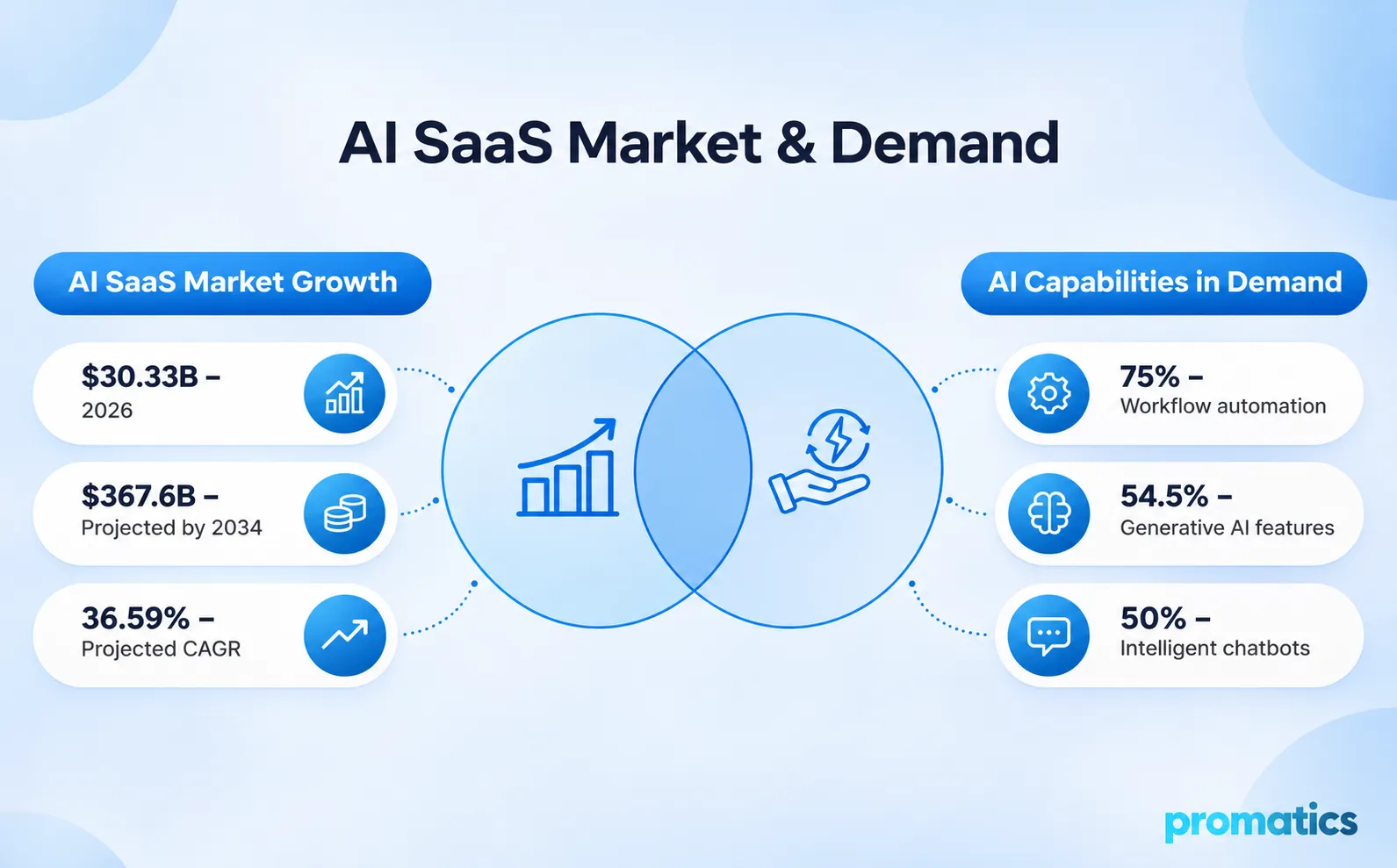
According to Fortune Business Insights, the AI SaaS market is projected to grow from $30.33 billion in 2026 to $367.6 billion by 2034. Meanwhile, a GoodFirms survey found that 75% of surveyed software development companies identified workflow automation as the most requested AI capability.
Building an AI-powered SaaS product, however, involves more than integrating an AI model. Architecture, data management, security, scalability, model selection, and recurring AI costs all influence the product’s long-term success.
This guide explores AI SaaS architecture, technology choices, development costs, AI agents, and the process of building a scalable AI SaaS product in 2027.
What Is AI SaaS Product Development?
AI SaaS product development involves building cloud-based software that uses artificial intelligence to deliver intelligent, predictive, or automated capabilities.
Traditional SaaS applications rely primarily on predefined workflows and business logic. AI SaaS products extend these capabilities through machine learning, generative AI, natural language processing, predictive analytics, and AI agents.
For example, a traditional CRM helps manage customer records and sales pipelines. An AI-powered CRM can additionally analyze conversations, prioritize leads, predict churn, and recommend follow-up actions.
Common AI technologies used in SaaS products include:
- Generative AI: Creates content, summaries, and responses.
- Machine Learning: Supports predictions, recommendations, and classification.
- RAG: Retrieves relevant information to ground AI responses.
- AI Agents: Execute tasks through connected tools and workflows.
- Computer Vision: Processes images and visual information.
Businesses exploring AI-powered applications can also refer to AI software development to understand how AI technologies can be integrated into digital products.
Why Businesses Are Investing in AI SaaS Development
AI is increasingly becoming a core software capability rather than an experimental feature. Businesses are exploring AI SaaS to improve productivity, reduce repetitive work, and deliver smarter user experiences.
1. AI-native software
Businesses are designing products around AI from the beginning, incorporating intelligent onboarding, automated reporting, recommendations, and AI-assisted workflows.
2. AI agents and automation
AI agents can retrieve information, interact with tools, and execute multi-step workflows within defined permissions. They are increasingly being explored for sales, customer support, analytics, and business automation.
3. Personalized user experiences
AI can adapt recommendations, dashboards, workflows, and assistance based on user behavior, preferences, and contextual information.
4. Smarter business workflows
AI SaaS products can connect with CRMs, ERPs, databases, document systems, and communication tools to help businesses automate processes rather than rely on standalone AI chat interfaces.
How to Build an AI SaaS Product
Building an AI SaaS product requires a structured approach that connects product goals with technology and user needs.
Step 1. Validate the product idea
Identify the problem your SaaS product will solve before selecting AI models or frameworks.
| Business Problem | Potential AI Solution |
| Manual customer support | AI support assistant |
| Document review | AI document analysis |
| Sales follow-ups | AI lead prioritization |
| Data analysis | AI-powered analytics |
| Repetitive workflows | AI agent automation |
Before development, determine your target users, the problem, required data, AI feasibility, and monetization strategy.
Step 2. Define the MVP features
Avoid adding too many AI features in the first release. Focus on one or two workflows that demonstrate the product’s value.
For example, an AI document SaaS MVP could include:
- Document uploads.
- AI summaries.
- Natural language search.
- Data extraction.
- User accounts and document history.
- Usage limits and subscription management.
Advanced agent workflows, integrations, and analytics can be introduced later.
Step 3. Choose the right architecture
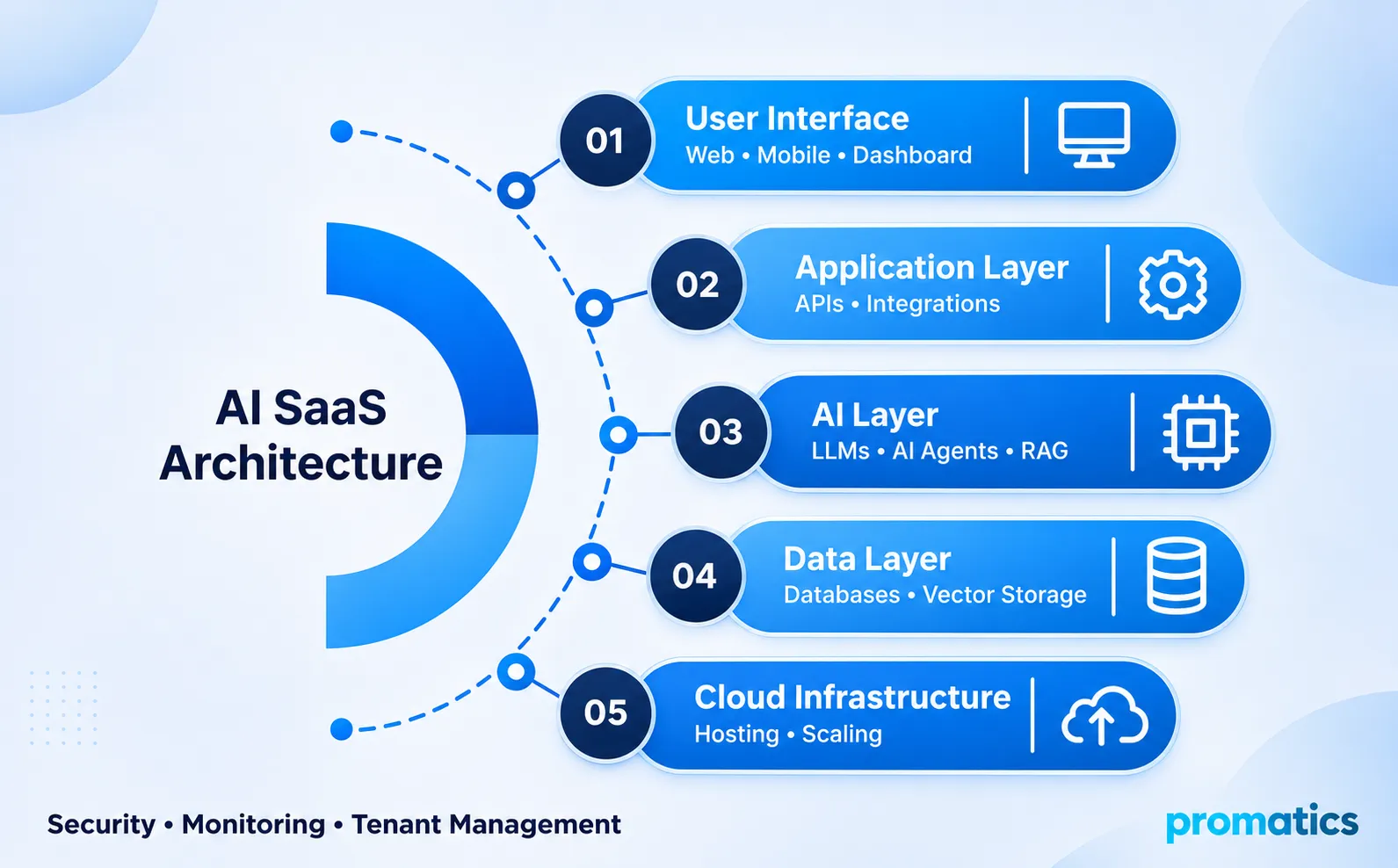
A scalable AI SaaS architecture needs to support user requests, application logic, AI workflows, data retrieval, model integrations, and cloud infrastructure.
AI SaaS Architecture: Key Components
1. Frontend
The frontend delivers the user experience through dashboards, AI chat interfaces, reports, workflows, and account management.
Technologies: React, Next.js, TypeScript, Tailwind CSS.
2. Backend and API layer
The backend manages business logic, authentication, permissions, integrations, subscriptions, and communication between the frontend and AI services.
Technologies: Node.js, NestJS, Python, FastAPI, Django.
3. AI orchestration
This layer connects AI models with prompts, retrieval systems, tools, and workflows. It manages model selection, context retrieval, output validation, and execution.
Technologies: LangChain, LangGraph, LlamaIndex, Semantic Kernel or direct model APIs.
4. AI models
Depending on product requirements, the platform may use language, vision, embedding, speech, or predictive models.
Platforms: OpenAI, Anthropic, Google Gemini, Amazon Bedrock, Azure AI and Hugging Face.
5. Data infrastructure
AI SaaS products may need structured data, documents, conversation histories, embeddings, and generated outputs.
| Technology | Purpose |
| PostgreSQL | Application data |
| Redis | Caching and queues |
| Pinecone / Qdrant | Vector search |
| MongoDB | Document-oriented data |
| Amazon S3 | File storage |
A vector database is particularly useful when the product requires semantic search, RAG, or similarity matching. It may not be necessary for every MVP.
6. Cloud and deployment
Cloud infrastructure supports application hosting, storage, scalability, deployment, monitoring, and backups.
Platforms: AWS, Microsoft Azure, Google Cloud.
Supporting tools: Docker, Terraform, GitHub Actions and cloud-native monitoring.
Businesses can also explore AWS web development for cloud-based application development and deployment.
Multi-Tenant Architecture, Security and Scalability
SaaS applications serve multiple customers through a shared platform. Multi-tenant architecture allows customers to use the same application while keeping their data, permissions, and configurations isolated.
| Architecture | How It Works |
| Pool | Shared infrastructure and database structures |
| Bridge | Shared infrastructure with logical separation |
| Silo | Dedicated infrastructure or resources |
The pool model can be a cost-efficient starting point for many products, while bridge and silo architectures may suit customers with stronger isolation requirements.
AI SaaS security should include:
- Tenant-level data isolation.
- Authentication and authorization.
- Encryption at rest and in transit.
- Secure AI data retrieval.
- Prompt injection protection.
- Audit logs.
- AI usage controls.
- Human approval for sensitive actions.
For additional guidance, link to Multi-Tenant SaaS Architecture: Security, Scalability, and Best Practices.
AI SaaS Tech Stack: What Should You Choose?
The best AI SaaS tech stack depends on product functionality, development speed, AI requirements, and scalability.
| Layer | Technologies |
| Frontend | React, Next.js |
| Backend | Node.js, Python, FastAPI |
| Database | PostgreSQL, MySQL |
| Cache | Redis |
| AI Models | OpenAI, Anthropic, Gemini |
| AI Orchestration | LangGraph, LangChain |
| Vector Database | Pinecone, Qdrant, Weaviate |
| Cloud | AWS, Azure, Google Cloud |
| DevOps | Docker, Terraform, GitHub Actions |
The goal is not to use every technology listed. Choose a stack that supports the product’s current needs without introducing unnecessary complexity.
AI Agents in SaaS: What’s Changing?
AI agents extend traditional AI functionality by allowing applications to interact with tools and execute multi-step tasks.
| Capability | Traditional SaaS | AI SaaS | Agentic SaaS |
| Interaction | Forms and menus | AI-assisted | Goal-oriented |
| Automation | Rule-based | AI-supported | Multi-step execution |
| Data processing | Structured logic | AI analysis | Context-driven actions |
| Task execution | Manual | Assisted | Tool-based execution |
Examples of AI agents in SaaS
- Sales agents: Analyze leads, prepare follow-ups, and update CRM records.
- Support agents: Retrieve information, classify tickets, and draft responses.
- Marketing agents: Analyze campaigns and prepare reports.
- Project agents: Summarize progress and identify potential delays.
AI agents require clear permissions, execution limits, monitoring, error handling, and human approval where necessary.
Businesses can explore the AI Agent Development Guide for more details on agent architecture and implementation.
AI SaaS Development Cost in 2027
AI SaaS development costs depend on product complexity, AI workflows, integrations, architecture, security, and the development team.
| Product Type | Estimated Cost | Timeline |
| AI SaaS MVP | 25K–50K | 8–12 weeks |
| Mid-level product | 50K–100K | 3–5 months |
| Advanced platform | 100K–250K+ | 5–9 months |
| Enterprise platform | 250K–500K+ | 6–12+ months |
<caption>Illustrative planning estimates, not fixed prices. Actual costs depend on scope, team, integrations, AI complexity and infrastructure.</caption>
What influences development costs?
- AI integration: Model APIs, retrieval systems, and agent workflows.
- Data infrastructure: Document processing, databases, and vector search.
- Integrations: CRM, ERP, payment, and business systems.
- Security: Permissions, encryption, audit logs, and compliance.
- Scalability: Infrastructure and workload requirements.
AI SaaS operational costs
Development costs are only part of the investment. AI SaaS products also require recurring operational expenses.
| Cost | Includes |
| AI usage | Tokens, API calls, inference |
| Cloud | Compute and networking |
| Data | Databases and storage |
| Monitoring | Logs and observability |
| Maintenance | Updates and bug fixes |
| Support | Customer assistance |
Businesses can optimize operating costs by using smaller models for simpler tasks, caching results, reducing prompt length, monitoring usage, and avoiding unnecessary AI agent loops.
Build vs. Buy AI SaaS Components
Not every component needs to be developed from scratch.
| Component | Recommended Approach |
| AI models | Use APIs unless custom models are justified |
| Authentication | Use managed services |
| Payments | Integrate payment providers |
| Cloud | Use managed infrastructure |
| AI workflows | Build differentiated workflows |
| Analytics | Use existing tools or customize |
Build when the functionality is central to your competitive advantage, requires unique data, or demands custom workflows.
Buy when the capability is standard, such as payment processing, authentication, or general-purpose AI models.
Customize when existing services provide a foundation but the product requires proprietary workflows, integrations, or user experiences.
For many startups, combining existing AI services with custom application development offers a practical balance between cost, speed, and differentiation.
AI SaaS Product Development Roadmap
| Phase | Key Activities | Timeline |
| Discovery | Validate product and use cases | 1–2 weeks |
| Architecture | Define stack, data and security | 1–2 weeks |
| UI/UX | Design interfaces and workflows | 2–3 weeks |
| Development | Build core application | 4–8 weeks |
| AI Integration | Models and AI workflows | 2–6 weeks |
| Testing | QA, AI evaluation and security | 2–3 weeks |
| Launch | Deployment and optimization | 1–2 weeks |
What should an AI SaaS MVP include?
| Feature | Priority |
| Login & Registration | Essential |
| Core AI Feature | Essential |
| Dashboard | Essential |
| Data Storage | Essential |
| Security | Essential |
| Usage Tracking | Essential |
| Payments | Essential for SaaS |
| AI Monitoring | Recommended |
| Admin Panel | Recommended |
| AI Agent Workflows | Later |
Common Mistakes to Avoid
- Building too many features: Start with a focused AI workflow.
- Choosing models without testing: Benchmark accuracy, latency, and cost.
- Ignoring AI operating costs: Implement usage tracking and limits.
- Overengineering the MVP: Avoid unnecessary infrastructure.
- Ignoring AI evaluation: Test output quality using real scenarios.
- Weak tenant isolation: Secure data access across every AI workflow.
How Promatics Technologies Can Help Build AI SaaS Products
Building an AI SaaS product requires product strategy, architecture, AI integration, and software engineering expertise.
Promatics Technologies helps businesses develop custom software, AI-powered applications, cloud-based solutions, and digital products aligned with their business goals.
From product discovery and architecture to AI integration, development, deployment, and optimization, the focus should be on building software that solves real business problems.
Businesses can explore Promatics’ product development services to plan and develop scalable digital products.
Build an AI SaaS Product That Solves Real Business Problems
Successful AI SaaS products are built around meaningful use cases, reliable architecture, practical AI capabilities, and sustainable operating costs.
Start with a focused MVP, choose the right technology stack, and scale your AI capabilities as customer requirements evolve.
Explore AI and custom software development with Promatics Technologies.
