How Much Does it Cost to Build a Dating App in 2025?
TL;DR
- Explains the cost of developing a dating app.
- Covers features, technology stack, and development complexity.
- Highlights backend, UI/UX, and maintenance costs.
- Discusses monetization opportunities and scalability.
- Helps businesses plan dating app development budgets.
Nowadays, the popularity of online dating services continues to grow, so an entrepreneur needs to know that the cost of creating a dating app must be considered before launching the product. Moving from an idea to a launch plan implicates several concerns regarding features, compatibility with a platform, user security, and the capacity to scale. Dimensions of the online dating industry reveal that currently, it is estimated to be worth USD 9. 4 billion in 2022 and is expected to hit USD 15.78 billion by 2030 with a CAGR of 7.03%. This growth is favorable for new entrants in this industry since high growth is anticipated in app development services. Still, it depends on how new entrants will be willing to grasp the fundamentals of financial structuring, techniques, and strategies involved in the app development industry.
For a developer to remain relevant in the market, he has to be keen on elements such as matchmaking, social network integration, in-app purchases, and users’ security. However, these are essential features that incur different degrees of development costs based on the complexity and quality of implementation.
This article analyses the cost factors and the decisions that are needed when constructing a dating application and presents a perspective on development costs as well as the potential costs of maintaining the application in the future.
Breaking Down the Cost to Build a Dating App
The cost of building a dating app can vary widely, mainly depending on the app’s scope, features, and complexity. For instance, a basic MVP (Minimum Viable Product) with core features like profile creation, matching, and messaging can cost between $5,000 and $25,000. On the other hand, a more full-featured, high-end dating app with advanced functionalities such as video calls, geolocation features, or AI-based matchmaking could range between $80,000 and $100,000 or even higher.
Here’s a breakdown of estimated costs across various phases of dating app development:
| Phase | Estimated Cost |
| Planning and Discovery | $5,000 – $10,000 |
| UX/UI Design | $5,000 – $15,000 |
| Frontend Development | $20,000 – $30,000 |
| Backend Development | $15,000 – $25,00 |
| Testing and QA | $5,000 – $15,000 |
| Total | $50,000 – $100,000 |
Planning and Discovery
The planning and discovery phase, even though itself, is a critical step in the development of the dating app. This entails developing user requirements as well as analyzing the market and competitors. In cooperation with the client, the development team decides on the app’s unique selling proposition (USP) and the target clientele that is to use it – this is always a major guide. This phase can cost in the range of $ 5000 to 50000 dollars, depending on the size of the pool or room that has to be painted.
UX/UI Design
The next step, therefore, is the design stage, in which the overall experience of the application or UX and the look and feel of the app or UI are drawn. It is done in order to make the interfaces easy to work with, aesthetically pleasing, and appealing to the target users. This entails positioning wires, creating models, and coming up with numerous designs according to customers’ feedback. This makes navigation easy and people’s favorite, which is important in maintaining users’ interest. The UX/UI design cost is approximately between $5,000 and $15,000, depending on the intricacy of the application.
Frontend Development
Frontend development concerns itself with the building of the app with which the users tend to engage. This phase entails the transformation of the designs into a working interface through coding for web applications through HTML, CSS, and JavaScript, while for mobile applications through Swift and Kotlin. The front side should fit any device and any screen size to which it is displayed. The mass market, however, can be developed during this phase at an expense of $ 20,000- $ 30,000.
Backend Development
Backend development is the technical part of the APP, which deals with user database management, user profile matching, the messaging system, etc. The backend securely supports the app’s speedy functioning in terms of the increasing number of users. Backend development falls in the range of $ 15,000 to $ 25,000, but the value might be greater depending on the number of necessary features and the size of the application.
Testing and QA
Once development is complete, rigorous testing and quality assurance (QA) are essential to ensure a bug-free, seamless user experience. This includes functionality testing, UI/UX testing, performance testing, security testing, and cross-device compatibility. Thorough testing is critical for dating apps, which handle sensitive user data and personal interactions. Testing and QA costs can range from $5,000 to $15,000.
Cost to Maintain a Dating App
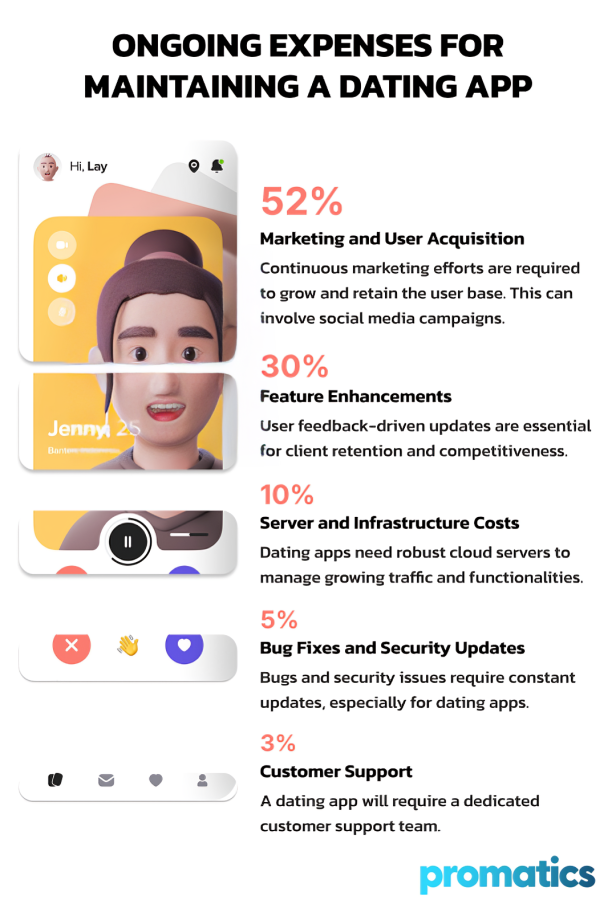
The cost of building a dating app continues after development. Ongoing maintenance is crucial for the app’s long-term success and includes updating features, ensuring app security, addressing bugs, and managing user support. Below are the key components that contribute to maintenance costs:
Server and Infrastructure Costs
While growing its user base, dating apps need a good server to be able to guarantee increasing traffic and real-time functionality such as messaging or video calls. Ideally, the hosting solution is based on cloud technologies like AWS or Google Cloud because of the possibility of expanding hosting with different types of applications, but such cases require subsequent payments. This may increase over time, especially with a larger user base and the amount of data that needs to be handled by the server.
Feature Enhancements
It is also important to keep on updating and enhancing the features with current feedback from the users in order to sustain the interest of the clients and dominance over other streaker applications. Further additions, for example, new matching algorithms, inputs of artificial intelligence proposals, or security options, will require extra developing costs.
Bug Fixes and Security Updates
Bug and security issues will creep into every app at one point or the other in their lifecycle, and this will be so, especially with new operating systems on the way. This is due to its utility, and since its usage is never-ending, constant updates are needed to ensure it works efficiently and securely. Dating itself is connected with the privacy and security of application users’ data, so frequent update checking is a must.
Customer Support
A dating app will require a dedicated customer support team to address user queries, issues, and complaints. This could range from handling login issues to addressing inappropriate behavior or technical glitches. Maintaining a full-time support staff adds to the ongoing operational costs.
Marketing and User Acquisition
Continuous marketing efforts are required to grow and retain the user base. This can involve social media campaigns, influencer partnerships, SEO, paid advertising, and more. The cost of user acquisition varies depending on the marketing strategy but is crucial for sustaining growth.
Maintaining a dating app involves costs beyond the initial development budget. It’s essential to factor in these ongoing expenses when planning your app’s long-term financial strategy.
What Are the Factors that Affect Dating App Development Costs?
Developing a dating app involves several critical factors, each significantly determining the overall development cost.
UI/UX Design
The conversational UI is important anyway to keep the users engaged in the dating application. If the users cannot find their way around or they find the interface to be unattractive, they will quit the app as a consequence. As for the UI/UX, it is a critical component in software that enhances trailing user satisfaction and rate of user retention; however, more involving and elaborate designs increase the cost. Designing clickable areas and unique and attractive graphics that operate across different platforms is a time-consuming process since it involves teamwork between designers and developers. Elements like unique user profiles and other intelligent recommendations can also lead to increased design costs.
Features of the App
The app’s features are the biggest driver of development costs. Essential features for a dating app include user profiles, matching algorithms, messaging, and notifications. However, incorporating advanced functionalities like geolocation-based matching, swipe gestures, video chat, or integration with social media accounts can dramatically increase complexity and cost. Personalization features that use AI and machine learning to provide tailored matches are becoming increasingly popular but require a substantial investment in technology.
- Basic Features: User profiles, matching algorithms, chat/messaging, and notifications.
- Advanced Features: Geolocation, swiping mechanisms, video calls, AI-driven matchmaking, social media integration, and payment gateways.
The more features you add, the higher the development cost will be. Striking a balance between essential and innovative features is critical to ensuring user satisfaction and budget control.
Type and Size of the Application
The type and size of the app are critical determinants of cost. An essential app with limited features for a small audience will cost less than a fully-featured app targeting a global audience. A mobile-only app for iOS or Android is generally less expensive to develop than a cross-platform or web-based app that requires backend development. Additionally, larger applications with more users require more extensive databases and higher server capacities, increasing infrastructure costs.
Development Team
The development team’s size, location, and expertise will also impact the project’s overall cost. Typically, you will need a team that includes backend and frontend developers, a UI/UX designer, a project manager, and QA testers. A highly experienced team will charge more but can deliver better quality and reduce risks. For example, hiring developers in India or Eastern Europe is generally more affordable than in the US or Western Europe. However, offshore development may sometimes lead to communication challenges, making choosing a team with a proven track record and effective communication strategies essential.
Technology Stack
The selection of the technology stack may greatly affect the project’s cost. For example, if you decide to get a native application (development for iOS and Android), it will be more expensive than cross-platform applications using frameworks such as React Native or Flutter. The depth of the stack that you have will pose some additional costs; this would be even more so if those features that you are incorporating entail the use of third-party APIs, machine learning algorithms, or real-time chat, among others.
Selecting the right stack to support your dating application is perhaps one of the most important things that will determine the performance, scalability, and cost of running the dating application. The technical specifications must be met to reach a point of satisfactory development and maintenance expenditure, which means understanding the technical specifications together with the cost implications to strike an optimal balance.
Third-Party Integrations
As for integrating 3rd party APIs, the most frequently used and developed elements are payments, chat, social media registration, and notifications. However, each integration is time-consuming in terms of development and may additionally entail some licensing costs. For instance, including a payment gateway for a premium app or a subscription-based model comes with transaction costs and thus contributes to an app’s cost. Also, integrating such social sites as Facebook, Instagram, or any other social networks where people can share their profiles or articles boosts the site’s complexity and price.
Application Testing
Testing is also a crucial process of dating app development since it helps to identify whether the app has bugs, how it reacts to loads and provides users with data protection. The functional test ensures that all functional requirements work as required, while performance tests check for the quickness and size ability of the system. Security testing is especially important for dating applications since the given applications work with individual information. These include the risks of data leakage, hacking, and malware, among others, and require appropriate testing. The more elaborate the application is being developed, the longer and more expensive it will take to complete the testing phase, yet it is important to do it to avoid problems afterward.
The Leading Dating App Development Cost
Some of the most successful dating apps on the market today have invested significantly in their development, maintenance, and marketing efforts. Here’s an overview of the estimated development costs for two leading dating apps:
Tinder
Tinder’s estimated cost of development: $50,000 – $100,000. Although the app boasts a complex layout and a broad range of functions at present, it was initially relatively simplified, and the primary function evolved around the possibility of swiping left or right depending on the user’s preference. In the course of the last several years, it has introduced further features to Tinder: Super Likes, Boosts, and Tinder Gold. The costs related to app management and development have increased significantly because the platform is used by millions of people in several countries. Tinder’s success around the world has also needed a lot of promotion and sponsorship, which reaches hundreds, even millions of dollars each year.
Bumble
First, Bumble started with more features than simply the swipe since it’s a dating app for women where they have to start the conversation, which makes a lot of sense for Bumble’s positioning. These are Instagram and Spotify links, complex profile options, and an interface like no other Bumble app. Based on experts’ research, it may have taken Bumble anywhere between $50,000 and $120,000 to build its app initially, but that is not including costs related to the company’s global expansion or subsequent new features such as video calling, among others, and continual and sustained marketing and user acquisition campaigns. At the current stage, with all these advancements, Bumble’s total costs will probably exceed $ 1 million annually while competing in the market.
Is Dating App Development a Profitable Business?
Competition is high; however, for the dating application, it’s highly remunerative if the firm can offer the best engaging application. Mobile apps such as Tinder and Bumble have indicated high levels of monetization through the use of in-app purchases, subscriptions, and advertisements. For instance, Tinder recorded over $800 million in revenue in 2023, and Bumble also landed over $400 million. Other specialty dating apps, such as Hinge, Grindr, and BLK, also turned out to be quite lucrative, with Hinge making over $200 million in revenues.
Revenue streams for dating apps typically come from the following sources:
- In-App Purchases: Users pay for premium features, such as seeing who liked them, boosting their profiles, or accessing more advanced search options
- Subscription Models: Many apps offer monthly or yearly subscriptions that enhance functionality and better matching results.
- Advertisements: Some dating apps, particularly free ones, generate revenue by displaying ads to users.
By understanding the user base and offering engaging, innovative features, dating apps can create multiple revenue streams and achieve long-term profitability.
Build a Cost-Effective Dating App With Promatics Technologies
If you’re considering building a dating app, Promatics Technologies offers cost-effective solutions tailored to your needs. We specialize in creating apps that are not only feature-rich but also scalable and secure. We can help you build a dating app that stands out in a competitive market by focusing on high-quality design and development while keeping costs within your budget.
Our team includes experienced developers, designers, and project managers who work closely with you to define the scope of your project. We prioritize transparency, ensuring that you understand where every dollar is going, and we use scalable technologies that allow your app to grow alongside your user base. With Promatics India, you can confidently launch a cost-effective dating app that attracts and retains users while maximizing profitability.
Frequently Asked Questions
Q1. What is the requirement for dating app development?
The development of a dating app requires a detailed plan that includes identifying the target audience, defining essential features like matchmaking algorithms and messaging systems, and ensuring robust security measures for data protection. Additionally, scalability, platform selection, and user experience must be carefully considered.
Q2. Which development team is ideal for a dating app?
An ideal development team for a dating app would include experienced backend and frontend developers, UX/UI designers, project managers, and QA testers. The team should have expertise in cross-platform development, mobile app security, social networking features, and a deep understanding of the online dating market.
Q3. Are there additional costs besides the initial development cost?
Yes, there are several ongoing costs associated with maintaining a dating app. These include hosting and server fees, regular feature updates, bug fixes, customer support, marketing, and user acquisition. Additionally, updates are often required to comply with changes to app store policies or operating system updates.
By considering these aspects, you can develop a well-rounded, cost-efficient dating app that resonates with users and delivers a profitable return on investment.