The Rise of Facial Recognition in Mobile App Development

Mobile apps today are expected to be fast, secure, and easy to use. Users no longer want to remember passwords or go through lengthy verification steps. This shift in user expectations has led to the rapid adoption of facial recognition technology in mobile applications. From unlocking smartphones to verifying payments and accessing sensitive data, facial recognition is making mobile experiences more seamless and secure. As a result, businesses are increasingly investing in facial recognition app development and AI mobile app development to deliver smarter and more secure digital experiences.
Powered by artificial intelligence, machine learning, and computer vision, facial recognition technology allows apps to identify users quickly and accurately. This not only improves security but also creates smoother and more personalized user journeys. Industries such as fintech, healthcare, eCommerce, and enterprise platforms are already using biometric authentication, computer vision solutions, and machine learning development to simplify onboarding, reduce fraud, and enhance customer experiences.
As businesses across the USA, UK, UAE, and global markets continue to invest in AI development services and mobile app development services, facial recognition is becoming an essential feature in modern mobile app development. It helps companies build smarter applications, improve user trust, and stay competitive in an increasingly digital world.
In this blog, we’ll take a closer look at how facial recognition technology works, the machine learning models behind it, and how businesses can benefit from integrating facial recognition in mobile apps. Read on to discover how AI powered facial recognition is shaping the future of mobile applications.
Overview of Face Detection and Recognition
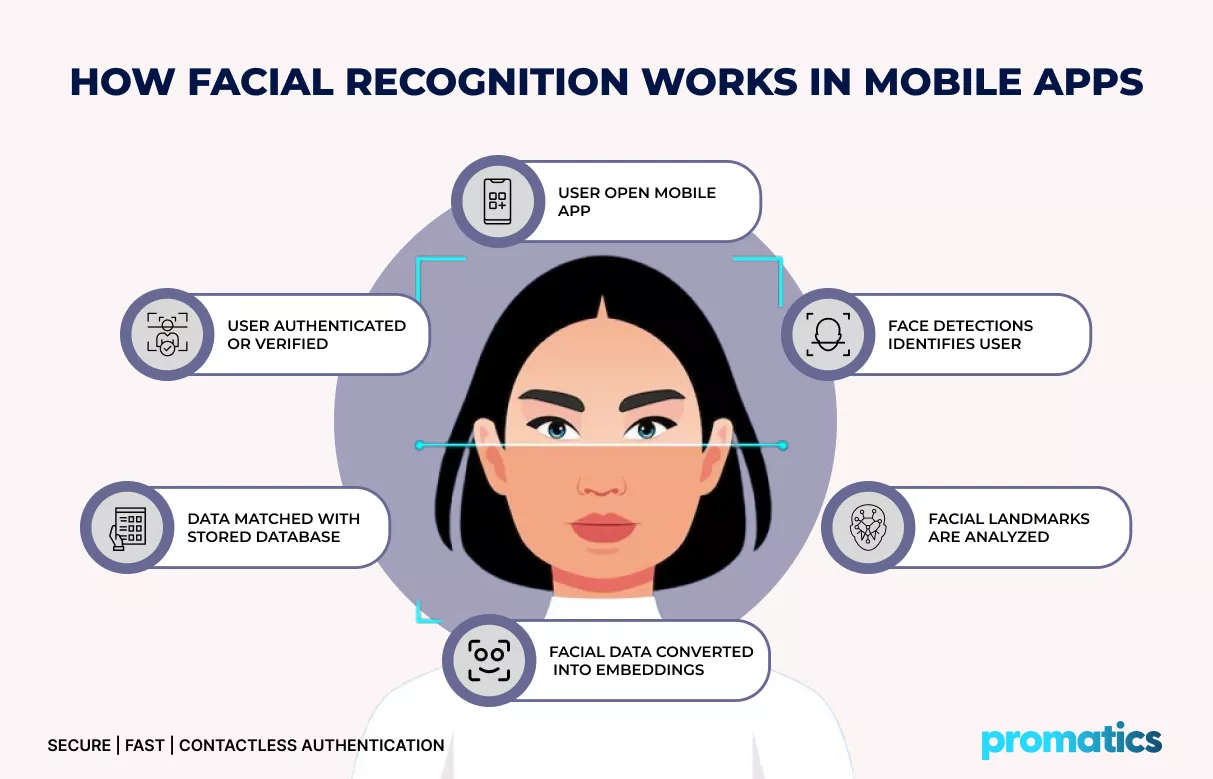
Face detection and face recognition are closely related technologies, but they serve different purposes in facial recognition systems. Face detection is the first step, where the system identifies and locates human faces within an image or video. Once a face is detected, face recognition comes into play by analyzing unique facial features and matching them with stored data to identify or verify a person’s identity.
Together, these technologies power many of the intelligent features we see in modern mobile applications. From biometric login and secure authentication to identity verification and fraud prevention, face detection and recognition help create safer and more seamless user experiences. Businesses are increasingly integrating these capabilities into AI powered mobile apps to enhance both security and convenience.
By leveraging advanced machine learning, computer vision, and AI development solutions, mobile apps can detect faces in real time and accurately recognize users across different environments. This enables applications to deliver personalized experiences, improve security, and streamline user interactions. As a result, face detection and recognition are becoming essential components of facial recognition app development and next generation mobile app development services.
Why Facial Recognition Matters for Mobile Apps
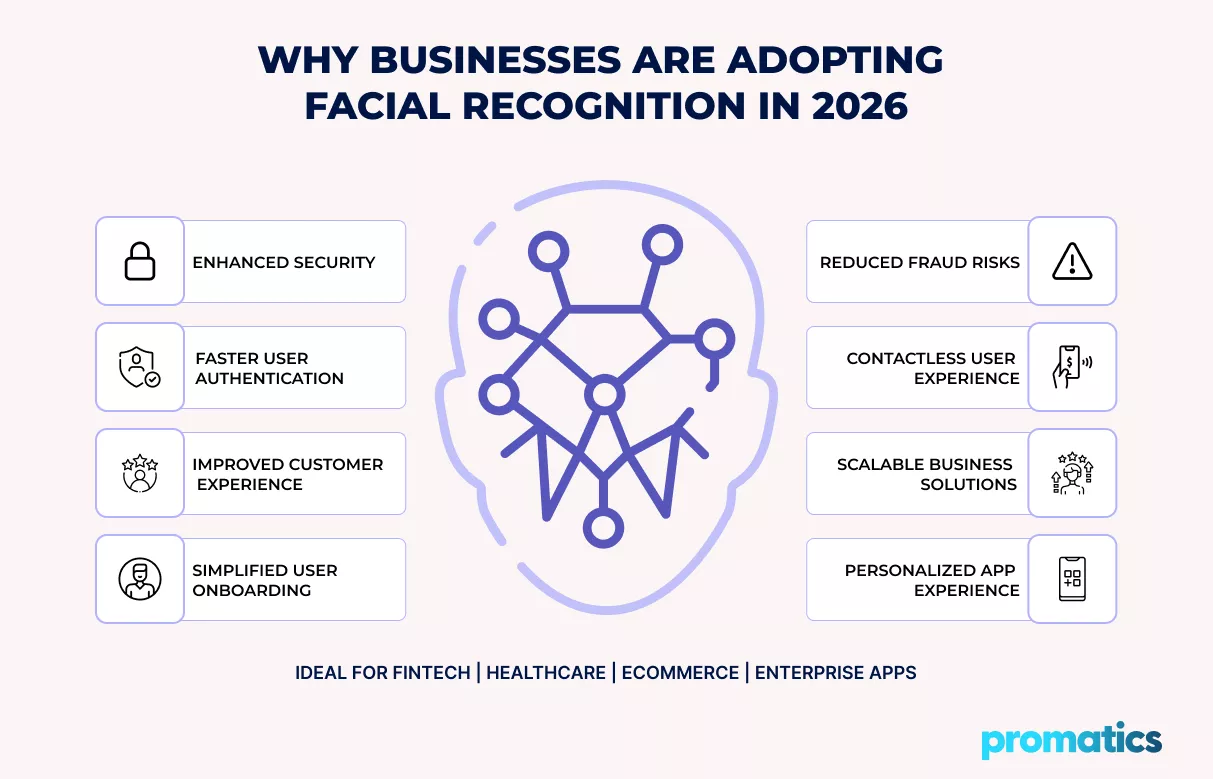
As mobile apps continue to evolve, security and user convenience have become top priorities for businesses. Traditional authentication methods such as passwords and PINs often create friction and increase the risk of data breaches. Facial recognition technology addresses these challenges by offering a fast, contactless, and highly secure method of identity verification. With just a glance, users can access apps, approve transactions, and verify their identity, making the overall experience smoother and more secure.
One of the biggest advantages of facial recognition in mobile apps is enhanced security. AI powered facial recognition systems can verify identities, detect suspicious activities, and prevent unauthorized access. This makes facial recognition particularly valuable for industries such as banking, fintech, healthcare, and enterprise applications where protecting sensitive user data is critical. Businesses implementing facial recognition app development and AI mobile app development can significantly reduce fraud risks while improving user trust.
Facial recognition technology also improves customer experience by eliminating complex login processes. Users no longer need to remember passwords or complete lengthy verification steps. This frictionless authentication helps improve onboarding, reduce drop offs, and increase user engagement. Many businesses across eCommerce, travel, and healthcare industries are leveraging biometric authentication and computer vision solutions to deliver faster and more personalized experiences.
In addition to security and convenience, facial recognition enables intelligent personalization. Mobile apps can recognize returning users and tailor recommendations, content, and services accordingly. For example, retail apps can offer personalized product suggestions, while enterprise apps can enable secure employee access and attendance tracking. These capabilities help businesses improve efficiency and enhance customer satisfaction.
Facial recognition technology also plays a growing role in public safety, identity verification, and digital onboarding. From airport check ins to secure financial transactions, the technology is transforming how businesses operate in a digital first world. As companies across the USA, UK, UAE, and global markets accelerate digital transformation, facial recognition is becoming a standard feature in modern mobile app development services and AI driven mobile applications.
With increasing demand for secure, intelligent, and user friendly apps, facial recognition is no longer just an advanced feature. It is quickly becoming an essential component of next generation mobile applications, helping businesses enhance security, improve user experience, and stay competitive in today’s digital landscape.
Face Recognition Technology in 2026: Trends, Adoption, and Future Outlook
Facial recognition technology is evolving rapidly, and by 2026, it is expected to play an even bigger role in mobile apps, security systems, and enterprise solutions. With advancements in artificial intelligence, machine learning, and computer vision, facial recognition is becoming more accurate, scalable, and widely adopted across industries. Below are the key trends, adoption areas, and future outlook shaping facial recognition technology in 2026 and beyond.
-
Rapid Adoption Across Multiple Industries
Facial authentication is expanding across industries including banking, healthcare, retail, manufacturing, hospitality, and enterprise security. Organizations are implementing facial recognition for secure access control, identity verification, workforce management, and customer authentication. Industries such as financial services, healthcare, and enterprise environments are among the fastest adopters, using facial recognition to improve security and operational efficiency.
-
Growing Demand for Passwordless Authentication
Businesses are moving toward passwordless authentication to reduce security risks and improve user experience. Facial recognition eliminates the need for passwords, cards, or PINs, enabling fast and secure access to mobile apps and enterprise systems. This shift toward biometric authentication is becoming a major trend in AI powered mobile app development and digital identity solutions.
-
Increasing Consumer Adoption of Facial Biometrics
User acceptance of biometric authentication continues to grow. Around 81% of consumers consider biometrics more secure than traditional methods, and 72% of users prefer facial biometrics over passwords for online processes. Additionally, facial biometric payments are rising rapidly, with over 671 million users already using facial biometrics for payments, expected to reach 1.4 billion users globally.
-
Enhanced Security and Fraud Prevention
Facial recognition technology is being widely adopted for fraud prevention and identity verification. Industries such as banking, telecom, and eCommerce use facial authentication to prevent account takeovers, unauthorized access, and identity fraud. This makes facial recognition an essential feature in AI mobile app development, fintech solutions, and enterprise applications.
-
Contactless and Seamless User Experiences
Facial recognition enables contactless authentication, improving hygiene, convenience, and speed. Industries such as hospitality, travel, and retail are using facial recognition for contactless check ins, secure payments, and personalized customer experiences. This trend is expected to grow significantly as businesses prioritize frictionless digital experiences.
-
Growth in Smart Cities and Public Safety
Governments and organizations are increasingly implementing facial recognition for smart city initiatives, surveillance systems, and identity verification. These implementations help improve public safety, streamline services, and enhance operational efficiency across transportation, airports, and government services.
-
AI Powered Personalization and User Experience
Facial recognition is also being used to personalize mobile app experiences. Businesses can identify returning users, customize services, and improve engagement through AI powered personalization. This capability is becoming a key differentiator in mobile app development services and AI driven applications.
Future Outlook: Facial Recognition Becomes a Standard Feature
As AI technology advances, facial recognition is expected to become a standard feature in modern mobile apps. Businesses adopting facial recognition in 2026 and beyond will benefit from improved security, faster authentication, and enhanced user experiences. Companies investing in facial recognition app development, AI development services, and computer vision solutions will gain a competitive advantage in the evolving digital landscape.
Key Challenges in Face Recognition Technology
While facial recognition technology offers significant benefits for mobile apps and digital platforms, it also presents several challenges that businesses must address before implementation. As organizations across the USA, UK, UAE, and global markets increasingly adopt facial recognition app development and AI powered mobile applications, understanding these challenges becomes essential for building secure, scalable, and compliant solutions.
-
Privacy and Data Protection Concerns
One of the biggest concerns surrounding facial recognition technology is user privacy. Facial data is highly sensitive biometric information, and improper handling can lead to privacy violations. Businesses must ensure compliance with global data protection regulations such as GDPR, CCPA, and other regional privacy laws. Implementing secure biometric authentication solutions with strong encryption and user consent mechanisms is essential for protecting user privacy and maintaining trust.
-
Biometric Data Security Risks
Unlike passwords, biometric data cannot be changed once compromised. If facial data is exposed or misused, it can create long term security risks. Companies implementing AI facial recognition systems must invest in secure data storage, encryption, and cloud security solutions. Many organizations now prefer device processing and secure AI models to minimize data exposure and improve security.
-
Accuracy and Bias Issues
Facial recognition systems can sometimes face accuracy challenges, particularly in low lighting conditions, different facial angles, or diverse demographics. Bias in training datasets may also affect performance. To address this, companies are investing in advanced machine learning development and diverse training datasets to improve accuracy and fairness across global users.
-
High Implementation Costs
Developing and deploying facial recognition systems can require significant investment in AI infrastructure, data processing, and security frameworks. However, with advancements in AI development services and cloud based solutions, businesses can now implement scalable facial recognition systems with reduced costs.
-
Ethical and Regulatory Concerns
The use of facial recognition technology raises ethical questions related to surveillance and user consent. Governments and organizations worldwide are introducing regulations to ensure responsible use of biometric technology. Businesses must follow ethical AI practices and transparent policies to ensure compliance and responsible deployment.
-
Spoofing and Fraud Risks
Although facial recognition technology is highly secure, it can still face spoofing attempts using photos, videos, or masks. To address this, modern facial recognition solutions use liveness detection, 3D facial recognition, and AI based fraud detection to prevent unauthorized access and strengthen authentication systems.
-
Environmental and Technical Limitations
Facial recognition performance can be affected by poor lighting, facial coverings, or device limitations. However, advancements in computer vision development and AI algorithms are improving performance even in challenging environments, making facial recognition more reliable.
Despite these challenges, continuous advancements in artificial intelligence, machine learning, and computer vision are helping businesses overcome limitations and improve system reliability. As a result, facial recognition technology continues to evolve as a powerful solution for secure mobile app development, biometric authentication, and AI driven digital experiences.
Machine Learning Models Behind Face Recognition
Facial recognition systems rely on deep learning models such as Convolutional Neural Networks (CNNs). These models detect facial landmarks including eyes, nose, and facial structure.
The system converts facial features into numerical embeddings and compares them with stored data for identification. Preprocessing techniques such as normalization and alignment improve accuracy across different lighting conditions and angles.
These AI-powered models continuously improve through training on large datasets, enabling faster and more accurate face recognition.
Pre-Trained CNN Models Overview
Pre-trained CNN models accelerate face recognition development by eliminating the need to train models from scratch. These models are trained on large datasets and can be fine-tuned using transfer learning.
Popular models include FaceNet, VGGFace, and ResNet. These models extract facial embeddings and enable accurate identity verification. Pre-trained models reduce development time, improve accuracy, and support scalable AI solutions.
Benefits of Using Pre-Trained Models in Computer Vision
Pre-trained models have become a cornerstone of modern computer vision and AI-powered mobile app development. These models are already trained on large datasets, allowing developers to build intelligent applications faster and more efficiently. Businesses implementing computer vision solutions, machine learning development, and facial recognition app development can significantly benefit from using pre-trained models. Below are the key advantages explained in detail.
-
Reduced Development Time
Pre-trained models eliminate the need to build and train models from scratch. Since these models already understand visual patterns and features, developers can quickly adapt them for specific use cases such as facial recognition, object detection, or image classification. This significantly accelerates AI development services and helps businesses launch products faster.
-
Improved Accuracy and Performance
Pre-trained models are trained on massive datasets, enabling them to recognize complex patterns with high accuracy. This results in improved performance across various computer vision tasks. Businesses implementing AI-powered mobile apps and facial recognition systems can achieve reliable and consistent results using these models.
-
Less Training Data Required
Training deep learning models typically requires large amounts of labeled data. Pre-trained models reduce this requirement by leveraging existing knowledge. This is especially useful for businesses with limited datasets. By using transfer learning, developers can fine-tune models with smaller datasets while maintaining strong performance.
-
Lower Computational Costs
Training models from scratch requires powerful GPUs and significant computing resources. Pre-trained models reduce these costs by minimizing training time and computational requirements. This makes AI development more accessible and cost-effective for businesses of all sizes.
-
Transfer Learning Capabilities
Transfer learning allows developers to customize pre-trained models for specific applications. For example, a model trained on general images can be adapted for facial recognition, medical imaging, or retail analytics. This flexibility makes pre-trained models ideal for computer vision development and enterprise AI solutions.
-
Faster Deployment
Since pre-trained models are already optimized, they can be deployed quickly in real-world environments. Businesses can integrate these models into mobile app development, AI applications, and enterprise software solutions without long development cycles.
-
Scalable AI Applications
Pre-trained models support scalable AI solutions that can grow with business needs. Whether deploying facial recognition in mobile apps or implementing computer vision in enterprise platforms, pre-trained models enable scalable and future-ready solutions.
These advantages make pre-trained models essential for modern AI-powered mobile apps, facial recognition app development, and computer vision solutions. Businesses leveraging these models can build faster, smarter, and more efficient AI-driven applications.
Top Pre-Trained Models in Computer Vision
-
YOLOv8
YOLOv8 enables real-time object detection and segmentation. It is widely used in surveillance, retail analytics, and automation.
-
ResNet
ResNet supports deep learning architectures and is widely used for image classification and face recognition.
-
MobileNet
MobileNet is lightweight and optimized for mobile devices and edge computing.
-
EfficientNet
EfficientNet balances accuracy and performance, making it suitable for production environments.
-
Mask R-CNN
Mask R-CNN performs object detection and segmentation with high accuracy.
Top Tips for Using Pre-Trained Models
Pre-trained models can significantly speed up AI development, but using them effectively requires the right approach. Whether you’re building facial recognition apps, computer vision solutions, or AI-powered mobile applications, following best practices helps improve accuracy, scalability, and performance. Here are some key tips to get the most out of pre-trained models.
-
Choose the Right Model for Your Task
Selecting the right pre-trained model is essential for achieving optimal results. Different models are designed for specific tasks such as image classification, object detection, segmentation, or facial recognition. For example, lightweight models like MobileNet are ideal for mobile app development, while more complex models like ResNet or EfficientNet are better suited for applications that require high accuracy. Choosing the right model ensures better performance and faster deployment.
-
Understand the Training Dataset
It is important to understand the dataset used to train the pre-trained model. Models trained on large datasets like ImageNet or COCO learn general features, but may require fine-tuning for specific use cases. Understanding the training data helps determine how well the model will perform in your application and whether additional training is required.
-
Use Transfer Learning
Transfer learning allows developers to adapt pre-trained models for new tasks using smaller datasets. Instead of training from scratch, developers can fine-tune the model for specific use cases such as facial recognition, object detection, or computer vision development. This approach improves performance while reducing development time and cost.
-
Optimize Performance
Performance optimization is essential for real world applications. Developers should consider model size, inference speed, and hardware requirements. Lightweight models are better suited for mobile app development, while larger models may be used for enterprise level AI solutions.
-
Use Data Augmentation
Data augmentation techniques such as rotation, scaling, cropping, and flipping help improve model accuracy. These techniques create variations in training data, helping the model perform better in real world conditions and improving generalization.
-
Monitor Model Accuracy
Regularly monitoring model performance is important to ensure accuracy and reliability. Developers should track metrics such as accuracy, precision, recall, and performance under different conditions. Continuous monitoring helps identify issues and improve model performance over time.
-
Consider Deployment Environment
The deployment environment plays a major role in model selection. Whether deploying on cloud servers, mobile devices, or edge devices, developers must optimize models accordingly. For example, AI mobile apps require lightweight models, while enterprise systems may use larger models for higher accuracy.
Following these best practices helps businesses build scalable, reliable, and high performing AI powered applications, facial recognition solutions, and computer vision systems.
Why Choose Promatics Technologies for Facial Recognition?
Promatics Technologies helps businesses integrate facial recognition into mobile apps in a simple, secure, and scalable way. With strong experience in mobile app development, facial recognition app development, and computer vision solutions, Promatics builds solutions that improve both security and user experience.
Whether you need biometric login, identity verification, or personalized user experiences, Promatics develops facial recognition features that fit your business needs. These solutions help reduce fraud, simplify onboarding, and make mobile apps easier and faster for users.
Promatics Technologies works with businesses across the USA, UK, UAE, and global markets, delivering reliable and scalable mobile applications. From fintech and healthcare to eCommerce and enterprise platforms, Promatics helps companies build secure and future ready mobile apps with facial recognition capabilities.
With a focus on performance, security, and usability, Promatics Technologies is a trusted partner for businesses looking to implement facial recognition in modern mobile applications.
Conclusion
Facial recognition technology is quickly becoming an essential feature in modern mobile apps. From improving security and simplifying authentication to creating more personalized user experiences, facial recognition helps businesses deliver smarter and more seamless digital solutions. As mobile apps continue to evolve, integrating facial recognition is no longer just an added feature. It is becoming a key requirement for businesses looking to stay competitive and meet growing user expectations.
Whether you’re building a fintech platform, healthcare app, eCommerce solution, or enterprise application, facial recognition can help enhance security, reduce friction, and improve overall user experience. However, successful implementation requires the right expertise and a reliable development partner.
Promatics Technologies helps businesses integrate facial recognition into mobile apps with secure, scalable, and user friendly solutions. With experience in mobile app development, facial recognition app development, and computer vision solutions, Promatics ensures smooth implementation tailored to your business needs.
Ready to add facial recognition to your mobile app? Partner with Promatics Technologies to build secure, scalable, and future ready mobile applications that deliver better user experiences and stronger security.
Frequently Asked Question
1. What is facial recognition in mobile apps?
Facial recognition in mobile apps is a biometric authentication technology that identifies or verifies users based on their facial features. It is commonly used for secure login, identity verification, payments, and personalized user experiences in modern mobile applications.
2. How secure is facial recognition for mobile app authentication?
Facial recognition is considered highly secure as it uses biometric data that is difficult to replicate. Advanced features like liveness detection, encryption, and real time verification further enhance security, making it safer than traditional passwords or PIN based authentication.
3. Which industries are using facial recognition in mobile apps?
Facial recognition is widely used across industries such as fintech, healthcare, eCommerce, travel, education, and enterprise applications. Businesses use it for secure authentication, fraud prevention, digital onboarding, and personalized user experiences.
4. How much does facial recognition app development cost?
The cost of facial recognition app development depends on several factors, including features, platform (iOS, Android, or both), security requirements, and integration complexity. Businesses typically choose custom solutions to match their specific needs and scalability requirements.
5. Why should businesses integrate facial recognition into mobile apps in 2026?
In 2026 and beyond, facial recognition is becoming a standard feature for secure and seamless mobile experiences. Businesses can improve security, reduce fraud, simplify user onboarding, and enhance customer engagement by integrating facial recognition into their mobile applications.
