Flutter 2.2 Features and Performance Improvements: A Milestone in Cross-Platform App Development

Flutter has steadily evolved into one of the most influential frameworks in modern application development. As a powerful UI toolkit and cross-platform development framework, Flutter enables businesses to build high-performance applications for Android, iOS, web, desktop, and embedded systems from a single codebase.
When Flutter 2.2 was released, it marked a critical turning point in the framework’s maturity, reinforcing its capabilities across Flutter mobile app development, Flutter web app development, and enterprise Flutter solutions. More than just a routine update, Flutter 2.2 strengthened performance, stability, tooling, monetization, and platform adaptability bringing the Flutter SDK closer to true production-grade scalability.
For companies investing in custom Flutter app development, this release played a foundational role in shaping modern cross-platform application architecture.
Dart 2.13: Reinforcing the Language Backbone of Flutter
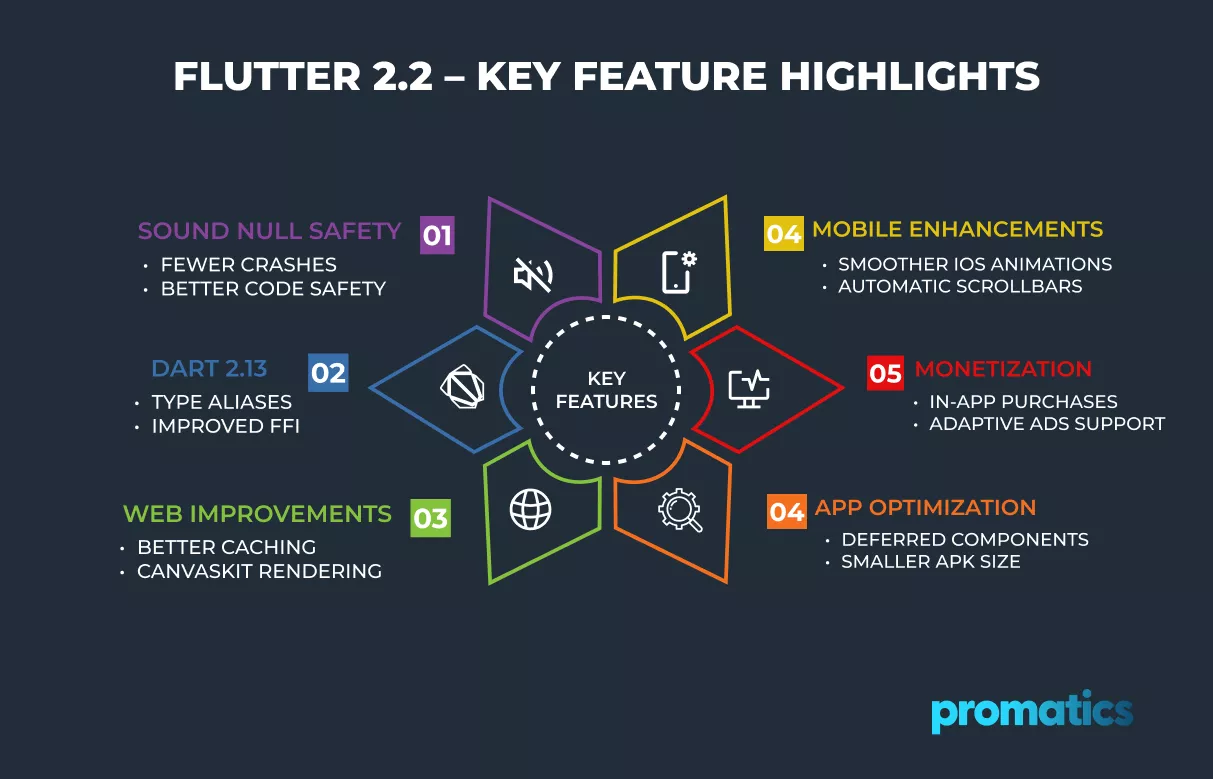
Every major Flutter update brings enhancements to Dart, the programming language powering the Flutter framework. Flutter 2.2 shipped with Dart 2.13, introducing improvements that directly impacted Flutter app development performance, native interoperability, and enterprise scalability.
By enhancing the Foreign Function Interface (FFI), Dart enabled stronger integration between Flutter and native system libraries. This was especially valuable for enterprise Flutter development projects requiring hardware integration, backend communication, or performance-critical modules.
Type Aliases for Better Code Maintainability
Type aliases were one of the most anticipated additions in Dart 2.13. Developers could now define readable aliases for complex function signatures and data types.
In large-scale applications, especially enterprise-grade systems, this improved:
- Code readability
- ArFlutter 2.2 significantly architectural consistency
- Refactoring efficiency
- Long-term maintainability
Clearer type definitions reduce technical debt and make collaboration easier across development teams.
Expanded Foreign Function Interface (FFI)
Dart 2.13 significantly enhanced its Foreign Function Interface capabilities, allowing smoother communication with native C APIs. Developers gained improved support for arrays and packed structs, making it easier to integrate system-level modules and high-performance native libraries.
This enhancement was particularly important for:
- Performance-intensive applications
- Hardware integrations
- Custom backend connectors
- Hybrid mobile-native architectures
By reducing the barrier between Flutter and native environments, Dart 2.13 increased Flutter’s enterprise viability.
Updated for 2026 Context
Flutter has advanced well beyond version 2.2, with modern stable releases introducing Dart 3.x, enhanced rendering engines, deeper desktop support, and broader ecosystem maturity.
This article focuses specifically on the Flutter 2.2 release and its impact at the time of launch. Many innovations introduced in this version such as sound null safety, web optimizations, and platform-adaptive improvements laid the groundwork for the stability and performance that modern Flutter applications benefit from today.
Sound Null Safety: A Major Leap Toward Stability
One of the defining improvements in Flutter 2.2 was the introduction of sound null safety as the default configuration for new projects.
Null reference exceptions have historically been a leading cause of application crashes across platforms. By enforcing non-nullable types at compile time, Dart prevents these issues before applications reach production.
The advantages include:
- Fewer runtime crashes
- Stronger code reliability
- Improved performance due to optimized execution paths
- Reduced debugging overhead
- Lower long-term maintenance costs
More than 5,000 open-source packages migrated to null safety during this period, strengthening the ecosystem’s consistency.
For businesses relying on stable production applications, this was a transformative step forward.
Flutter Web Improvements: Closing the Performance Gap
Flutter 2.2 introduced meaningful upgrades to Flutter web development, addressing several concerns raised in earlier versions.
Improved Caching and Resource Handling
Previously, some web applications faced issues where files such as main.dart.js would unnecessarily redownload, potentially causing relaunches or instability. Flutter 2.2 introduced improved service worker caching mechanisms, reducing redundant downloads and enhancing load consistency.
This resulted in:
- Faster reload times
- Improved user experience
- Better perceived application reliability
CanvasKit Rendering Enhancements
Enhanced support for CanvasKit significantly improved graphics and text rendering precision in web apps. Developers could now achieve more accurate typography positioning and smoother visual transitions.
This brought Flutter web applications closer to parity with traditional JavaScript-based frameworks in visual performance.
Accessibility Improvements
Semantic node positioning improvements strengthened screen reader compatibility. This narrowed the accessibility gap between mobile and web implementations, improving compliance and usability for broader audiences.
For organizations building customer-facing web applications, these improvements enhanced production readiness.
Mobile Enhancements: Performance and User Experience
Flutter 2.2 delivered several mobile-focused upgrades across Android and iOS.
-
Improved iOS Animation Performance
Animation smoothness on iOS saw significant improvements. First-run stutters were reduced, transitions became more fluid, and rendering consistency improved.
In user-centric applications, animation quality directly influences engagement and perceived professionalism.
-
Automatic Scrollbar Behavior
Scrollbars became automatic across platforms when content exceeded container size. Developers no longer needed manual implementations, improving cross-platform consistency and reducing boilerplate code.
-
Enhanced Text Interactivity
Support for cursor customization within TextSpan widgets enabled hyperlink-style behavior directly inside text. This improved interactivity in hybrid applications blending web-style navigation patterns with mobile experiences.
Platform-Adaptive Applications: True Cross-Platform Flexibility
Flutter 2.2 strengthened support for platform-adaptive applications, enabling developers to fine-tune behavior based on device type and input method.
Applications could dynamically adjust to:
- Touch-based mobile interfaces
- Mouse and keyboard desktop interactions
- Larger screen layouts
- Foldable devices
This adaptability reinforced Flutter’s promise of building once and deploying everywhere, while still delivering native-like experiences.
For businesses, this translated into:
- Reduced development duplication
- Unified design systems
- Faster product iteration cycles
- Lower operational costs
Deferred Components for Android: Optimizing App Size
Application size directly impacts install rates and user retention. Flutter 2.2 introduced deferred components for Android, allowing specific modules to download at runtime rather than being bundled into the initial APK.
Benefits included:
- Reduced initial download size
- Faster installations
- Lower storage footprint
- Improved scalability
Smaller applications often see higher user acquisition rates, particularly in bandwidth-sensitive regions.
Monetization Enhancements: Supporting Business Growth
Flutter 2.2 introduced meaningful improvements in monetization support.
-
Adaptive Banner Ads SDK
Improved ad format support allowed better responsiveness across device sizes.
-
Production-Ready In-App Purchases
The in-app purchase plugin reached production quality, making cross-platform monetization more reliable.
-
Payment Plugin Integration
Developed in collaboration with Google Pay, the payment plugin simplified handling transactions for physical goods.
For startups and SaaS platforms, these tools reduced platform-specific complexity and accelerated revenue implementation.
DevTools Improvements: Strengthening Developer Productivity
Flutter 2.2 enhanced the DevTools suite with improved debugging and performance monitoring capabilities.
Enhancements included:
- Advanced memory allocation tracking
- Performance profiling improvements
- Provider debugging tools
- Network inspection updates
- Third-party DevTools extension support
Early detection of memory leaks and performance bottlenecks reduces long-term application degradation.
For enterprise projects, stronger tooling shortens development cycles and enhances quality assurance processes.
Linux and Windows Expansion
Flutter 2.2 expanded compatibility with ARM64 Linux machines and improved Universal Windows Platform support.
These enhancements demonstrated Flutter’s growing ambition to become a universal UI toolkit across mobile, desktop, IoT, and embedded environments.
Performance Enhancements and Ecosystem Growth
Flutter 2.2 focused heavily on performance optimization, including:
- Reduced first-run jank
- Improved rendering efficiency
- Better memory management
- Smaller package sizes
At the time of release, Flutter adoption was accelerating rapidly, with hundreds of thousands of applications deployed globally. Enterprises across industries—including fintech, mobility, and retail were increasingly adopting Flutter for scalable cross-platform solutions.
Flutter 2.2 in Retrospect: 2026 Perspective
Modern Flutter releases have introduced:
- Dart 3.x enhancements
- Advanced rendering engines
- Improved desktop stability
- Greater ecosystem maturity
However, many of the structural improvements enabling today’s performance were strengthened during the Flutter 2.2 cycle.
Flutter 2.2 represented the stage where Flutter moved from emerging framework to production-ready solution.
Why Flutter 2.2 Mattered for Businesses
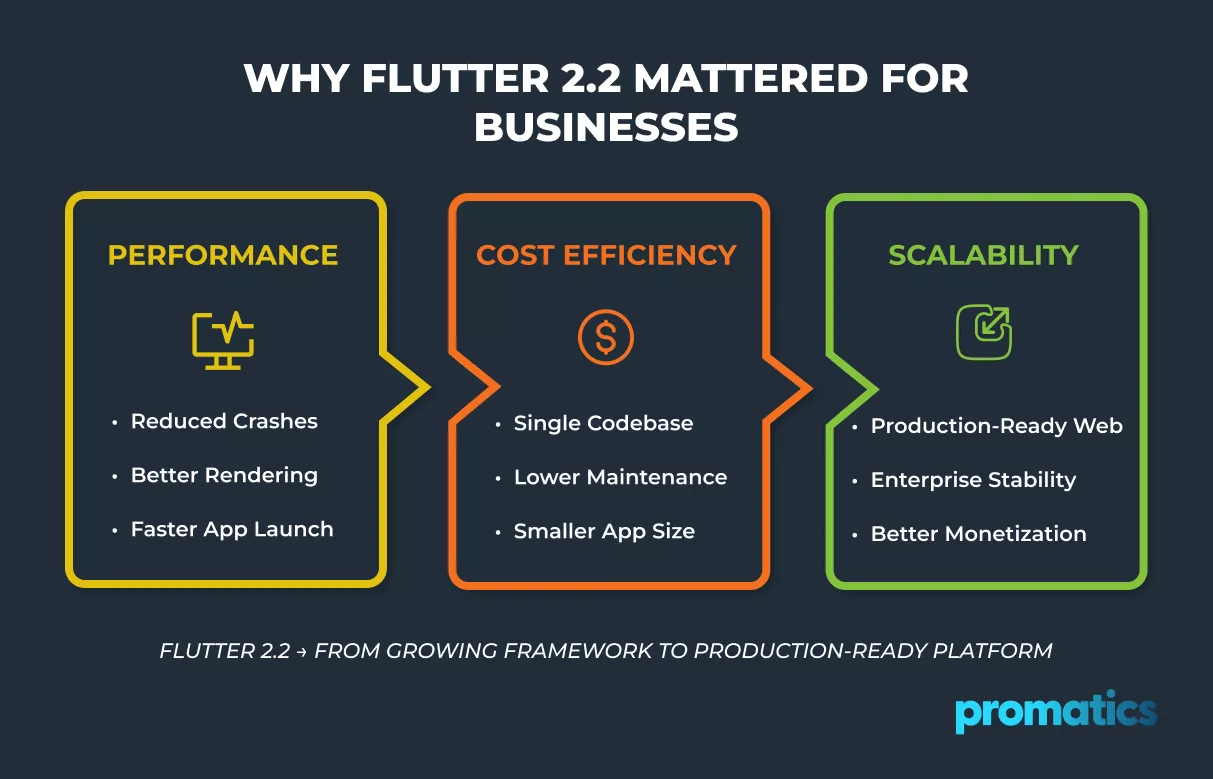
From a business standpoint, Flutter 2.2 delivered:
- Increased application stability
- Better web viability
- Reduced crash rates
- Lower maintenance overhead
- Improved monetization tools
- Smaller app sizes
- Stronger cross-platform parity
For organizations building scalable digital products, these improvements reduced risk and improved long-term ROI.
Conclusion
Flutter 2.2 was more than a version update; it was a structural reinforcement of Flutter’s long-term vision. By strengthening null safety, enhancing web performance, improving DevTools, expanding monetization capabilities, and optimizing cross-platform adaptability, it marked a decisive step toward production maturity.
Although the framework has evolved significantly since then, many of the reliability and performance principles introduced during the Flutter 2.2 release continue to shape modern Flutter development.
For businesses seeking scalable, secure, and high-performance cross-platform applications, partnering with an experienced Flutter app development company ensures both legacy strengths and modern advancements of the Flutter framework are fully leveraged.
At Promatics Technologies, we deliver custom Flutter mobile app development, Flutter web solutions, and enterprise-grade cross-platform applications designed for performance optimization and long-term growth. If you are planning your next Flutter project, our team of expert Flutter developers can help transform your idea into a scalable digital product built for the future.
Frequently Asked Questions
1. What were the key features introduced in Flutter 2.2?
Flutter 2.2 introduced Dart 2.13, sound null safety by default, improved web performance, enhanced DevTools, deferred components for Android, and better monetization support. These updates strengthened stability, performance, and cross-platform reliability.
2. How did Flutter 2.2 improve performance?
Performance improvements included smoother iOS animations, reduced first-run jank, optimized memory allocation, and smaller APK sizes through deferred components. Null safety also improved runtime efficiency by eliminating common crash scenarios.
3. Was Flutter 2.2 suitable for enterprise applications?
Yes. With sound null safety, better debugging tools, and improved native interoperability through FFI, Flutter 2.2 became more stable and scalable for enterprise-level mobile and web applications.
4. How did Flutter 2.2 enhance Flutter web development?
Flutter 2.2 improved service worker caching, reduced unnecessary file re-downloads, enhanced CanvasKit rendering, and strengthened accessibility. These upgrades made Flutter web more production-ready.
5. Is Flutter 2.2 still relevant today?
While newer Flutter versions offer additional enhancements, Flutter 2.2 marked a foundational shift toward production maturity. Its improvements in null safety, performance, and tooling continue to influence modern Flutter development.