Which Programming Language is Best for Mobile Game Development?
TL;DR
- Best programming languages for mobile game development projects.
- C++, C#, Java, Kotlin, and Swift performance comparison.
- Unity and Unreal Engine development ecosystem overview.
- Graphics rendering, multiplayer support, and scalability factors.
- Language selection based on game type and complexity.
1. Introduction
The mobile gaming industry is thriving and will probably continue this upward trend. At the same time, mobile games are expected to make over $126 billion in revenue globally, as more and more people get smartphone users, internet speeds become faster, and casual and competitive games become more popular. A lot of new games get downloaded daily on both iOS and Android, and the need for ingenious, high-performing games has never been greater.
Mobile games offer a very enjoyable experience to users and are still popular for their accessibility, portability, and engagement. While short daily games such as Candy Crush Saga take only a few minutes, the usage of complex multiplayer gaming like PUBG Mobile continues for hours.
However, this enormous popularity hugely challenges developers to keep on providing the expected games with smooth gameplay, engaging graphics, and fast loading experiences.
The programming language to use for mobile game development should be among the first questions considered in the whole process. The language that you pick here has a direct impact on how well the game will be, how big it will be, how it will be compatible with different devices, and what the general user experience will be. Pick the wrong one and it can cause your game to slow performance, downgrade the difficulty of updating it, or non-compatibility with platforms completely.
This article will provide a comprehensive guide on mobile game development, the factors that influence the choice of programming language, a detailed analysis of the top 10 programming languages for mobile games in 2025, and guidance on selecting the right language based on your project requirements.
Additionally, we’ll discuss the advantages of working with a mobile game development company in India to optimize costs and quality.
2. What is Mobile Game Development?
Mobile Game Development means building games specifically for mobile devices such as smartphones and tablets. In contrast to PC or console games, mobile games have to run smoothly on gadgets with limited processing power, battery life, and memory. Besides, developers have to consider different screen sizes, operating systems, and user interactions, which makes the task of mobile game development a more difficult one.
Types of Mobile Game Development
2D Game Development
- Works with graphics and mechanics of the game are from the viewpoint of two-dimensional side-scrolling, top-down, or puzzle.
- Easier to create and fine-tune, thereby suitable for casual games.
- One instance is the game Candy Crush Saga – performance-wise the game was developed using C++.
3D Game Development
- This type of game involves virtual characters and scenarios, which are the result of realistic graphics, complex physics, and immersive gameplay.
- High-performance coding and usage of more advanced engines such as Unreal or Unity are required.
- For example, PUBG Mobile was developed on Unreal Engine using C++ for 3D graphics that are optimized.
How Mobile Games Differ from PC/Console Games
- Performance Constraints: Mobile devices are less powerful when it comes to processing therefore they have to limit and balance carefully the graphics, memory usage, and game physics to the last detail so that the tender parts of the mobile device will not break down.
- Monetization Models: The revenue of mobile games mostly comes from ads, in-app purchases, freemium models, and seasonal events while console games, however, are the other way around, as they can rely on upfront purchases only.
- Input Methods: Instead of traditional controllers, touchscreens, accelerometers, and gyroscopes are used. As a result, the user interface and user experience have to be designed uniquely.
- Platform Diversity: Apart from Android and iOS, developers must consider different device models, screen sizes, and OS versions.
Role of Programming Languages
The programming language directly affects the following aspects:
- Graphics Rendering: High-quality textures, smooth frame rates, and accurate physics.
- Cross-platform compatibility: Basically, the game can be released on any platform like iOS, Android, or others without having to rewrite the code extensively.
- Development Speed and Cost: If the language is equipped with libraries and frameworks, it can make the entire development process and the producer’s expenses cut down by a large margin.
Games and their Programming Languages Examples:
- Clash of Clans – C++ for performance-critical components, with Objective-C for iOS integration.
- Angry Birds – Java was used for Android development while Lua was used for scripting the game logic.
- Pokémon Go – C# with Unity for cross-platform development.
In short, programming languages form the foundation of mobile game development services, influencing both performance and profitability.
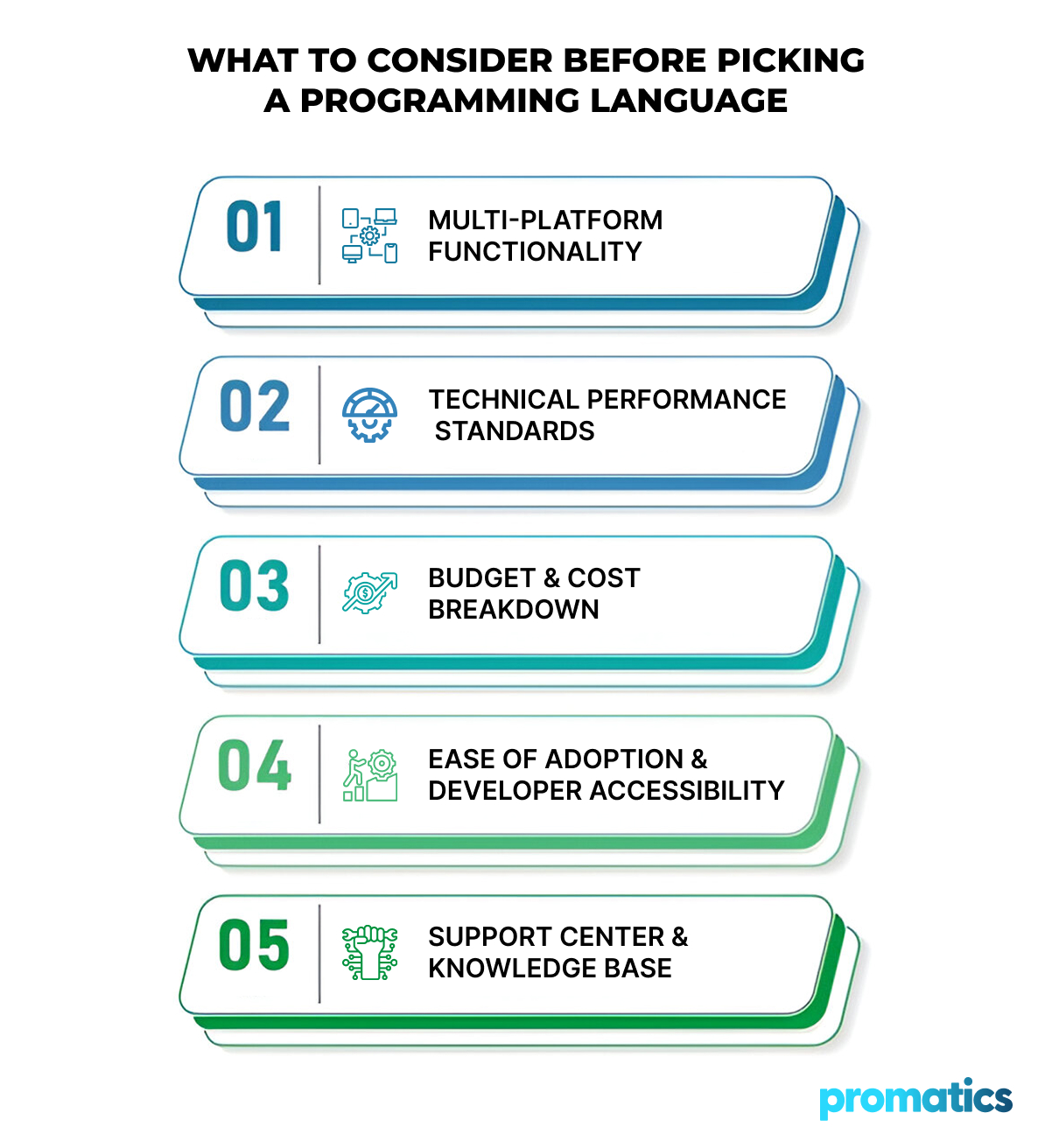
3. Factors to Consider When Choosing a Programming Language
Choosing the best programming language which is suitable for mfcrossobile game development is not a straight-forward answer. The correct language depends on the target audience, budget, performance requirements, and platform goals. The key factors to consider are:
1. Platform Compatibility
- Android-First Games: Java and Kotlin are the core technologies of Android and the performance of apps developed in these languages is great.
- iOS-Only Games: In conjunction with Apple’s ecosystem, Swift or Objective-C provide frictionless integration.
- Cross-Platform Games: The use of C# (Unity) and JavaScript frameworks allows developers to release a single game for both iOS and Android without additional work, thus making the process more efficient. For example, modern frameworks like Flutter app development help companies achieve seamless cross-platform experiences.
2. Performance Requirements
- Casual Games: Languages that require fewer resources like JavaScript or Python may be ideal for small 2D games.
- High-Performance / 3D Games: The production of an AAA title is done through combining several technologies and processes: the use of high-level languages such as C++ or C# for Unity/Unreal Engine, advanced graphics, sound physics, etc.
3. Development Cost
- It might take more money to develop in C++ because you have to find very professional programmers and the creation process has to be quite long.
- Startups and indie developers can make use of the kind of technology that is powered by Unity with C# to lower their costs and still keep innovating.
- The following are the average hourly rates of the developers in India:
C# (Unity): $10– $25/hr
- Upwork: $20–$40
- VirtualEmployee: $9/hour
- Hyperlink InfoSystem: ~$4.7/hour
C++ (Unreal Engine): $20– $40/hr
- Juegos Studio: $20–$49
- 300Mind: from $20/hour
Java/Swift: ₹700–₹2500/hour
- Flexiple: ~$3/hour
- Upwork (Swift): $18–$39
4. Learning Curve & Developer Availability
- Languages with simple syntaxes, such as C#JavaScript, and Python enjoy a high popularity among developers and boast a sizable number of tutorials and educational institutions.
- Rust, Lua, and some engine-specific scripting languages are so low-profile that only a few people account for skills in them and a graduate program is necessary to teach people.
5. Community Support & Libraries
- The most common programming languages such as C#, Java, and JavaScript have improved over the years to now have a large community, plentiful libraries and asset marketplaces.
- Niche programming languages may not have enough libraries, which can cause the development process to take more time.
There is no universal “best” language for mobile games. The right choice depends on your goals, platform targets, and budget. Partnering with a mobile game development company can help balance all these factors for success.
4. Best Programming Languages for Mobile Game Development in 2025
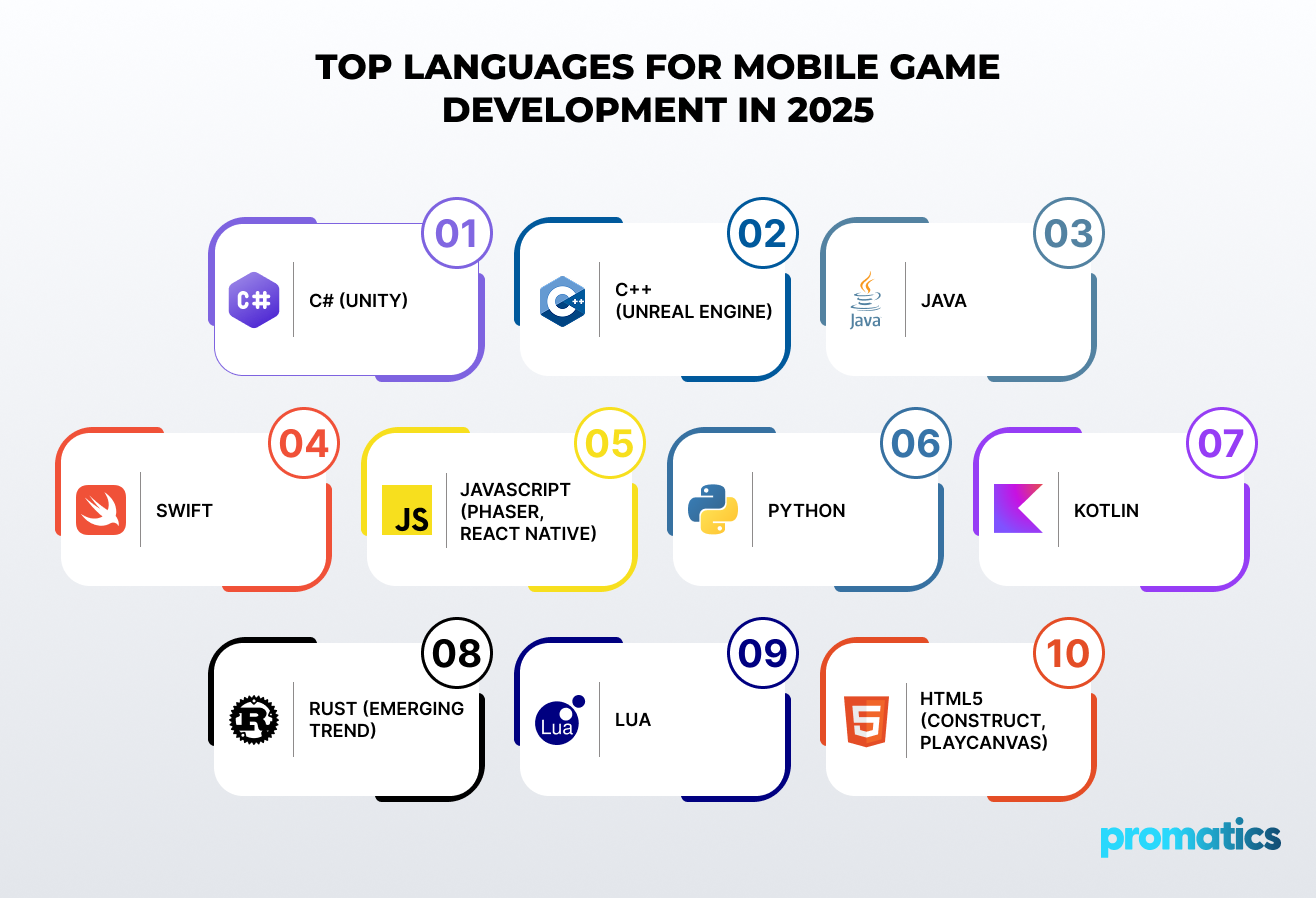
Here is a detailed comparison of the top 10 most popular programming languages for mobile game developers with pros, cons, cost-related issues, and examples of games.
4.1 C# (Unity)
Overview:
C# should be the first and leading language when programming with the Unity engine, which is responsible for more than half of the total number of mobile games all over the world. Unity offers 2D and 3D game development, VR/AR experiences, and software that can run on different platforms.
Pros:
- The syntax is simple and the developer is more likely to feel comfortable when coding.
- It is possible to carry out cross-platform deployment (iOS, Android, PC, consoles) with this language.
- One good point is the enormous community and Unity Asset Store having a wealth of pre-made materials.
- Most of the time, 2D casual games and 3D complex titles can be combined and run efficiently with this software.
Cons:
- The works of graphics that result from C++ are more powerful than those of C#.
- The dependence on Unity engine updates and the issue of compatibility plague the users.
Cost Implications:
- If a developer with experience level C# For Unity to be hired in India, it would typically require $10– $25 per hour.
- The faster the development side of the project becomes, the lower the cost for the whole project will be.
Example Games:
- Pokémon Go
- Monument Valley
4.2 C++ (Unreal Engine)
Overview:
C++ is fundamental to the Unreal Engine, which is the main software for AAA-standard 3D games. The engine produces high-end graphics and great performance, thus, it is perfect for virtual reality-type applications.
Pros:
- High performance and visually accurate rendering.
- Perfect for intensive 3D and games with heavy physics parts.
- Compatible with mobile, console, and PC products.
Cons:
- Compared to C#, C++ has a more difficult understanding of the language.
- More extended development time results in more expenses.
Cost Implications:
- Unreal Engine developers in India: $25– $40/hr
- Most applicable for higher-budgeted projects.
Example Games:
- PUBG Mobile
- Fortnite
4.3 Java
Overview:
Java is a conventional language used for Android native development and is noted for its dependability and a mature ecosystem.
Pros:
- Performance of Android native.
- Large community of developers and good community support.
- Very stable for large projects.
Cons:
- Java is slower than C++ or C# when it comes to the creation of complex 3D games.
- The available graphics libraries are limited.
Cost Implications:
- Java developers in India: $10– $18/hr
- Reasonably priced for startup companies making Android games.
Example Games:
- Angry Birds
- Numerous early Android arcade games.
4.4 Swift
Overview:
Swift is Apple’s native programming language for iOS development, designed to be fast, secure, and follow modern coding principles.
Pros:
- Great compatibility with iOS devices.
- Contemporary, safe, and quick.
- Apple’s ecosystem is integrated very easily.
Cons:
- Strictly for iOS devices; not compatible with other platforms.
- The number of skilled developers is less than that of Java or C#.
Cost Implications:
- Swift developers in India: $15– $30/hr
Sample Games:
- iPhone-only casual and puzzle games.
4.5 JavaScript (Phaser, Babylon.js, React Native)
Summary:
JavaScript is used for creating games that run in a browser as well as for low-weight mobile games. Technologies such as Phaser, React Native, and Babylon.js are compatible with cross-platform development.
Pros:
- Best choice for casual and browser-based games.
- Open-source community and ready-to-use libraries.
- Fast development and easy cross-platform deployment.
Cons:
- There are some limitations regarding 3D games with impressive graphics.
- Restricted performance for applications with heavy graphics.
Cost Implications:
- JavaScript developers in India: $10– $18/hr
Example Games:
- Browser-based puzzle games like 2048
- Simple casual mobile titles
4.6 Python
Summary:
Python is no longer a primary choice for mobile game development but it is great for prototyping, educational games, and lightweight apps. People usually use Kivy and Panda3D libraries for such purposes.
Pros:
- Eases the learning process and is developer-friendly.
- Excellent choice for rapid prototyping and educational games.
- Great for the initial phase of game logic testing.
Cons:
- Not suitable for AAA or heavy 3D games due to low performance.
- Few available libraries and frameworks for mobile deployment.
Cost Implications:
- Python developers in India: $10– $15/hr
Example Games:
- Educational apps and prototypes
- Indie experimental projects
4.7 Kotlin
Overview:
Kotlin is Google’s most recommended language for Android development, delivering the latest syntax and security features.
Pros:
- Kotlin is concise, modern, and more secure than Java.
- Completely compatible with Java libraries.
- Wider community acceptance.
Cons:
- Only available in the Android eco-system.
- Less existing game-specific libraries compared to Java.
Cost Implications:
- Kotlin developers in India: $10– $25/hr
Example Games:
- Indie Android-first puzzle and casual games
4.8 Rust (Emerging Trend)
Overview:
Rust is becoming known as a language for performance-critical and memory-safe applications, such as experimental game engines.
Pros:
- Lightening speed and safety which suits well for performance-critical parts.
- Because of the increased number of it in the future it is considered future-proof in game development.
Cons:
- Use in the iOS niche.
- Support by the library is restricted and the developer pool is small.
Cost Implications:
- Not many Rust developers globally; plus, the cost of hiring is greater.
Example Games:
- Unconventional indie projects
- Development of future-proof engine
4.9 Lua
Overview:
Lua is a small and light programming language and is typically used for game logic in Corona SDK or for logic scripting in big games.
Pros:
- A small and fast scripting language.
- Simple to pair with C++ or other engines.
Cons:
- Very few works as the main language of mobile games.
- Not fully scalable when large projects are targeted.
Example Games:
- Angry Birds (game logic)
- Tiny indie mobile projects
4.10 HTML5 (Cocos2d-JS, Construct, PlayCanvas)
Overview:
HTML5 is used to develop cross-platform, browser-based, and instant games that can be played on any device without the need for any installation.
Pros:
- With minimal adjustments, games can be run virtually on any platform.
- Launch through web browsers makes it very simple.
Cons:
- Has limited graphics compared to native apps.
- Not compatible with AAA or heavy 3D games
Example Games:
- Facebook Instant Games
- Browser-based puzzle and casual titles
Comparison Table
| Language | Best For | Difficulty | Cost (India) | Example Game |
| C# | Cross-platform, 2D/3D | Easy-Medium | $10– $25/hr | Pokémon Go |
| C++ | AAA, 3D, performance | Hard | $25 – $40/hr | PUBG Mobile |
| Java | Android-native | Medium | $10 – $18/hr | Angry Birds |
| Swift | iOS-only | Medium | $15 – $30/hr | iOS casual games |
| JavaScript | Casual, web-based | Easy | $10 – $18/hr | Browser games |
| Python | Prototypes, learning | Easy | $10 – $15/hr | Educational apps |
| Kotlin | Modern Android | Medium | $10 – $25/hr | Indie Android titles |
| Rust | Future-proof engines | Hard | $25 – $40/hr | Experimental projects |
| Lua | Scripting, lightweight | Easy | $10– $15/hr | Angry Birds (logic) |
| HTML5 | Casual, instant games | Easy | $10 – $18/hr | Facebook Instant |
5. Which Programming Language Should You Choose?
Picking up one programming language depends on project kinds, budget, and targeted platform:
- Startups with limited money for a project – C# (Unity) for cross-platform adaptability.
- AAA/ high-performance games – C++ with Unreal Engine.
- Android-first games – Java or Kotlin.
- iOS-only games – Swift.
- Quick prototypes or casual games – JavaScript or Python.
Pros & Cons Quick Overview:
- C# – Easy, low-cost, multi-purpose, active community.
- C++ – Top performance, high-priced, complex learning curve.
- Java/Kotlin – Perfect for Android ecosystem, medium cost.
- Swift – iOS-native, fast, limited cross-platform.
- JavaScript – Cross-platform, casual-friendly, lightweight.
The language of your software should correspond to your business goals, target audience, and the amount of money you want to allocate for the development of your software and not just be based on the latest trends.
6. Why Work with a Mobile Game Development Company?
There are many major pluses connected to the hiring of a mobile game development company:
1. Access to Experienced Programmers Across Languages
- Knowledge and skills in C#, C++, Java, Swift, Kotlin, as well as in newly created languages.
- Working with the properly developed code and technical architectures which may be easily scaled is ensured.
2. Reduced Development Time & Faster Time-to-Market
- Pre-built frameworks, plugins, and assets that teams utilize can speed up your development, hence your development time will be reduced and your time-to-market will be faster.
3. Access to Latest Tools and Engines
- Platforms like Unity, Unreal, Kivy, Phaser, Construct, etc.
- Advanced AR/VR integration and cloud services.
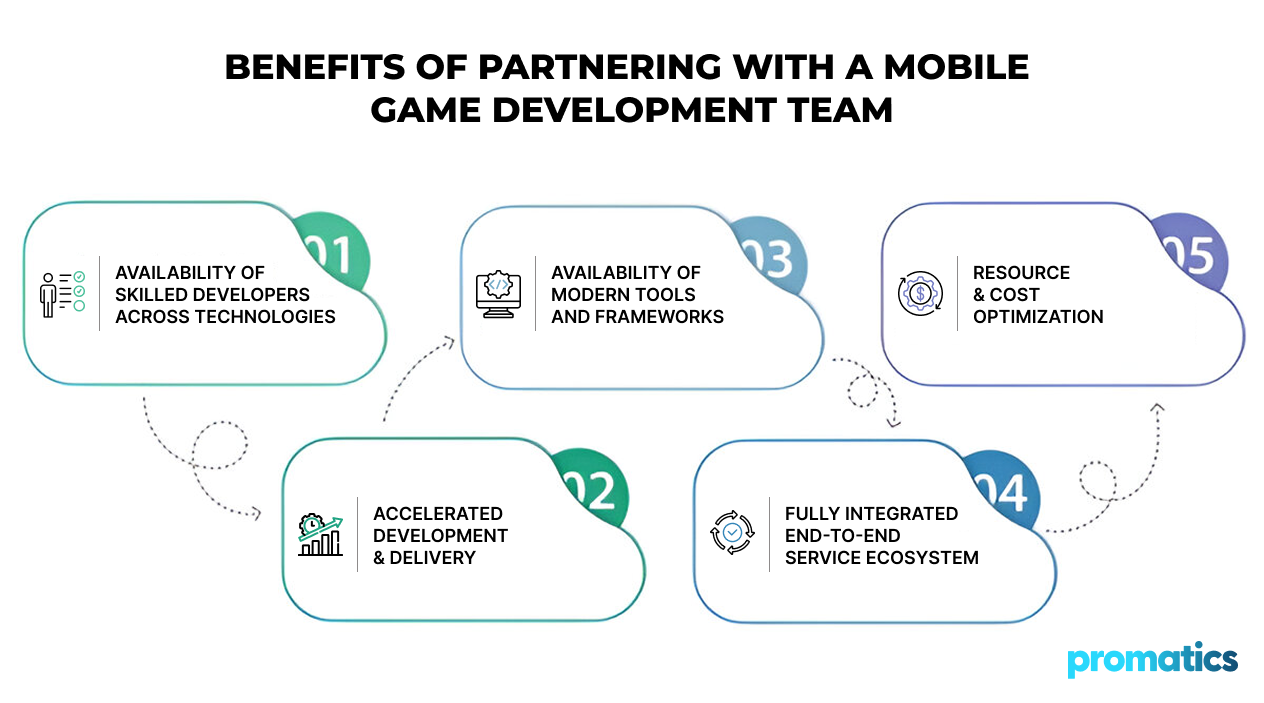
4. End-To-End Services
- Ideation, UI/UX design, programming, QA, testing, and maintenance. Many businesses also explore hybrid mobile app development for reducing costs while reaching both iOS and Android users.
5. Cost Efficiency
- The costs can be reduced by 40–60% if you hire a mobile game development company in India as compared to the rates in the US/Europe without affecting the quality of work.
7. Conclusion
As a top Indian mobile app development company recognized on Clutch, Promatics ensures quality game delivery. The programming language is chosen based on the type of game, performance needs, and target audience. C# works best for startups and cross-platform games. C++ is suited for AAA and high-performance projects. Swift and Kotlin are ideal for platform-specific titles.
Eventually, the concentration should be on the skills, the quality, and the scalability, and not merely a language preference. Therefore a collaboration with a specialist company, which is in charge of the creation of mobile games, can guarantee that your game is made in such a way that is effective, saves you money, and is already the winner in the market.
So, for customized mobile game development services, contact Promatics, and let your gaming concept become real modern!
