Hybrid App Development for Enterprise: Architecture, Security and Scalability

TL;DR
- Hybrid app development supports iOS and Android with a streamlined approach.
- Security, scalability, performance, and integrations should shape the architecture.
- Choose technology based on business goals and user needs.
- A strong architecture helps apps scale with business growth.
- The right partner can combine mobile, API, AI, cloud, and enterprise technologies.
Enterprise mobile applications are no longer standalone products. They are increasingly connected to CRMs, ERPs, payment platforms, cloud infrastructure, analytics systems, customer portals, and AI services. That means choosing a mobile development approach is not simply about building an app for iOS and Android. It is about creating a reliable digital layer that can support business operations at scale.
This is where hybrid app development becomes relevant for enterprises evaluating faster development, code reuse, simplified maintenance, and multi-platform deployment.
However, enterprise requirements are different from those of a basic consumer application. Security, API architecture, authentication, offline functionality, third-party integrations, performance, scalability, and long-term maintainability all need to be considered before development begins.
For businesses planning an enterprise-grade mobile product, working with an experienced mobile app development company can help translate these requirements into the right technical architecture.
This guide explains how hybrid app development works in an enterprise environment, what its architecture should look like, how to approach security and scalability, when hybrid makes sense over native development, and what businesses should evaluate before selecting a development partner.
What Is Hybrid App Development?
Hybrid app development refers broadly to building applications that can operate across multiple mobile platforms while sharing some or much of the underlying development effort.
The exact technology stack can vary. Depending on the requirements, enterprises may consider technologies such as Ionic/Capacitor, React Native, Flutter, or Kotlin Multiplatform. These approaches are not architecturally identical, so the technology should be selected based on the product rather than treated as a one-size-fits-all solution.
For enterprises, the more important question is:
Can the chosen architecture deliver the required security, performance, integrations, scalability, and user experience across platforms?
If the answer is yes, hybrid or cross-platform development can reduce duplicated engineering effort while giving businesses a path to launch and maintain applications across iOS and Android.
For businesses still evaluating different approaches, our guide to cross-platform app development and React Native, Flutter, and .NET MAUI provides a deeper framework-level comparison.
Why Are Enterprises Considering Hybrid App Development?
For an enterprise, the value of hybrid development goes beyond writing code once.
A well-designed architecture can help organizations simplify development while creating a common foundation for multiple mobile platforms.
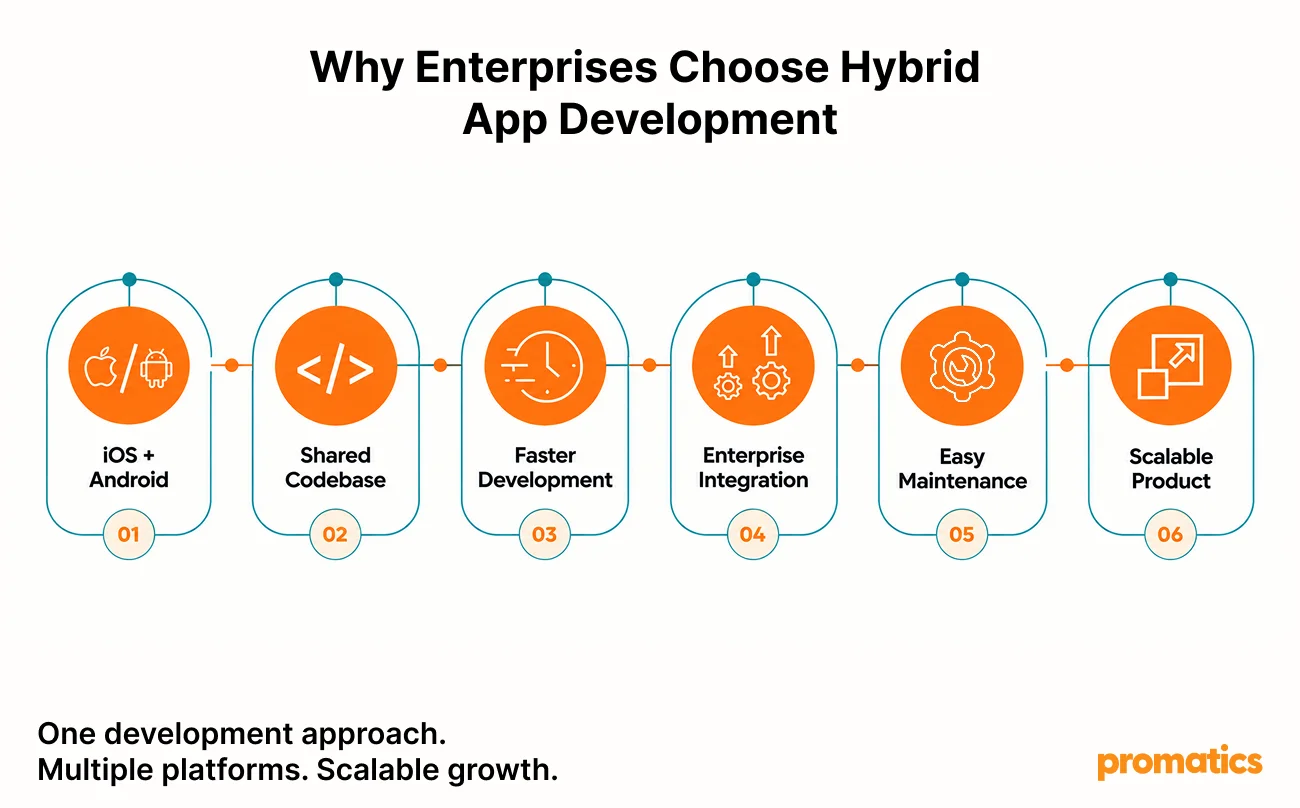
Key business considerations include:
| Enterprise requirement | How hybrid development can help |
| iOS + Android | Shared development approach |
| Faster product iterations | Less duplicated implementation |
| Maintenance | Centralized code and workflows where applicable |
| Backend integration | Common API layer |
| Enterprise systems | APIs can connect mobile apps with CRM, ERP and other systems |
| Product expansion | Shared architecture can support future features |
| Development resources | Reduced duplication across platform teams |
However, code reuse should not be treated as the only objective. For an enterprise application, architecture quality, security, maintainability and scalability matter more than simply maximizing code reuse.
Enterprise Hybrid App Architecture: What Should It Look Like?
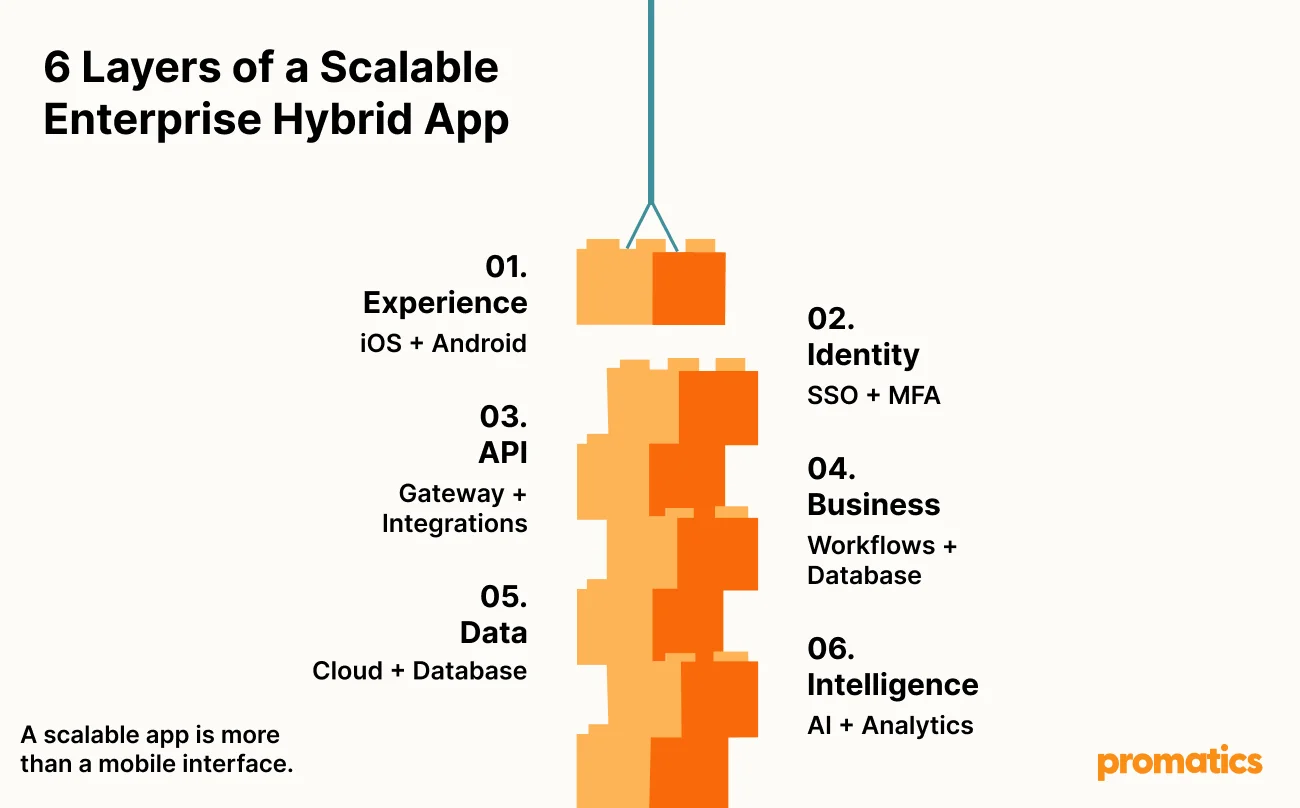
Enterprise applications require more than a mobile interface.
A scalable architecture typically separates the mobile experience from business logic, APIs, backend services, data, identity, and monitoring.
A typical enterprise architecture can include:
1. Presentation Layer
The mobile interface used by employees, customers, partners, or field teams.
2. Business Logic Layer
Handles workflows, rules, calculations, validation, and application behavior.
3. API Layer
Connects the mobile application with backend services and enterprise systems.
4. Backend & Cloud Layer
Provides business services, processing, authentication, storage, queues, and infrastructure.
5. Data Layer
Manages databases, caching, storage, synchronization, and data access.
6. Security & Monitoring Layer
Covers authentication, authorization, encryption, logging, monitoring, and threat detection.
For applications with multiple integrations, an API-first development approach can provide a more structured foundation for connecting mobile applications with backend systems.
You can explore the approach in Promatics’ guide to API-first development for web and mobile applications.
Simplified architecture
USERS
↓
iOS + Android App
↓
Authentication / SSO
↓
API Gateway
↓
Business Services
↙ ↓ ↘
CRM ERP AI Services
↘ ↓ ↙
Database + Cloud
↓
Analytics & Monitoring
This separation becomes particularly important when an application needs to scale beyond its initial user base.
Enterprise vs. Consumer Hybrid Applications
The architecture requirements can differ significantly.
| Area | Consumer App | Enterprise App |
| Users | General public | Employees, customers, partners |
| Authentication | Email/social login | SSO, MFA, enterprise identity |
| Integrations | Limited | CRM, ERP, HRMS, payments, APIs |
| Security | Important | Often business-critical |
| Offline functionality | Optional | Frequently important |
| Analytics | Product analytics | Product + operational analytics |
| Compliance | Product-dependent | Often regulatory/business-specific |
| Scalability | User-driven | User + business workload |
| Administration | Basic | Roles, permissions, centralized controls |
This is why an enterprise hybrid application should be planned around business workflows, not just mobile screens.
Hybrid App Security: What Enterprises Need to Consider
Security cannot be added as a final development phase.
It needs to influence the architecture from the beginning.
An enterprise mobile application may handle customer information, employee records, financial information, proprietary business data, or credentials for internal systems.
Key areas include:
Authentication
Consider enterprise authentication mechanisms such as:
- SSO
- OAuth 2.0
- OpenID Connect
- MFA
- Biometric authentication where appropriate
Authorization
Authentication answers who the user is.
Authorization determines what that user can access.
Role-based access control and permission models should therefore be designed alongside business workflows.
Data Protection
Sensitive data should be protected both:
- In transit
- At rest
Applications should also minimize unnecessary local storage of sensitive information.
API Security
Because enterprise applications frequently depend on APIs, API security should cover:
- Authentication
- Authorization
- Rate limiting
- Input validation
- Secure tokens
- API monitoring
- Error handling
Dependency Security
Third-party libraries and SDKs should be continuously evaluated for vulnerabilities.
Security testing should also cover the mobile application, backend APIs, authentication mechanisms, and connected services.
Scaling Hybrid Applications for Enterprise Users
An application can perform perfectly with 5,000 users and behave very differently at 500,000.
That is why scalability needs to be considered before the user base grows.
A scalable architecture should account for:
- API traffic
- Database load
- Concurrent users
- File and media storage
- Background processing
- Caching
- Network conditions
- Cloud infrastructure
- Monitoring
- Failover and recovery
A scalable model could look like:
Mobile Users
↓
Load Balancer
↓
API Gateway
↓
Application Services
↙ ↓ ↘
Cache Database Queue
↓
Cloud Infrastructure
↓
Monitoring & Analytics
The mobile application itself is only one part of scalability.
The backend architecture supporting it often becomes the more important scaling factor.
Enterprise Integrations: The Real Complexity Behind the App
For many enterprise projects, the difficult part isn’t building the mobile interface.
It is connecting the application to the company’s existing technology ecosystem.
Common integrations include:
- Salesforce
- SAP
- Microsoft Dynamics
- Oracle
- Payment gateways
- HRMS
- CRM platforms
- ERP systems
- Cloud storage
- Analytics platforms
- Communication tools
- AI services
This is another reason an API-first architecture can be valuable.
Instead of allowing the mobile application to directly depend on every backend system, APIs can provide a controlled integration layer.
Adding AI to Enterprise Hybrid Applications
AI can extend the role of enterprise mobile applications beyond traditional workflows.
Possible applications include:
- AI-powered search
- Intelligent recommendations
- Document processing
- Voice interfaces
- Predictive analytics
- Automated customer support
- AI assistants
- Field-service assistance
- Knowledge retrieval
- Workflow automation
Enterprises can use cloud-based AI APIs, on-device models, or a hybrid approach depending on privacy, latency, cost, and processing requirements.
For businesses exploring this direction, Promatics also provides AI mobile app development services for applications that combine mobile experiences with AI capabilities.
Offline Capability: An Important Enterprise Requirement
Not every enterprise user operates in a reliable network environment.
Field workers, delivery teams, healthcare professionals, sales representatives, inspectors, and technicians may need applications that continue working with limited connectivity.
A hybrid enterprise application can be designed around:
Online → Local storage → Offline actions → Sync queue → Conflict resolution → Server
The important part is not simply allowing offline access.
The architecture must determine:
- What data can be stored locally?
- How long can it remain available?
- What happens when data changes offline?
- How are conflicts resolved?
- What happens when synchronization fails?
These decisions should be made during architecture planning.
Hybrid vs. Native: What Should Enterprises Evaluate?
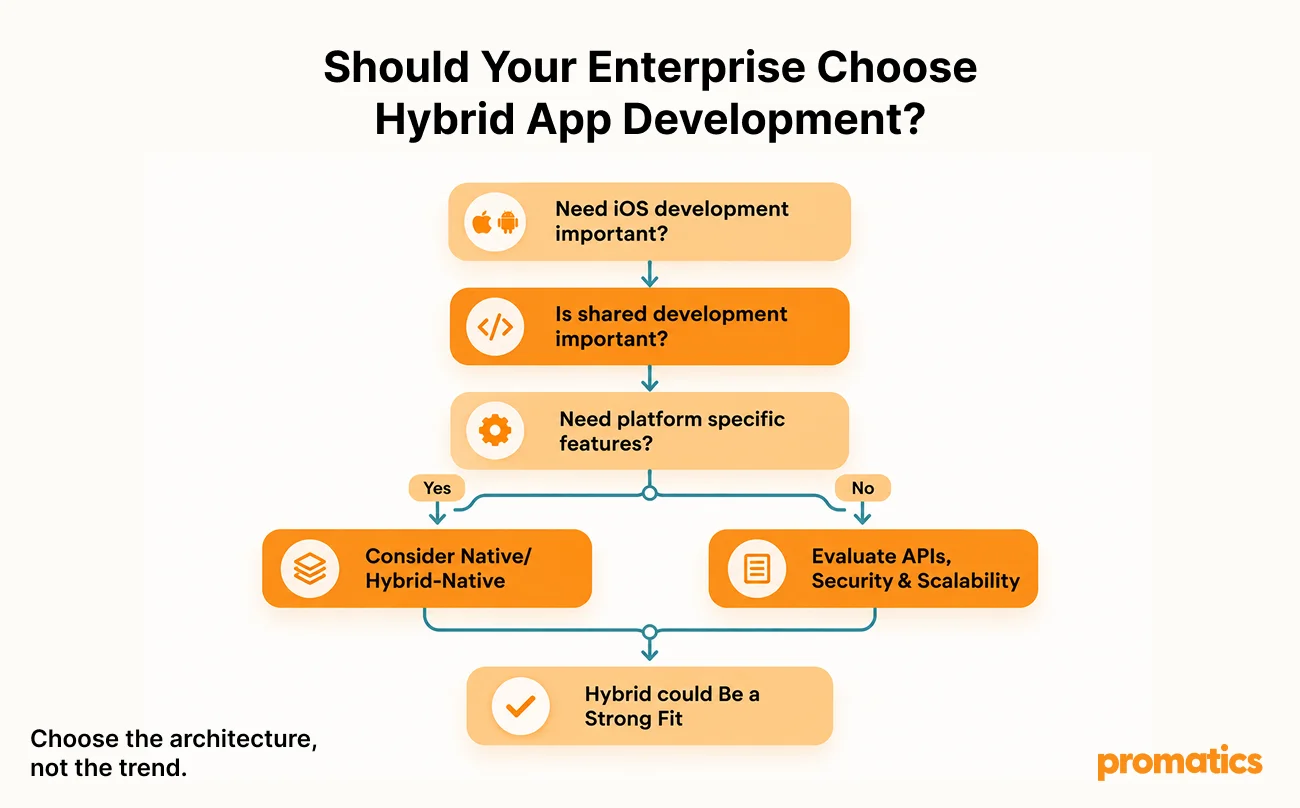
There is no universal architecture that fits every enterprise application.
| Requirement | Hybrid/Cross-platform | Native |
| iOS + Android | Strong fit | Requires separate platform implementations |
| Shared development | Strong potential | Lower |
| Platform-specific features | Depends on framework | Strong |
| Complex graphics | Depends on requirements | Often preferred |
| Enterprise APIs | Strong | Strong |
| Rapid multi-platform development | Potential advantage | More platform-specific work |
| Hardware-specific functionality | Framework-dependent | Strong |
| Long-term maintenance | Can simplify shared areas | Platform-specific maintenance |
The right choice depends on the application’s requirements rather than the popularity of a framework.
How Much Does Enterprise Hybrid App Development Cost?
There is no fixed cost for enterprise hybrid app development. Pricing varies based on the project’s complexity, development location, integrations, security requirements, and ongoing support.
Indicative Cost by Market
| Market | Agency Rates* | Project Range |
| USA | $25–$49+/hr | $75K–$250K+ |
| India | <$25/hr | $30K–$120K+ |
| Canada | $50–$99/hr | $75K–$200K+ |
| Australia | $100–$149/hr | $100K–$300K+ |
*Rates vary by provider, expertise, and project scope.
**Project ranges are indicative estimates, not fixed market prices.
For international businesses, India can offer a cost-efficient development model while providing access to experienced engineering teams.
The best way to estimate the investment is to consider total cost of ownership, including development, infrastructure, security, maintenance, upgrades, and future scaling.
How Long Does Hybrid App Development Take?
Again, project complexity is the primary factor.
AppZoro estimates approximately:
- 3–4 months: Focused MVP
- 6–9 months: Feature-rich application with significant backend integrations
Enterprise applications can take longer when they involve complex integrations, security requirements, compliance, multiple user roles, extensive testing, or migration from legacy systems.
Common Enterprise Hybrid App Development Mistakes
1. Choosing a framework before defining requirements
Technology should follow the product requirements.
2. Treating security as a final-stage activity
Security architecture needs to be defined early.
3. Ignoring backend scalability
A scalable mobile interface cannot compensate for an overloaded backend.
4. Building integrations without an API strategy
Poorly structured integrations can increase long-term maintenance.
5. Overlooking offline workflows
This can create serious usability problems for field teams.
6. Measuring only development speed
Fast initial development does not necessarily mean lower long-term cost.
7. Choosing a vendor based only on portfolio screenshots
Enterprise development requires evidence of architecture, security, integrations, QA, cloud expertise, and post-launch support.
How to Choose a Hybrid App Development Company
The development partner you choose can influence the application’s architecture, scalability, security, and long-term maintenance.
Look beyond the number of apps a company has built.
Evaluate:
| Capability | What to evaluate |
| Mobile expertise | iOS + Android development experience |
| Architecture | Scalable application and API architecture |
| Security | Secure authentication, authorization and data protection |
| Integrations | CRM, ERP, payment and third-party systems |
| Cloud | AWS, Azure, Google Cloud or relevant infrastructure |
| AI | AI APIs, automation and intelligent features |
| QA | Automated + manual testing |
| Scalability | High-user and high-transaction applications |
| Maintenance | Post-launch support and optimization |
| Team | Product, design, engineering and QA capabilities |
If you are comparing development partners, this guide to choosing a mobile app development company can help define the technical and business criteria before you begin vendor discussions.
For projects that need a flexible engineering model, enterprises can also consider dedicated mobile app developers as an extension of their internal team.
Why Choose Promatics for Enterprise Mobile Development?
Enterprise applications require more than mobile development expertise.
They require a team that can understand the relationship between:
Product → UX → Mobile → APIs → Backend → Cloud → Security → AI → Analytics
Promatics brings experience across these layers to help businesses design and develop enterprise-grade digital products.
Whether you are building a new mobile product, modernizing an existing application, connecting mobile experiences to enterprise systems, or adding AI capabilities, the development approach should begin with the business requirements and technical architecture.
Explore Promatics’ mobile app development services or speak with the team about your enterprise application requirements.
Final Takeaway
Choosing hybrid app development is not simply about building one app for iOS and Android. For enterprises, the bigger decision is creating an architecture that can support security, integrations, scalability, performance, and future growth.
The right technology should fit your product, not the other way around.
If you’re planning an enterprise mobile application, start by defining:
Business goals → User needs → Architecture → Integrations → Technology → Scale
With the right foundation, your app can evolve as your business grows without creating unnecessary technical complexity.
From mobile app development and API integration to AI, cloud, and enterprise systems, Promatics helps businesses turn complex requirements into scalable digital products.
Explore Promatics’ mobile app development services and discuss your enterprise app requirements with our team.
Your next mobile product should be built for today and engineered for what comes next.