IoT and Edge AI: The Next Wave of Connected Innovation

TL;DR
- IoT + Edge AI enable real-time data processing and intelligent decisions at the device level
- Reduces latency, bandwidth usage, and dependency on centralized cloud systems
- Enhances data security and privacy through local, on-device processing
- Delivers faster insights, automation, and improved operational efficiency
- Powers advanced use cases like industrial IoT, smart cities, and predictive systems
The Internet of Things (IoT) is still a main driver for data management in most of the industries and organizations. Nowadays, IoT is not only about connecting devices together but has also evolved through the implementation of AI in IoT, which is considered to be the biggest market, with a growth rate of 37.3% per year that will total $1.8 trillion by the year 2030.
by utilizing Edge AI to combine localized processing with intelligent decision-making. This shift is developing a brand new generation of real-time automation, responsiveness, and operational efficiency.
As more devices generate massive volumes of data, conventional cloud-centric processing faces limitations in pace, fee, and privateness. IoT paired with Edge AI addresses those gaps by way of permitting smart processing at the supply of statistics era as opposed to depending exclusively on remote servers.
In this blog, we discover how IoT and Edge AI work collectively, their key benefits and advantages, real-world use instances, adoption challenges, and why this combination is vital for building smarter related structures.
What Are IoT and Edge AI?
IoT (Internet of Things) refers to networks of bodily devices embedded with sensors, software, and connectivity that collect and alternate statistics. These gadgets range from industrial sensors and fitness wearables to clever home equipment and independent motors.
Edge AI combines synthetic intelligence with aspect computing, enabling AI models to run immediately on or near devices as opposed to sending all records to far-off cloud servers for processing. By processing facts at the brink, systems can examine statistics with minimal delay.
IoT and Edge AI collaborate to build an intelligent and responsive environment in which devices can interact, analyze, and act in real time.
Why Are Traditional Cloud-Only Models Becoming Insufficient?
Cloud computing centralizes fact storage and analytics; however, cloud-handiest dependency introduces several operational challenges for IoT structures:
- Latency and Delay: Transmitting all information to far-off servers prevents immediate choice-making for time-touchy programs.
- Bandwidth Costs: Continuous information switches will increase network usage and operational fees.
- Data Privacy Risks: Sensitive facts can be exposed for the duration of transmission or even as stored in centralized systems.
In commercial automation, healthcare monitoring, transport systems, and remote infrastructure, where it needs to be decided in seconds, these restrictions are particularly important.
How IoT and Edge AI Collaborate
When mixed, IoT and Edge AI transform related systems from statistics creditors into sensible responders.
1. Localized Data Processing
Edge AI performs gadget learning and analytics directly on component devices or gateways, reducing reliance on centralized servers and enabling faster response times.
2. Real-Time Decision-Making
In environments along with production floors or autonomous vehicles, Edge AI enables immediate action without looking ahead to cloud confirmation.
3. Efficient Use of Network and Compute Resources
By filtering and processing statistics regionally, Edge AI reduces the extent of facts transmitted, decreasing bandwidth utilization and operational costs.
4. Improved Security and Privacy
Local data processing minimizes exposure to safety risks and supports compliance with regulatory standards.
This integration is often referred to as AIoT (Artificial Intelligence of Things), wherein related gadgets gather, analyze, and respond to records intelligently.
How IoT and Edge AI Are Transforming Connected Systems
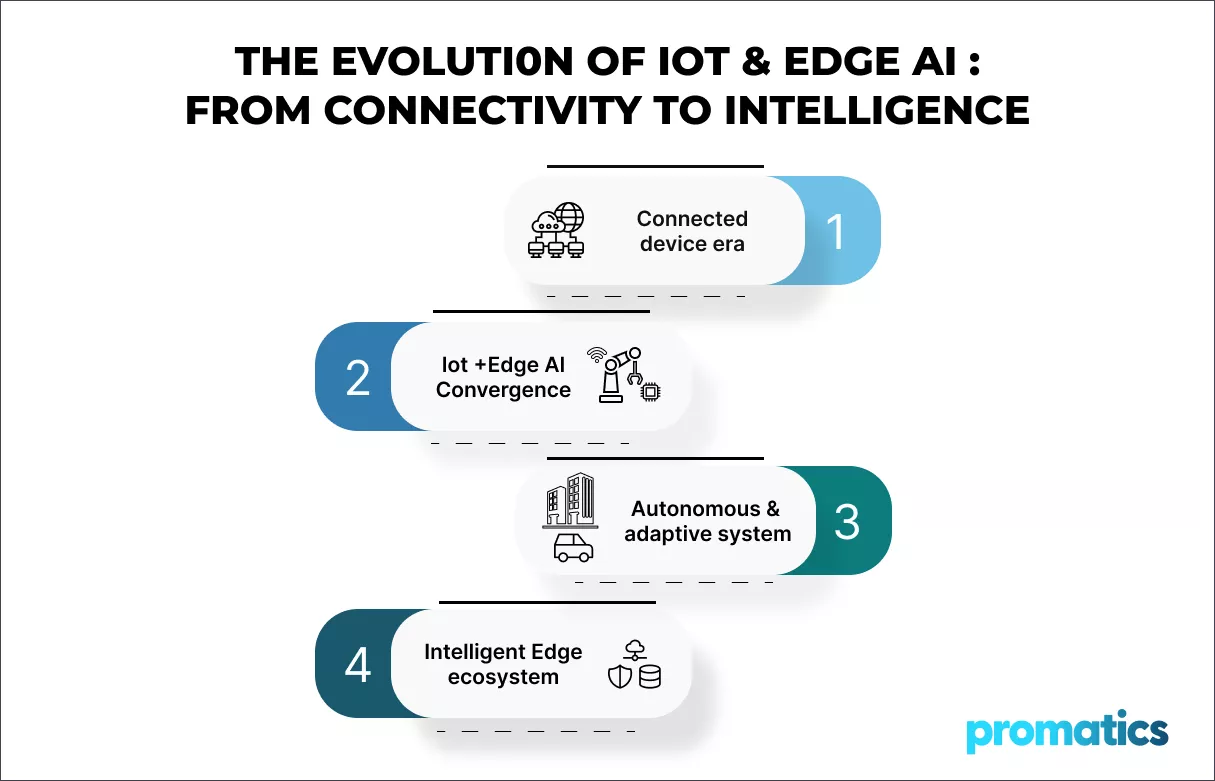
This visual highlights how IoT systems have evolved from cloud-dependent data collection to intelligent, autonomous, edge-driven ecosystems.
Key Business Benefits of IoT and Edge AI
Enterprises adopting IoT with Edge AI advantage sensible benefits:
- Faster, Smarter Operations: Real-time insights enhance automation, safety, and system reliability.
- Reduced Bandwidth and Cloud Costs: Only relevant data is transmitted upstream.
- Enhanced Data Security: Sensitive facts remain toward its source.
- Scalability Across Distributed Networks: Edge architectures assist enlargement across multiple sites without overloading critical structures.
5 Key Trends Shaping Edge AI Implementation
The very near future of AI is coming closer to the edge, and these five trends will unveil the next steps and the implications for AI adoption in the following 18 months.
1. Specialized Hardware for Edge Intelligence
The progress of edge AI and the main drivers behind it are specialized hardware, AI chips, and Neural Processing Units (NPUs), the latter being the most noticeable. Well, those are the real groupies, boys below, and thankfully, they have been designed for each aspect of work. The results are much better performance and the same power cost compared to traditional CPUs and GPUs. They allow the functioning of real-time
Emerging technology like neuromorphic computing similarly pushes performance with the aid of mimicking human mind-like processing, making energy-self-sufficient and occasion-driven edge systems possible.
2. Model Optimization for Resource-Constrained Devices
Model optimization has turned out to be a cornerstone of realistic Edge AI deployment. Techniques consisting of quantization, pruning, and understanding distillation reduce model length whilst keeping accuracy, allowing AI models to run effectively on part hardware. Post-education quantization now permits even big language models to function on-tool with minimal performance loss.
In parallel, small language models (SLMs) are gaining adoption, providing sturdy capabilities while working entirely offline on edge devices.
3. Hybrid Edge–Cloud Architectures
The destiny of Edge AI lies in wise workload distribution among edge and cloud environments. Time-touchy selections take place at the threshold, at the same time as complicated analytics and long-term insights are dealt with inside the cloud.
Approaches along with federated getting to know permit models to improve together without sharing raw records, supporting privateness and compliance. Split inference further balances performance and price by dividing AI processing across facet and cloud layers based on need.
4. Industry-Specific Edge AI Adoption
Edge AI adoption is accelerating throughout industries with measurable effects. Manufacturing makes use of predictive renovation and visual inspection to reduce downtime and enhance nice. Healthcare relies on aspect-powered diagnostics and real-time patient monitoring while preserving sensitive information on the website.
Automotive systems depend on part intelligence for split-second self sufficient choices, and retail leverages facet AI for smart inventory management, loss prevention, and frictionless checkout experiences.
5. Privacy, Security, and Next-Generation Connectivity
With the implementation of stricter data protection regulations worldwide, it has become a necessity for the Edge AI technologies to incorporate privacy and security measures. Domestic data processing not only minimizes the risk of losing control over the data but also makes it easier to follow the rules like GDPR and HIPAA. Besides, edge devices.
The upward thrust of 5G and multi-get right of entry to side computing (MEC) in addition accelerates Edge AI through allowing extremely low latency and high-bandwidth connectivity.
Real-World Examples of the Top 5 IoT Applications and Use Cases
1. Smart Traffic Management and Road Safety
Use Case: Many countries, such as Barcelona and Spain, deployed AI-enabled visitor control structures using IoT sensors and cameras to reveal vehicle glide and pedestrian movement in real time. Edge AI fashions analyze information locally to modify signal timings and reroute site visitors’ styles dynamically.
Impact:
Reduced congestion during top hours
Shorter go-back-and-forth times
Improved pedestrian safety
Why it matters : Two years after its clever city initiative commenced, Barcelona’s real-time mobility controls exhibit how intelligent visitor structures can transform city experience.
2. Remote Patient Monitoring
Use Cases: Hospital overload and not on-time medical response
Example: Many clinics inside the USA have partnered with generation carriers to set up IoT-enabled wearables and edge analytics for cardiac and continual sickness tracking. Vital signs and symptoms, inclusive of heart charge and oxygen saturation, are processed locally at the tool to cause real-time indicators before conditions get worse.
Impact:
- Reduced emergency admissions
- Faster clinical reaction
- Better chronic disease results
Why it matters: In healthcare, actual-time facet inference could make the distinction between timely intervention and crucial delays.
3. Free Retail Checkout Carrefour and Amazon Go
Use Case: Long queues and guide checkout friction
Example:
Amazon Go (USA): Amazon uses a network of IoT cameras and sensors with edge AI to stumble on which items customers pick and robotically expenses their account after they leave.
Carrefour (Europe): Pilot comparable cashier-much less checkout generation in pick out French stores using AI—more desirable shelf sensors and cameras.
Impact:
- Fully automatic checkout revels in
- Reduced keep staffing strain
- Improved consumer pride
Why these subjects: These systems exhibit how AIoT can dispose of friction factors that historically block conversions and consumer engagement.
4. Predictive Maintenance – Rolls -Royce
Use Case: Unexpected aircraft additives failures
Example: Rolls-Royce’s “Intelligence Engine” program uses IoT sensors on jet engines to accumulate vibration, temperature, and strain statistics. Edge AI fashions analyze information in real time to expect preservation windows earlier than anomalies come to be screw-ups.
Impact:
- Higher aircraft uptime
- Reduced operational delays
- Lower preservation fees
Why it matters: In safety-vital industries like aviation, predictive systems increase reliability and lower danger.
5. Public Health Monitoring & Early Warning structures
Use Case : Public fitness corporations inside the United States and South Korea are using IoT gadgets and AI to display health traits, track sickness outbreaks, and assist remote affected person care, specifically all through pandemics.
How it really works
- Wearables and linked monitoring gadgets constantly capture vitals.
- AI analyzes styles at the edge to hit upon anomalies and issues.
- Alerts are generated for fitness businesses straight away while chance thresholds are crossed.
Impacts
Early detection of health and hotspots
Improves resource allocation for healthcare offerings
Reduced burden on hospitals and emergency offerings.
How Promatics Supports IoT and Edge AI Solutions
Promatics Technologies facilitates groups designing and installing scalable IoT and Edge AI solutions tailored to employer and commercial environments. Our information includes:
- Custom IoT utility improvement
- Edge AI answers for real-time intelligence
- Secure and dependable fog computing services
- Industrial IoT answers built for scale
- Intelligent related structures designed for lengthy-term boom
We focus attention on turning connected statistics into actionable insights that power measurable commercial enterprise results.
Conclusion
IoT and Edge AI represent a first-rate shift in how connected structures perform. By bringing intelligence in the direction in which facts are generated, companies can gain faster decision-making, lower expenses, improved security, and extra operational performance.
In the modern competitive landscape, merely having connectivity does not suffice. The combination of IoT with Edge AI gives the opportunity for insights in real-time and thus makes it possible for the companies to move more intelligently and so, for the companies to be innovative, to scale and to keep their operations safe against the future changes.
Ready to Build Smarter Connected Systems? Whether you’re embarking on a new IoT project or looking to upgrade existing infrastructures with Edge AI solutions, Promatics Technologies empowers you to design savvy, robust, and scalable solutions easily. Get in touch with our experts to see how IoT or Edge AI solutions may help make your business ideas come alive!
