Offshore Software Development: A Strategic Guide for Global Businesses

TL;DR
- Offshore development = outsourcing to global teams for software projects
- Reduces costs while accessing skilled global talent
- Enables faster delivery and scalable team expansion
- Requires strong communication, security, and process management
- Works best as a long-term strategic partnership, not just cost-saving
The software development industry is not static; it is very dynamic and full of rapid changes. Nowadays, companies have to deliver top-notch digital products within a very short time frame, with limited budget and internal resources. The challenge of finding a perfect orbit between speed, creativity, and cost has become more acute with the increase of technological demands.
The practice of offshore software outsourcing gives a feasible answer to the problem. Rather than employing numerous in-house staff at the very beginning, companies engage with talented software engineers from around the world, thus being able to grow quicker, getting their hands on a specific knowledge base, and delivering their projects with greater efficiency. What had been envisioned as an alternative for reducing costs has turned out to be a major contributor to the company’s growth, flexibility, and creativity.
This blog will discuss the offshore software development process, its major benefits, potential difficulties, and how a company can make the process successful in the long run.
Definition and Core Essence of Offshore Software Development
At its core, offshore software development means partnering with a software development company located in another country to design, build, test, and maintain a digital product. These teams work remotely but operate as an extension of your workforce.
Overseas development is most of the time referred to under “outsourcing,” but the two terms do not really mean the same thing. In most cases, outsourcing concerns only the execution of tasks.
Offshore IT services, however, are focused on creating long-lasting engineering competency if properly executed. The intention is not only to add features but also to amplify your product vision, technology roadmap, and business growth.
The offshore teams that have been successful keep very close ties with the internal workflows, product goals, and decision-making processes. It is less important where the teams are located than the quality of the communication, the ownership, and the execution.
Offshore vs. Nearshore vs. Onshore Development: Key Differences Explained
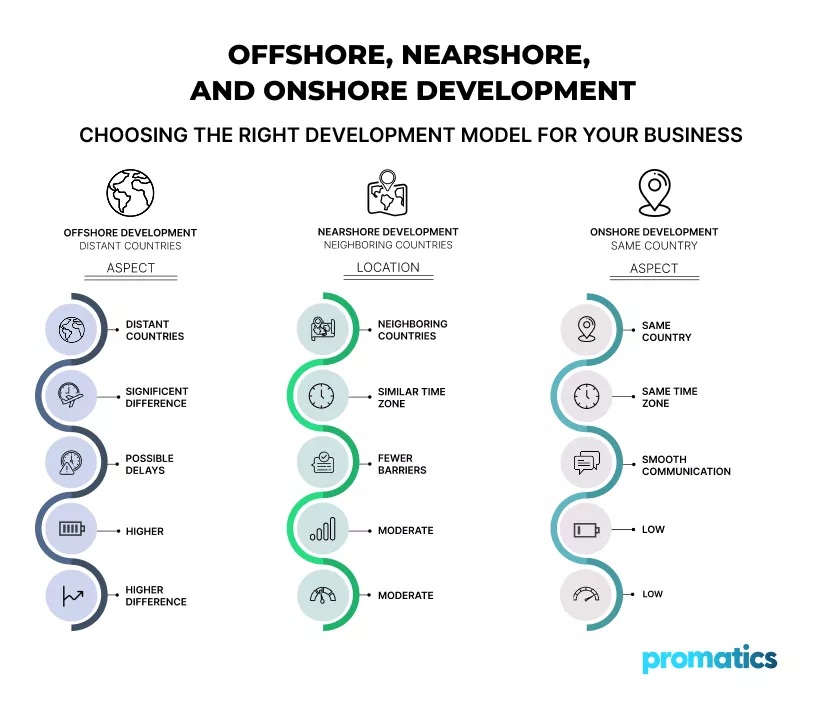
Each model has its advantages. Offshore development is preferred for cost efficiency and access to a global software and app development company talent pool. Nearshore and onshore offer easier collaboration due to time zone and culture alignment. The right choice depends on business priorities, budget, and project complexity.
Why Offshore Development Has Become a Global Technology Backbone
Offshore development is no longer an emerging trend—it is a core part of how modern software is built and delivered.
The main factors are:
- Global trends across engineering, AI, Cloud, and enterprise systems are accessible
- Fintech, healthcare, SaaS, logistic, and eCommerce industries have the deepest experience
- Agile, DevOps, and cloud-native practices are widely adopted
Today’s offshore and enterprise web development teams do more than write code. They question assumptions, suggest better approaches, and actively contribute to strategy. Many global companies rely on offshore teams as long-term collaborators embedded directly into their development cycle.
Business Benefits of Offshore Software Development
When aligned strategically, offshore development delivers measurable business fees.
- Cost Efficiency
Offshore software outsourcing lets businesses optimize budgets even while retaining excessive engineering requirements. Savings are reinvested into innovation, product growth, and user enjoyment of upgrades.
- Access to Niche & Emerging Skills
From AI and blockchain to cloud-local architecture and cell engineering, offshore groups offer entry to specialized expertise that may be scarce locally.
- Round-the-Clock Development Cycles
Distributed groups permit near 24/7 development shortening improvement cycles and accelerating comment loops.
Strategically placed offshore teams act as
- Growth enablers
- Innovation accelerators
- Long-term engineering partners
When Offshore Development Makes the Most Sense
Offshore development works best when driven by strategy, not urgency
Common use cases include:
- Startups scaling MVPs into production-ready products
- Enterprises modernizing legacy systems or following a clear roadmap for app development
- SaaS companies expanding features and global offerings
Offshore development is not just a way to reduce costs but rather a strategy employed by the most successful businesses to scale, gain speed, and become long-term sustainable.
Choosing the Best Offshore Development Partner
The partner you select plays a vital role in the successful offshore development and .
Key evaluation factors:
- Technical information across relevant technologies
- Domain expertise and product thinking capability
- Cultural and communique alignment
- Process transparency, reporting, and governance
- Accountability and possession attitude
The best offshore partners don’t behave like vendors. They think like product teams, identifying risks early, suggesting improvements, and aligning technology decisions with business goals.
Engagement Models Explained
Choosing the proper engagement version guarantees readability, control, and performance.
- Dedicated Development Team
Ideal for long-time-period products requiring continuous evolution.
You get a stable, faraway improvement group completely aligned along with your roadmap.
- Fixed-Price Model
Ideal for nicely defined tasks with clean scope and timelines.
- Time & Material Model
Suited for evolving merchandise where necessities change frequently.
The right model encompasses product maturity, risk tolerance, and internal governance.
Dealing with Biases in Communication, Time Zones, and Collaboration
Time zones are often perceived as challenges; however, when managed intentionally, they come to be operational advantages.
Best Practices:
- Overlapping paintings hours for actual-time collaboration
- Clear Agile ceremonies and sprint cadences
- Centralized documentation and choice logs
- Collaboration tools of the present day (Jira, Slack, Notion, Git)
Good supervision of offshore teams creates a united remote team rather than separated silos.
Quality, Security and Compliance Factors
Modern offshore ecosystems aid organization-grade quality and governance.
Key Focus Areas
- Code nice requirements, peer reviews, and automatic trying out
- Secure improvement practices and IP protection
- One of the significant factors that companies prioritize is adherence to global standards such as GDPR, HIPAA, and ISO requirements.
Top management has to ask for security by default, not security as a last resort.
Common Offshore Problems and Their Solutions
Offshore improvement failures are not often technical.
Common issues include:
- Unclear desires and fulfillment metrics
- Poor onboarding and know-how switch
- Lack of ownership and duty
- Weak communique frameworks
These challenges can be avoided through clear documentation, shared responsibility, and active involvement from leadership.
Cost Breakdown and ROI Perspective
Offshore improvement expenses vary based totally on:
- Technology stack
- Team composition
- Project complexity
- Engagement period
Watch for Hidden Costs
- Rework because of poor requirements
- Delays resulting from misalignment
- Inadequate QA and checking out insurance
When controlled properly, offshore improvement can provide long-term ROI via scalability, resilience, and sustained innovation—making it a funding approach, no longer a fee line.
The Future of Offshore Software Development
Offshore development is evolving unexpectedly.
Key trends include:
- AI-pushed improvement workflows
- Cloud-local and platform engineering
- Product-centric offshore teams embedded in commercial enterprise strategy
The future belongs to partnerships that deliver ownership and innovation—not just execution.
Beyond Outsourcing : Offshore Development the Promatics Way
Offshore development should never feel like handing work to an external vendor. At Promoatics Technologies, we believe offshore teams should feel like an extension of your in-house team—aligned with your goals, your product vision, and your peace of growth.
Our approach goes beyond task execution. We focus on understanding your business, your users, and your long-term plans and initiatives; our offshore teams work with ownership and accountability.
How Promatics Deliver Real Offshore Value
- Global delivery approach designed for worldwide collaboration
- Dedicated offshore teams aligned with your workflows and priorities
- Strong communication practices for clarity across time zones
- End-to-end development assistance, from the initial planning stage to the provision of long-term maintenance.
Our priorities concerning scalability, security, and quality are set right from day one. So are you ready to build, scale, or extend the development team? Join us and discover an offshore model designed for a successful long-term partnership.
