Offshore Software Development in 2026: Cost, Models & How to Choose a Partner

The Right Development Partner Can Cost Less Than the Wrong One
Building software is rarely just a development challenge.
You need the right engineers, architecture, UI/UX, QA, cloud infrastructure, security, and ongoing support. Building all of these capabilities internally can take significant time, and managing multiple vendors can add another layer of complexity.
That is why businesses are increasingly considering offshore software development to access specialized tech talent and scale product development without building every capability in-house.
The global offshore software development market is projected to reach $204.32 billion in 2026, according to Research and Markets.
But choosing an offshore partner should never come down to price alone.
The real question is:
Can this development partner help us build the right product, at the right cost, with the expertise and scalability we need?
This blog covers the key factors businesses should consider before choosing an offshore development company, including cost, engagement models, team structure, AI capabilities, security, communication, and vendor selection.
Why Consider Offshore Software Development?
The biggest advantage of offshore development is not simply lower development rates. It is access to a broader technology talent pool.
DECODE reports that 76% of companies in IT struggle to find skilled technology talent, with demand particularly strong for areas such as AI/ML, cloud, DevOps, cybersecurity, and data.
An offshore development team can help businesses address these gaps while providing flexibility to scale resources around a product roadmap.
Companies commonly consider offshore development when they need to:
- Build an MVP quickly
- Expand an existing engineering team
- Access specialized developers
- Develop mobile and web applications
- Build SaaS products
- Add AI capabilities
- Modernize legacy software
- Scale cloud infrastructure
- Reduce development overhead
For international businesses, working with an app development agency in India can also provide access to teams experienced in mobile, web, cloud, AI, and enterprise software development.
How Much Does Offshore Software Development Cost in 2026?
There is no standard offshore development price.
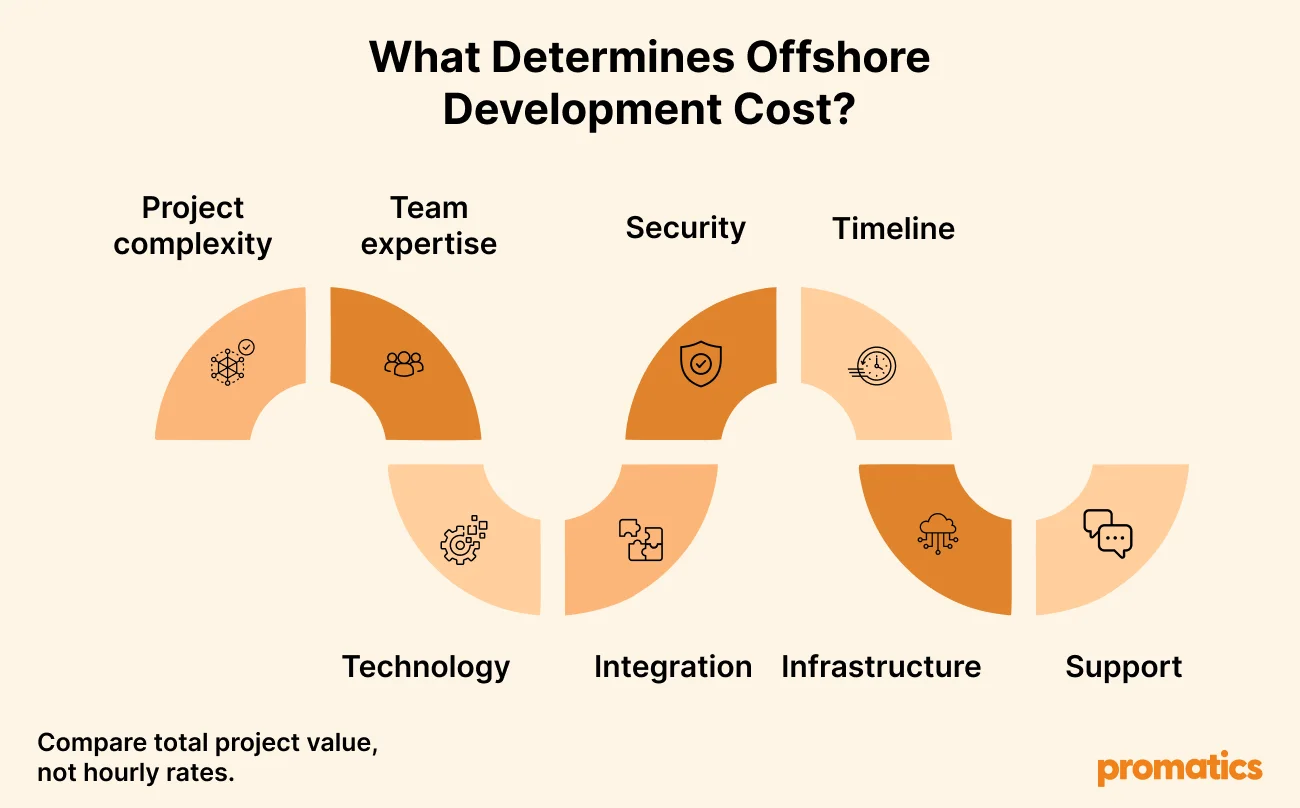
Your investment depends on the project’s:
- Complexity
- Team size
- Technology stack
- Developer expertise
- Timeline
- AI requirements
- Integrations
- Cloud infrastructure
- Security requirements
- Testing
- Maintenance needs
Don’t compare hourly rates alone
Consider two proposals:
- Company A: $25/hour
- Company B: $40/hour
Company A may look cheaper. But if its estimated effort is significantly higher, the total project could cost more.
Instead, compare:
Team + Estimated Effort + Timeline + Deliverables + QA + Infrastructure + Support
A good software development partner should provide enough detail for you to understand the complete investment rather than simply quoting an hourly rate.
Ask your vendor for:
- Team composition
- Estimated hours
- Development timeline
- Technology stack
- Deliverables
- Exclusions
- Change-request process
- Post-launch support
This gives you a much more accurate basis for comparing offshore development companies.
Which Offshore Development Model Should You Choose?
Your engagement model affects cost, flexibility, control, and scalability.
1. Fixed-Price Development
You agree on scope, deliverables, timeline, and cost upfront.
Best for: Clearly defined projects, MVPs, migrations, and specific features.
Choose it when: You know exactly what you need to build.
The limitation is flexibility. Significant changes can require additional scope and cost.
2. Time and Materials
You pay according to the resources and development time used.
Best for: SaaS products, Agile development, enterprise applications, and evolving requirements.
Choose it when: Your roadmap is likely to change during development.
This model offers flexibility but requires strong project management and budget monitoring.
3. Dedicated Development Team
A dedicated offshore development team works continuously on your product.
A team may include:
- Developers
- UI/UX designers
- QA engineers
- DevOps engineers
- Project managers
- Business analysts
- Technical architects
- AI specialists
Best for: Long-term products and businesses that need continuous engineering capacity.
Promatics also offers dedicated mobile app development teams for businesses that need ongoing mobile product development.
4. Staff Augmentation
Instead of outsourcing the complete project, you add specialists to your existing team.
For example, your internal team may retain product management while an offshore partner provides React developers, mobile developers, QA engineers, or DevOps specialists.
Best for: Businesses that already have an engineering team but need additional skills or capacity.
Quick Comparison
| Model | Best For | Flexibility | Control |
| Fixed Price | Defined projects | Low | Medium |
| Time & Materials | Evolving products | High | High |
| Dedicated Team | Long-term development | High | High |
| Staff Augmentation | Existing teams | High | Very High |
What Should an Offshore Development Team Include?
Don’t choose a vendor simply because it can provide more developers.
Choose a team that covers the capabilities your product actually requires.
A typical product team may include:
- Project Manager: Coordinates delivery, priorities, and communication.
- Business Analyst: Converts business requirements into technical specifications.
- UI/UX Designer: Creates user journeys, prototypes, and interfaces.
- Frontend Developer: Builds the customer-facing application.
- Backend Developer: Handles APIs, databases, authentication, and business logic.
- Mobile Developer: Builds iOS and Android applications.
- QA Engineer: Tests functionality, performance, compatibility, and security.
- DevOps Engineer: Manages cloud infrastructure, CI/CD, deployment, and monitoring.
- Solution Architect: Designs scalable architecture and evaluates technical risks.
- AI/ML Engineer: Supports machine learning, LLMs, RAG, AI agents, NLP, and other AI capabilities where required.
For businesses comparing mobile and web development companies, this broader team capability can be more important than the number of developers a vendor lists on its website.
Is Your Offshore Partner Ready for AI?
AI is changing both software development and the products businesses are building.
DECODE reports that 83% of outsourcing executives are integrating AI into outsourced services.
That makes AI expertise an increasingly important consideration when selecting a development partner.
But don’t stop at asking:
“Do you provide AI development?”
Ask whether the partner can:
- Identify practical AI use cases
- Integrate LLMs
- Build RAG applications
- Develop AI agents
- Work with machine learning
- Secure AI systems
- Connect AI with existing software
- Move AI prototypes into production
Promatics provides AI software development services, covering AI strategy, development, integration, deployment, and optimization.
The goal should not be to add AI because it is trending.
The goal is to use AI where it creates measurable business value.
Cloud and DevOps Matter After Development
Writing the code is only part of building a successful application.
Your product also needs reliable deployment, monitoring, security, scalability, and ongoing maintenance.
When evaluating an offshore development company, ask about experience with:
- AWS
- Azure
- Google Cloud
- Docker
- Kubernetes
- CI/CD
- Infrastructure automation
- Cloud security
- Monitoring
Promatics provides Cloud Infrastructure and DevOps services covering cloud architecture, deployment automation, infrastructure, and DevOps practices.
A simple question can reveal a lot:
Who will manage the product after it goes live?
If the answer isn’t clear, your vendor evaluation isn’t complete.
Security Should Be Discussed Before Development Starts
Security should be part of your vendor-selection process, not a last-minute checklist.
Ask about:
Data Protection
How is sensitive business and customer data stored and accessed?
Source Code
Who owns the code and repositories?
Intellectual Property
Who owns the designs, documentation, integrations, and custom software?
Access Control
Who can access development and production environments?
Secure Development
Does the team perform code reviews, vulnerability testing, dependency checks, and security audits?
Compliance
Does your project require GDPR, HIPAA, SOC 2, ISO, or industry-specific controls?
A capable offshore software development partner should be able to answer these questions before development begins.
How Do You Manage Communication With an Offshore Team?
Geographical distance doesn’t have to mean poor collaboration.
The right processes can keep distributed teams aligned through:
- Overlapping working hours
- Regular stand-ups
- Sprint reviews
- Shared project-management tools
- Documentation
- Decision logs
- Clear escalation procedures
- Dedicated project management
The goal is simple:
One team. One roadmap. One source of truth.
Before signing, clarify working hours, reporting frequency, communication channels, response expectations, and escalation procedures.
How to Choose the Right Offshore Development Company
The vendor-selection stage can determine whether offshore development becomes a growth advantage or a management headache.
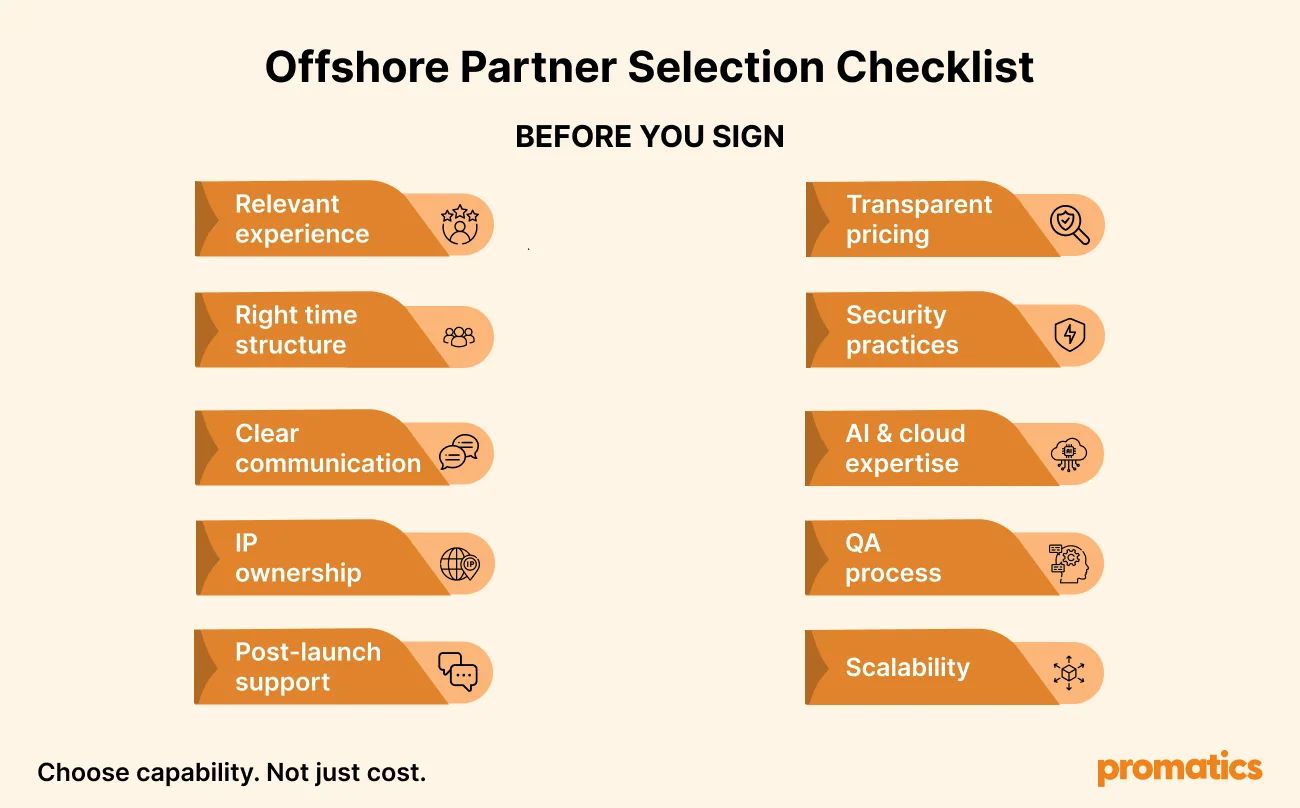
Use these questions to evaluate potential partners.
1. Have they built something similar?
Ask for relevant case studies rather than a generic portfolio.
2. Who will actually work on your project?
Meet the technical lead and core delivery team before signing.
3. How do they handle scope changes?
Understand the change-management process upfront.
4. How do they handle developer turnover?
Ask about documentation, knowledge transfer, and replacement resources.
5. What security practices do they follow?
Review their approach to data, source code, access, infrastructure, and compliance.
6. What happens after launch?
Clarify maintenance, support, SLAs, bug fixes, upgrades, and future development.
7. Can they scale with your product?
Your requirements may grow from six developers to fifteen. Make sure the partner can support that transition.
Why Choose India for Offshore Software Development?
India remains a major destination for global software development. Reports show that 54% of U.S. companies that outsource development choose India.
However, location should be only the starting point.
When evaluating an offshore development company in India, consider:
- Engineering expertise
- Relevant project experience
- Communication
- Technology capabilities
- AI expertise
- Cloud and DevOps
- Security
- Scalability
- Quality assurance
- Long-term support
The objective isn’t simply to find an Indian development company.
It’s to find the right technology team in India for your product.
For more insight, explore Promatics’ guide to the future of software development in India.
Offshore vs. In-House: Which Model Works Better?
You don’t necessarily have to choose one.
A hybrid model can combine internal product leadership with offshore engineering capacity.
| Factor | In-House | Offshore | Hybrid |
| Talent pool | Local | Global | Global + internal |
| Scaling | Hiring required | Flexible | Flexible |
| Product ownership | High | Depends on model | High |
| Specialist access | Depends on hiring | High | High |
| Engineering capacity | Internal | External | Combined |
For many growing businesses, this approach provides a practical balance between control and scalability.
When Should You Consider Offshore Software Development?
Offshore development may make sense if your business:
- Needs specialized technical talent
- Wants to accelerate development
- Is building an MVP
- Is launching a SaaS product
- Needs mobile and web development
- Wants to integrate AI
- Is modernizing legacy systems
- Needs cloud or DevOps expertise
- Wants to expand an existing engineering team
- Requires long-term development support
If you’re building a SaaS product, explore Promatics’ SaaS application development services for guidance on architecture, development, integrations, and technology considerations.
Why Promatics Technologies?
The right offshore software development partner should do more than provide developers.
It should understand your:
Business → Product → Users → Technology → Growth
Promatics Technologies brings together:
- Custom software development
- Web application development
- Mobile app development
- SaaS development
- AI software development
- UI/UX design
- Cloud infrastructure
- DevOps
- API development
- IoT solutions
- Enterprise software development
This integrated approach allows businesses to work with one technology partner across multiple stages of the product lifecycle.
From discovery and product strategy to development, QA, deployment, and ongoing support, Promatics can help businesses turn technology requirements into scalable digital products.
Final Takeaway
Offshore software development is no longer simply about finding a lower hourly rate.
It is about finding the right combination of talent, technology, speed, flexibility, and long-term support.
The strongest partnerships begin with the right questions:
What are we building?
What capabilities do we need?
Which engagement model fits us?
How will the team scale?
How will security be handled?
Who supports the product after launch?
Once those questions are answered, choosing the right development partner becomes much easier.
Ready to turn your product roadmap into reality? Talk to Promatics Technologies.
