Insights
Discover the latest trends, insights, and best practices in web and mobile app development
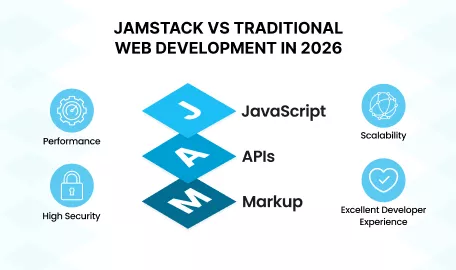
JAMstack vs Traditional Web Development: What’s Better in 2026?

Web development has evolved far beyond creating static websites. Today businesses rely on digital platforms that can scale seamlessly, support real-time interactions, integrate with multiple systems and deliver consistent performance across devices. As a result, choosing the right web development company has become a key business decision.
Why Custom Mobile App Development Services Are Better for Business Growth

In today’s mobile-first world, generic mobile apps do not satisfy the advanced needs of modern companies. Modern people spend around 4 hours and 37 minutes daily on their smartphones.
Enterprise Web Development: Building Scalable, Secure, and Future-Ready Solutions

Enterprise businesses depend on robust web applications to unify operations, automate processes, and support large-scale digital ecosystems. Creation of such applications calls for strategic engineering, profound security, and architectures that are ready for the future.
Why Progressive Web Apps (PWAs) Are the Future of Web Development

Today, users demand quick, dependable, and app-like experiences without the need to download heavy mobile apps. This is precisely where Progressive Web Apps (PWAs) come in to revolutionize the situation. PWAs combine the best features of both websites and native apps with great speed, offline capabilities, and high-quality performance.

How to Choose the Right Web Application Development Company for Your Business

Web applications are currently used in modern businesses to automate the workflow, improve the customer experience, and reach digital scalability. However, it may be difficult to select an appropriate development partner. The right web application development firm makes sure that your product is fast, secure, scalable and is future-innovative.
How to Develop an iOS Application on Windows? (Complete 2026 Guide)
Mobile apps have become an integral part of every modern business strategy. Apps increase interaction, purchases, and brand awareness whether it is an online shopping site, fintech startup, or a healthcare platform. iOS is one of the mobile platforms that have been at the forefront in providing smooth user experiences, high security and customer loyalty.It is one of the most lucrative ventures for developers and agencies who want to build a solid portfolio and earn recurring revenue.
Which Programming Language is Best for Mobile Game Development?

The mobile gaming industry is thriving and will probably continue this upward trend. At the same time, mobile games are expected to make over $126 billion in revenue globally, as more and more people get smartphone users, internet speeds become faster, and casual and competitive games become more popular. A lot of new games get downloaded daily on both iOS and Android, and the need for ingenious, high-performing games has never been greater.
What Skills Are Essential for Mobile App Development?
The mobile app industry is booming. There are millions of apps in app stores today, but only a few succeed. As of early September 2025, the Google Play Store hosts approximately 2,066,223 apps, while the Apple App Store lists around 1,990,284 apps.
What Factors Affect Hybrid App Development Costs in India?
As consumers are using mobile apps, more companies are investing in building their own mobile apps. Since hybrid apps offer both the convenience of native apps and the features of web apps, more businesses are planning to hire a hybrid app development company in India to enjoy affordable development and maintenance costs.